
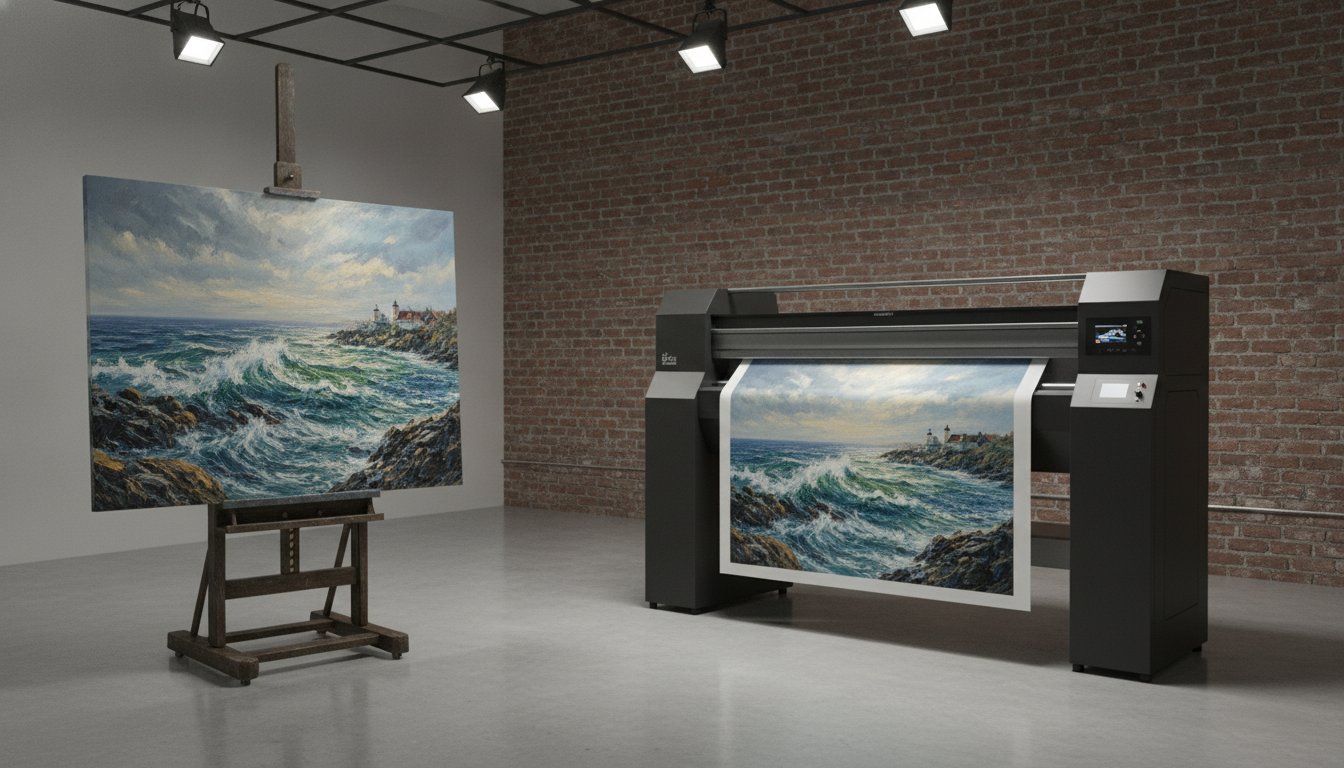
A high-quality reproduction isn’t just a copy of your painting; it’s a technical translation that must preserve every brushstroke and subtle glaze to maintain your artistic integrity. When you decide to print on canvas from original artwork, you’re trusting a process to honor months of your labor. It’s a high-stakes transition where the wrong equipment can lead to muddy shadows or a loss of the very texture that defines your style.
Most professional artists worry that a digital capture will never quite match the vibrancy of their physical media. You’ve likely seen reproductions that feel flat or utilize low-grade materials that look more like plastic than fine art. We understand these frustrations and believe that your prints should meet the same archival standards as the original piece itself. There’s a specific pride in producing work that stands the test of time, and that requires a partner who treats your art with the same respect you do.
In this guide, you’ll learn the exact technical steps required to transform physical paintings into museum-quality canvas reproductions that mirror the depth of your work. We will cover the precision of BetterLight scanning, the science of color calibration, and the finishing touches of custom framing that make a print gallery-ready. Whether you’re in Boston or Newburyport, this methodical approach ensures your legacy is preserved in every edition.
Key Takeaways
- Understand why BetterLight scanning is the superior method for capturing the physical texture and brushstroke depth of your paintings compared to standard DSLR photography.
- Learn how to select archival canvas materials and appropriate weights (gsm) to ensure your reproductions meet museum-quality standards for longevity.
- Discover the technical role of ICC profiles and professional color calibration in achieving absolute fidelity to your original artistic palette.
- Master the professional workflow to print on canvas from original artwork, transforming physical media into high-end Giclee editions.
- Explore final presentation options, including custom framing and gallery wraps, that prepare your large-scale prints for professional exhibition and sale.
The Artist’s Guide to Canvas Reproductions from Original Work
Professional art reproduction serves as a technical bridge between the physical studio and the collector’s home. It allows an artist to retain their original masterpiece while offering high-end, museum-quality editions to a wider audience. When you decide to print on canvas from original artwork, you’re engaging in a specialized process that differs significantly from standard commercial printing. This isn’t a mere photo print; it’s a precise translation of texture, color, and intent that ensures your work is represented accurately in a gallery setting.
Giclee Quality vs. Standard Inkjet Prints
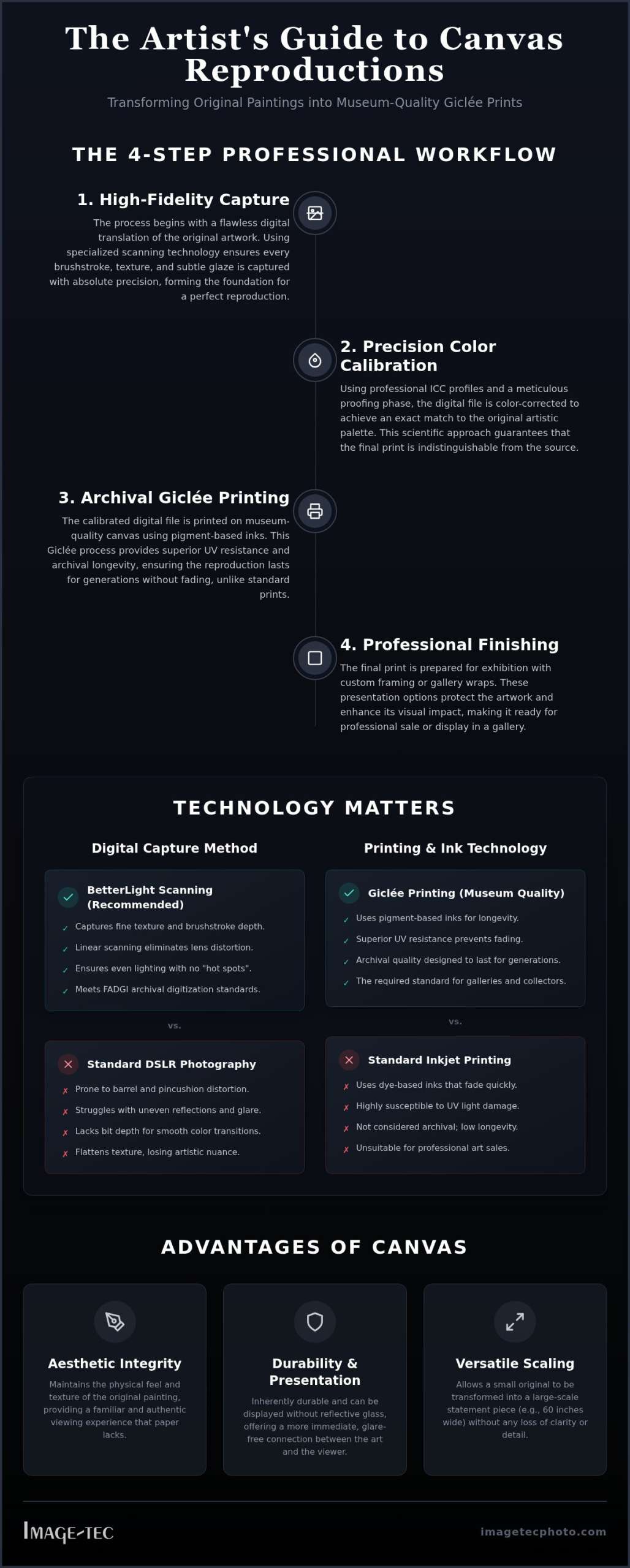
The term Giclée printing describes a high-resolution process that utilizes pigment-based inks rather than the dye-based inks found in standard office equipment. Pigment inks are essential for professional artists because they offer superior UV resistance and archival longevity. These prints don’t fade after a few years; they’re designed to last for generations. A critical component of this quality is the initial capture. Utilizing technology like BetterLight scanning ensures that every minute detail of the original surface is recorded at a resolution far beyond what a standard DSLR camera can achieve. These archival standards are mandatory for museum sales and high-tier gallery representation, where collectors expect the same durability they would find in an original painting. To understand the technical benchmarks that define genuine archival excellence, our guide on museum quality giclee prints clarifies the essential trinity of pigment inks, acid-free substrates, and high-resolution capture.
Why Reproduce Original Art on Canvas?
For painters working in oil or acrylic, canvas is the natural choice for reproductions. It maintains the physical aesthetic of the original medium, providing a familiar texture that paper often lacks. One practical advantage of canvas is its inherent durability. Unlike paper prints that require heavy frames and protective glass, canvas can be displayed as a gallery wrap or in a floating frame without the glare of a glass surface. This makes the art feel more immediate and accessible to the viewer. Additionally, the process offers immense versatility in scale. A small study can be enlarged into a 60-inch wide statement piece, allowing the artist to adapt their work for different interior spaces without losing clarity. By choosing to print on canvas from original artwork, you create a product that is both resilient and visually indistinguishable from its source, effectively expanding your commercial reach while preserving your most valued physical assets.
High-Resolution Capture: Why BetterLight Scanning is Essential
The foundation of any museum-quality reproduction is the digital capture. While many artists believe a high-end camera is sufficient, professional art reproduction requires a specialized digital back system designed for large-format studio cameras. BetterLight scanning is the gold standard for art reproduction as of 2026. This technology operates by moving a trilinear sensor across the image plane, capturing data with a level of precision that traditional sensors cannot replicate. When you intend to print on canvas from original artwork, this initial phase determines whether the final print will feel like a flat copy or a living extension of your original painting.
The Limitations of Standard Digital Photography
Standard DSLR and mirrorless cameras capture images through a single shutter release, which often introduces technical compromises. Most consumer and professional lenses produce some degree of barrel or pincushion distortion, subtly warping the straight edges of your canvas. DIY photography setups also struggle with “hot spots,” where light reflects unevenly off the paint’s surface. High megapixel counts on small sensors don’t necessarily translate to better art reproductions; they often lack the bit depth required for smooth color transitions. Adhering to FADGI’s digitization guidelines ensures that the capture meets the strict technical metrics for tone, color, and sharpness required by cultural heritage institutions. Without this level of control, the nuances of your palette can be lost before the printing process even begins.
BetterLight Scanning: Capturing Every Brushstroke
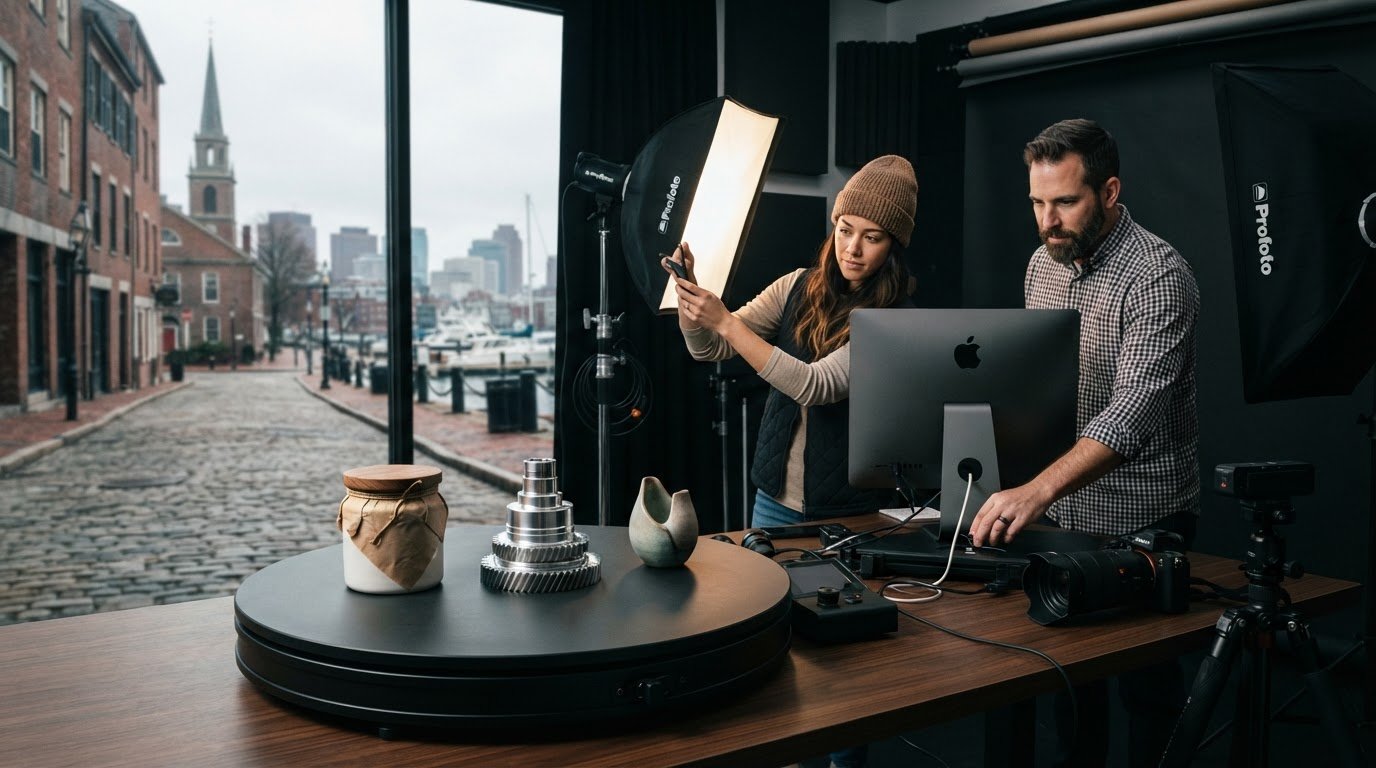
BetterLight scanning provides linear precision because the sensor moves slowly across the artwork. This eliminates the peripheral distortion found in wide-angle lenses and ensures that every square inch of the file is sharp from corner to corner. This method is vital for large-format enlargements. If you need a print that spans up to 60 inches, the source file must contain massive amounts of clean data without digital noise. We utilize polarized lighting in our studio to eliminate glare and specular highlights, which is particularly important for heavy oil impasto or glossy acrylics. This lighting technique allows the scanner to “see” into the valleys of the paint, capturing the three-dimensional texture of your work. You can learn more about our BetterLight art scanning process to see how this technical precision preserves your artistic intent. If you’re seeking a local partner to handle your portfolio, our Methuen studio provides the specialized reproduction services needed for gallery-ready results.
Selecting Professional Canvas Materials and Archival Finishes
Once the digital capture is perfected, the focus shifts to the physical substrate. Choosing the right material is a technical decision that directly impacts how the viewer perceives the depth and texture of your work. When you print on canvas from original artwork, you aren’t limited to a single “standard” option. Professional-grade canvases vary in their weave, weight, and base material, each offering distinct advantages for different artistic styles. Most museum-quality reproductions utilize either a 100% cotton canvas or a polycotton blend. While 100% cotton is the traditional choice, polycotton blends are frequently preferred for large-scale editions because they offer greater dimensional stability, meaning they won’t sag or stretch over time due to changes in humidity.
The weight of the canvas, measured in grams per square meter (gsm), is a primary indicator of durability. For professional results, we recommend a weight between 350 gsm and 450 gsm. This thickness provides the structural integrity needed for stretching over wooden bars without tearing. Beyond the material itself, archival coatings are essential. These specialized topcoats act as a functional barrier against UV light and moisture, preventing the pigment-based inks from fading or reacting to environmental pollutants. This protection ensures that the reproduction maintains its color fidelity for decades, meeting the rigorous standards required by collectors and galleries alike. For a deeper look at how shifting market trends and technical benchmarks define these standards, see our overview of the evolution of museum quality giclee prints and what separates a genuine archival edition from a commercial copy.
Matte vs. Glossy: Matching the Original Medium
The finish of your canvas should reflect the characteristics of your original media. Matte finishes are ideal for watercolors, charcoal, or pastel reproductions because they eliminate glare and preserve the soft, velvety appearance of the original surface. Conversely, satin or glossy finishes are better suited for oil and acrylic paintings. These finishes enhance the D-max (maximum density) of the inks, making blacks deeper and colors more saturated. When selecting a finish, consider the final display environment. A high-gloss finish may look stunning in a controlled gallery setting but can become difficult to view in a room with many windows or direct sunlight. We often recommend a satin finish as a versatile middle ground that provides depth without excessive reflection.
Wide Format Capabilities for New England Artists
Local artists in Boston, Manchester, and Newburyport often require the ability to produce statement pieces that command attention. Our wide-format Giclee printing capabilities allow us to print on canvas from original artwork at scales up to 60 inches wide. Maintaining edge-to-edge sharpness at this size requires a massive amount of digital data and precise mechanical calibration. Because we use BetterLight scanning for the initial capture, we can ensure that even at 60 inches, the fine details of your brushwork remain crisp and free of pixelation. This ability to scale work without losing its intimate technical qualities is what separates a professional reproduction from a commercial copy. Whether you’re producing a limited run of small studies or a single massive centerpiece, our Methuen studio provides the technical infrastructure to execute your vision with absolute precision.
The Color Correction and Proofing Phase: Ensuring Fidelity
The transition from a digital file to a physical print is where many reproduction projects fail. To successfully print on canvas from original artwork, a master printer must navigate the complex relationship between digital data and physical ink. This phase relies heavily on professional color calibration through custom ICC profiles. These profiles act as a technical translator, ensuring the printer understands exactly how to reproduce the specific colors captured during the scanning process. Software alone isn’t enough. The ambient light in the editing studio must be strictly controlled; otherwise, the editor’s perception of color shifts, leading to inaccurate adjustments that only become apparent once the work is displayed in a gallery.
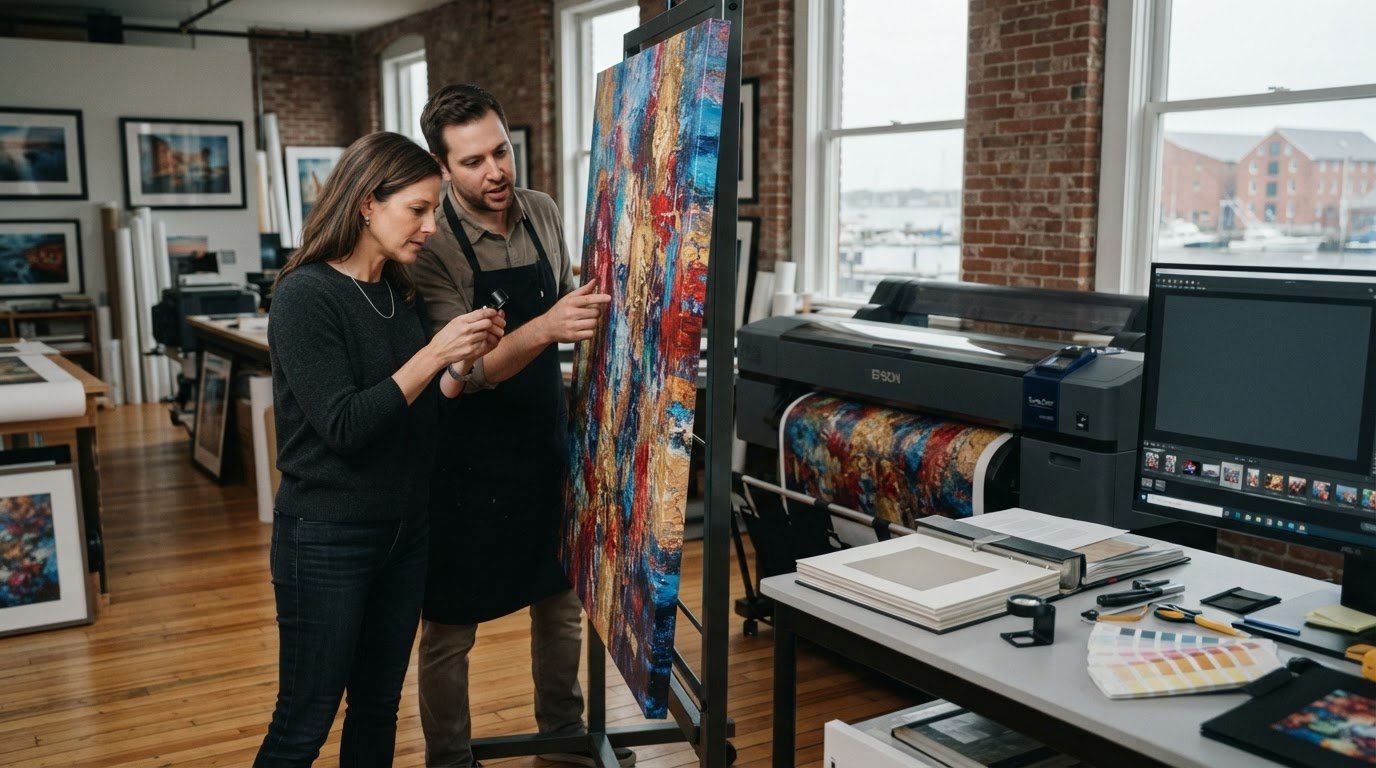
We follow a methodical three-step workflow to ensure absolute fidelity to your vision. First, we perform digital file adjustments while comparing the calibrated monitor directly to your physical painting. Second, we generate a physical test strip, or “proof,” on the exact canvas substrate chosen for the final run. Finally, we invite the artist to review this proof under controlled lighting. This collaborative review allows for final adjustments to the contrast or saturation before we commit to a full-scale print run.
Matching the Artist’s Palette
Artists often use pigments that are notoriously difficult to reproduce, such as cadmium reds or cobalt blues. These colors frequently sit at the edge of a printer’s achievable gamut, requiring manual intervention to match the intensity of the original media. We also have to account for metamerism, a phenomenon where two colors appear to match under one light source but differ under another. By using expanded gamut inksets and careful proofing, we ensure your palette remains consistent whether viewed under halogen gallery lights or natural sunlight. For the best results, start with a high-quality capture; see our guide on professional artwork scanning in Massachusetts for more on digital capture.
The Importance of the Physical Proof
A monitor is a backlit device, while a canvas print relies on reflected light. This fundamental difference means that looking at a screen is never sufficient for professional art reproduction. A physical proof allows us to see how the ink absorbs into the canvas weave and how the texture of the material interacts with the image. It’s the only way to verify that the fine details captured during the scanning phase have translated correctly to the final substrate. Once the proof is approved, we finalize the master file to ensure that every future print in your edition remains perfectly consistent. If you are ready to see your work translated with this level of accuracy, contact our studio for a professional consultation.
Custom Framing and Final Presentation for Large-Scale Canvas Prints
Framing serves as the final, structural stage of the reproduction process. It’s the point where a flexible piece of printed material becomes a durable, gallery-ready object. When you print on canvas from original artwork, the quality of the stretching and the choice of frame determine how well the work will hold its value and appearance over the years. Large-scale prints, especially those reaching 60 inches in width, demand a level of technical precision that goes beyond simple aesthetics. Without the proper support, large canvases can lose tension, leading to unsightly sagging or ripples in the surface.
The technical side of stretching involves using heavy-duty, kiln-dried wooden bars that resist warping. We ensure that the canvas is tensioned evenly across the entire surface, providing a drum-like finish that remains stable regardless of seasonal changes in humidity. By handling this process in our Methuen studio, we maintain absolute quality control. Shipping a large, unstretched canvas often leads to creases or edge damage that can’t be easily repaired. Local handling ensures that the work moves directly from the printer to the finishing table without the risks associated with long-distance transit.
Gallery Wrap vs. Floater Frames
Choosing between a gallery wrap and a floater frame depends on the intended display environment and the style of the original piece. A gallery wrap allows the image to bleed around the edges of the stretcher bars, creating a modern, frameless look that works well in contemporary spaces. This style is particularly effective for abstract works or pieces where the composition feels expansive. However, the edges must be carefully mirrored or extended during the file preparation phase to ensure no critical part of the composition is lost to the side of the bars.
Floater frames offer a more traditional museum-style presentation. These frames provide a small gap between the canvas edge and the frame interior, giving the illusion that the artwork is suspended in space. This protects the vulnerable edges of the canvas from physical impact while adding a sense of weight and importance to the piece. Selecting a frame style that complements the artwork’s era and style is essential; a sleek, dark wood floater frame might suit a modern landscape, while a more ornate profile could better serve a classical reproduction.
The Image-Tec Advantage: A Local Pillar for Artists
By integrating scanning, color correction, printing, and framing under one roof, we provide a seamless workflow that eliminates the communication gaps found when using multiple vendors. This “one-stop-shop” approach is a significant benefit for the artistic communities in Boston, Manchester, and Newburyport. You won’t have to worry about your original artwork being shipped to a distant facility or your final prints arriving with transit damage. Instead, you work with a local partner who understands the nuances of art handling and the specific needs of New England’s professional artists. Ready to reproduce your masterpiece? Contact Image-Tec for professional art reproduction services.
Preserving Your Legacy Through Professional Reproduction
Translating a physical painting into a digital edition is a technical journey that requires precision at every stage. You’ve seen how museum-quality results depend on high-resolution BetterLight scanning to capture brushstroke depth and the careful selection of archival substrates to ensure longevity. When you decide to print on canvas from original artwork, you’re not just making a copy; you’re creating a durable extension of your creative voice that can reach collectors far beyond your studio walls. The combination of professional color calibration and expert stretching ensures each piece is ready for immediate gallery exhibition.
Our Methuen studio has served artists across Massachusetts and New Hampshire since 1994, specializing in large-format prints up to 60 inches wide. We provide the technical infrastructure and art-handling experience to ensure your reproductions are indistinguishable from your physical originals. Don’t leave your legacy to chance with automated services that lack professional human oversight. Request a Professional Art Reproduction Quote from Image-Tec today. We’re ready to help you transform your physical portfolio into a sustainable, professional edition that stands the test of time.
Frequently Asked Questions
How do I prepare my original artwork for professional scanning?
Ensure the painting is completely dry and free of surface dust before bringing it to the studio. Remove any temporary protective layers or loose debris that might obscure fine details. If your work is on paper, keep it flat rather than rolled to prevent creasing. You don’t need to apply a final varnish before scanning; a matte surface is often easier to capture than a highly reflective, glossy one.
What is the maximum size canvas print I can get from a painting?
We specialize in large-format reproductions up to 60 inches wide. The length of the print can extend significantly beyond this, depending on the proportions of your original piece. Because our BetterLight system captures massive amounts of clean data, we can often enlarge smaller original paintings while maintaining sharp detail. This allows you to print on canvas from original artwork at a scale that commands attention in large residential or corporate spaces.
Will the canvas print show the texture of my brushstrokes?
The print captures the visual topography of your paint, though the final surface remains two-dimensional. Our specialized lighting records the highlights and shadows of individual brushstrokes and impasto techniques with extreme precision. When we print on canvas from original artwork, the interaction between this captured visual texture and the natural weave of the canvas substrate creates a museum-quality reproduction that convincingly mimics the depth and character of your original media.
How long do Giclee canvas prints last before fading?
Giclee prints are rated to last over 100 years under standard indoor display conditions. We use archival pigment-based inks and acid-free canvases that meet the highest museum standards for longevity. To maximize this lifespan, we apply a UV-resistant coating to every canvas. This functional barrier prevents fading from light exposure and protects the surface from moisture. These standards ensure your limited edition prints remain vibrant for generations of collectors.
Can you scan artwork that is already framed or behind glass?
We strongly recommend removing artwork from frames and glass before the scanning process begins. Glass creates reflections and refractions that interfere with the scanner’s ability to capture accurate color and fine detail. Framed pieces often have shadows cast by the frame’s lip, which can obscure the edges of your composition. For the highest fidelity, scanning the raw canvas or paper ensures every square inch of your work is recorded without distortion.
How does BetterLight scanning differ from a standard high-end camera?
A standard camera captures an image in a single instant, while a BetterLight scanner moves a trilinear sensor across the image plane. This methodical motion eliminates the lens distortion and corner softness common in traditional photography. It also captures significantly more data per pixel, providing smoother color gradations and higher resolution. This technical superiority is vital for artists who need large-scale reproductions that maintain the integrity of their smallest, most delicate marks.
Is it better to get a gallery wrap or a custom frame for my canvas?
The choice depends on your target market and the aesthetic of the piece. Gallery wraps offer a modern, minimalist look where the image continues around the sides of the bars. This is a popular, cost-effective option for contemporary interiors. Custom floater frames provide a more formal, finished appearance often preferred by high-end galleries. Frames also add a layer of physical protection to the vulnerable corners and edges of the canvas substrate.
Can I get a digital file of my artwork for my own records or website?
Yes, we provide high-resolution digital files as part of our scanning service. These files are professionally color-corrected and ready for use in digital archives, portfolio websites, or promotional materials. Having a professional master file ensures you have a permanent record of your original work even after the physical painting is sold. We can provide these in various formats, including TIFF for future printing and JPEG for web use, to suit your needs.




Leave A Comment
You must be logged in to post a comment.