
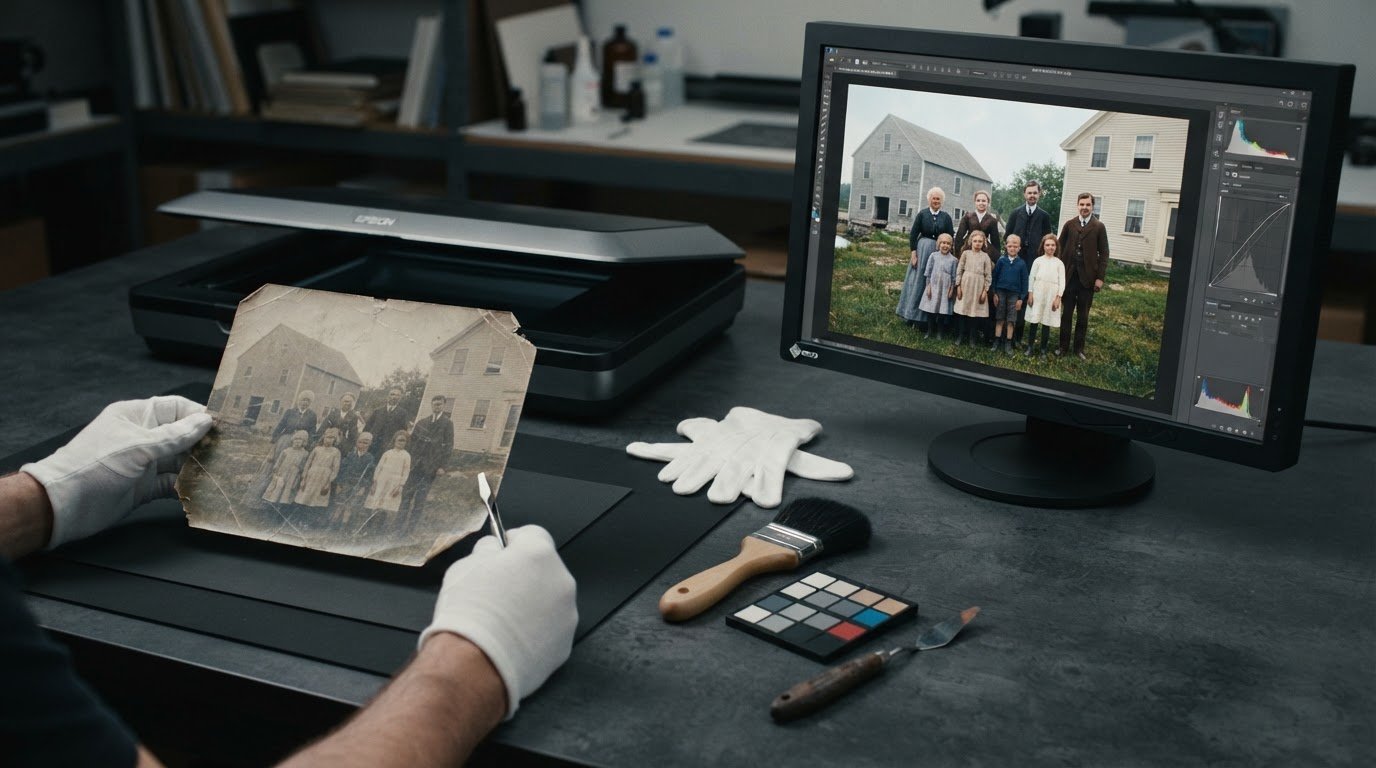
Can a photograph marked by fading, scratches, creases, or missing sections still be improved without risking the only surviving original? In many cases, digital restoration can address visible damage, but the result depends on how much detail remains in the image. For old photo restoration Massachusetts families should start by assessing the photograph’s condition and deciding how they hope to use the restored image.
It’s understandable to feel cautious when a picture carries family or local history. Digital restoration works on a scanned image, not by repairing the physical photograph. It may reduce fading and scratches or improve damaged areas, but it can’t recover details that are no longer present. Reconstructed features may involve interpretation. That’s different from physical conservation, which focuses on treating the original artifact.
This guide explains how to assess an aging photograph, what digital restoration can realistically improve, and what information to prepare about the image and your intended result. You’ll also learn how restoration differs from simple retouching and how a local studio can help. Image-Tec, based in Methuen, provides historical image restoration for customers in Methuen, Boston, Manchester, New Hampshire, and Newburyport.
Key Takeaways
- Start with the photograph’s condition and intended use to set realistic restoration goals.
- Understand the general stages of digital restoration, from assessing an image to reviewing the result.
- Compare digital restoration, basic DIY editing, and physical conservation to find the approach that suits the photograph.
- For old photo restoration Massachusetts, record the image’s history, visible damage, and desired result before seeking professional help.
- Image-Tec provides historical image restoration from its Methuen studio, serving customers across the region.
Old Photo Restoration in Massachusetts: What Can Be Improved?
A family portrait tucked into an album, a historical print passed down through generations, or an archival photograph kept in a local collection can mean far more than the image alone. Age can make photographs fragile, while fading, scratches, creases, stains, and missing sections can obscure details. The first step in old photo restoration Massachusetts is to assess what remains visible and decide what you want the restored image to do.
Photo restoration is digital work intended to improve an image while respecting its original character. It can address visible problems in a digital file, but it doesn’t physically repair the print. The field of Image restoration includes methods for improving damaged or degraded images. For an old photograph, the result depends on the quality of the available image and how much visual information the damage has obscured.
Which kinds of photo damage may be addressed?
Look at the photograph in good light and describe what you see before attempting edits. Common issues include:
- Fading: Faces, clothing, or backgrounds may look pale, with less contrast between light and dark areas.
- Surface marks: Scratches, dust-like marks, and stains can interrupt details or draw attention away from the subject.
- Creases and tears: A fold may cross a face or background, while a tear can separate or remove part of the image.
- Discoloration: Shifts in tone or color can make areas of the photograph look uneven.
- Missing image areas: A torn corner or damaged section may leave little or no original information to work from.
Some marks can be reduced in a digital version, but damage that has erased facial features, lettering, or other details limits what can be recovered. Make a note of the areas you find most distracting. Don’t tape a tear, write on the print, or try to clean a fragile original. These actions can affect the photograph before its condition has been assessed.
What should a restoration preserve?
Before restoration, consider what makes the photograph recognizable and historically meaningful. That may include familiar faces, clothing and hairstyles from its period, a building in the background, or the image’s original tonal character. A careful restoration aims to make the photograph easier to view without presenting guesses as recovered facts.
When information is missing, a digital edit may involve interpretation rather than recovery. Decide whether your priority is clearer viewing, preserving an understated historical appearance, or preparing a copy to share with family. A practical goal helps guide how much visible damage to reduce and how closely to retain the photograph’s existing look. The aim isn’t always to make an old image appear new. It’s to improve legibility while keeping its character intact.
How Digital Photo Restoration Rebuilds an Aging Image
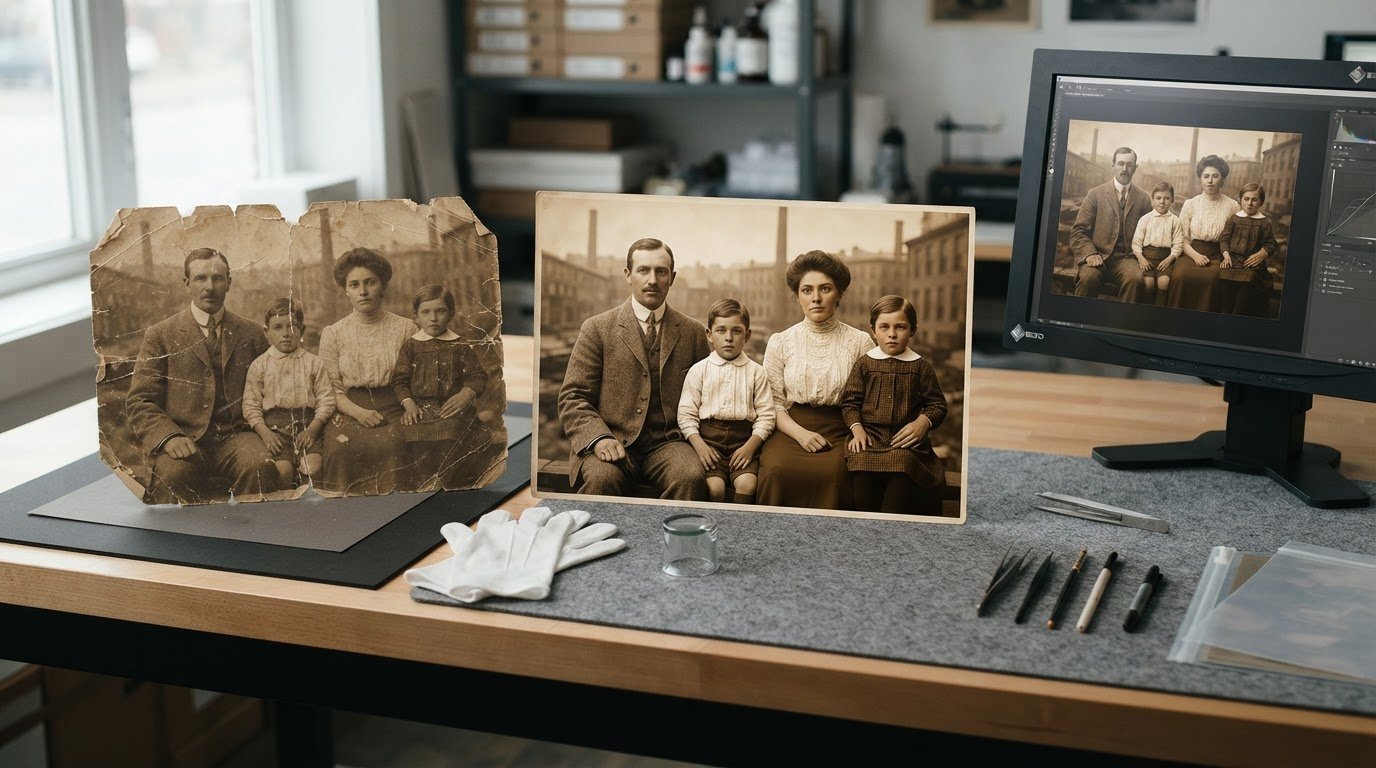
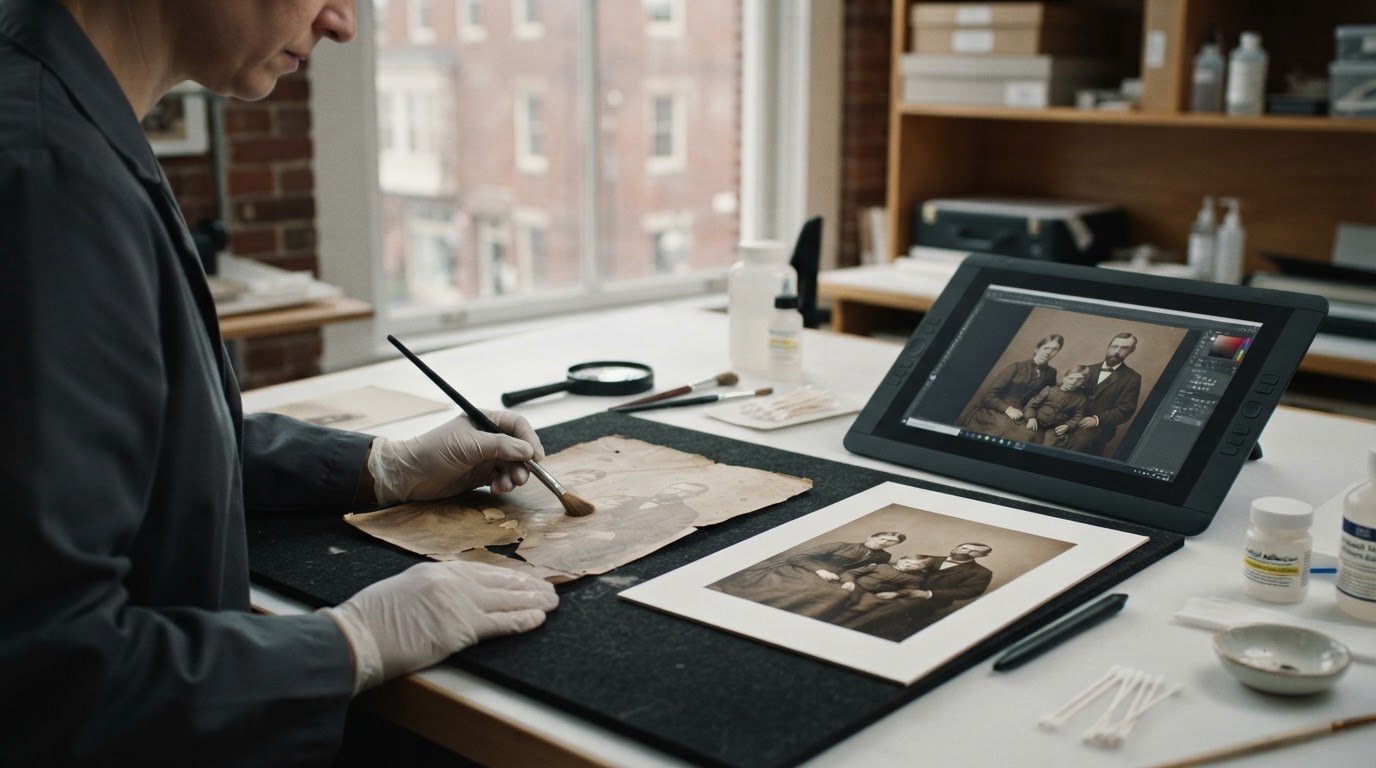
Digital photo restoration improves a digital image of a photograph; it doesn’t repair the physical print itself. Work takes place on a digital image, so edits to the file are separate from physical conservation of the original. In general, restoration involves assessing the image, working from a digital copy, making appropriate improvements, and reviewing the result. The exact work depends on the photograph and the damage.
Understanding this process helps set realistic expectations for old photo restoration Massachusetts. An image with clear surviving detail offers different possibilities from one where a tear or stain has obscured important information. Restoration decisions start with the image that’s available, not an assumption that every mark or gap can be removed.
From photograph assessment to digital working image
A useful restoration process starts by identifying the damage and the details that remain visible. A digital working image is then used for adjustments. Once the image is ready, restoration can address visible issues, followed by a review of whether the result is easier to read while retaining the photograph’s character.
Severe damage can narrow the possibilities. If part of a face, handwritten caption, or background feature is missing, the original may not contain enough information to reproduce it reliably. An edit may reduce the visual distraction, but it can’t make absent detail certain. When evaluating a result, distinguish visible information from anything that has been reconstructed.
Repairing image issues while retaining historical character
Digital adjustments may improve fading or reduce distracting marks. The key distinction is between revealing information that remains in the image and reconstructing information that has been lost. The first works with visible evidence; the second involves interpretation. This matters in family and historical photographs, where a convincing-looking edit could be mistaken for an accurate record.
Before work begins, consider how much retouching feels appropriate. Would you prefer subtle improvement that keeps signs of age, or a cleaner image for easier viewing? For a historical photograph, preserving period details and the original mood may matter more than removing every imperfection. If you’re uncertain, describe what should remain recognizable and identify areas where you want to avoid creative reconstruction.
Digital restoration and physical conservation address different needs. Restoration works with an image file; conservation concerns the physical photograph as an object. The Photographic Preservation resources from the American Institute for Conservation offer further reading on caring for photographic materials. Image-Tec provides historical image restoration as part of its photography and art reproduction studio in Methuen, Massachusetts.
Digital Restoration, DIY Editing, or Physical Conservation?
These approaches address different needs. Digital restoration works on an image file, basic editing makes limited adjustments, and physical conservation focuses on the photograph as an object. Choose based on your goal: do you want a clearer image to view, a few simple adjustments, or attention to the print’s physical condition?
Digital restoration
Purpose: Improve visible damage or fading in a digital image. Best suited to: Photographs that need a clearer image for viewing or reproduction. Work involves: A digital file, not direct repair of the physical print. Results depend on the image available and the detail it still contains.
Basic DIY editing
Purpose: Make straightforward adjustments, such as changing brightness or contrast. Best suited to: Minor image issues that don’t require careful repair of damaged areas. Work involves: A digital file. It can be a practical starting point, but may not provide the control needed for complex damage.
Physical conservation
Purpose: Address the photograph’s physical material. Best suited to: Concerns about the print itself, rather than only how its image looks on screen. Work involves: The physical object. This is distinct from editing a digital image and calls for a conservation-focused approach.
When is digital photo restoration a practical choice?
Choose a digital approach if your main aim is to improve the photograph’s visible image without treating its physical material. A digital version can be useful for viewing or reproduction, but its potential depends on the quality and information in the image. If fading has softened contrast, adjustments may make remaining details easier to see. If damage has removed a face or another detail, no method can reliably recover information that isn’t there.
Extensive damage doesn’t automatically mean a photograph is beyond assessment. A restoration specialist can consider what remains visible and what kind of result is realistic. The extent of damage matters, as does your intended use: an image for family viewing may have different priorities from one meant to preserve a historical record.
How does restoration differ from editing or physical conservation?
Basic editing usually involves a small number of general adjustments. Restoration is more deliberate: it considers specific image damage and how to improve the file while retaining the photograph’s character. Physical conservation, by contrast, concerns the print itself. If the paper is fragile or the object’s condition is your main concern, improving a digital image won’t address that physical need.
For old photo restoration Massachusetts, match the method to the problem rather than assuming one approach covers every need. A simple brightness adjustment may be enough for an image that looks too dark; a scratched photograph with more extensive damage may call for restoration. If the concern is the print’s physical condition, digital editing alone isn’t the right approach. Consider what you need improved, especially if the damage is extensive or the photograph is particularly important to you.

Preparing an Old Photograph for Restoration in Massachusetts
A few details prepared in advance can make a restoration discussion more focused. You don’t need technical terms for every flaw. A brief history, a clear description of the visible damage, and a realistic idea of your preferred result are useful starting points. If the print is fragile, don’t tape it, write on it, or try to clean it before professional review.
What details help describe the photograph?
Write down what you know, and distinguish confirmed facts from family memories or estimates. Even an approximate date or likely location can help explain the photograph’s context. Note whether it may be the only surviving print, since that can inform how carefully you want to proceed.
- History: Record an approximate date, the names of recognizable people, a known location, and any family or historical context.
- Condition: Describe visible fading, tears, stains, creases, missing corners, discoloration, or areas that are difficult to make out.
- Priorities: Identify what matters most, such as recognizable faces, readable details, historical character, or a cleaner overall presentation.
- Intended use: Say whether the image is mainly for family viewing or whether you hope to prepare a reproduction.
The most useful project notes bring together what the photograph shows, what has happened to it, and how you hope to use the restored image.
Be specific about where the damage appears. For example, note that a crease crosses the background or that fading makes faces hard to distinguish. That’s more useful than simply describing the photograph as “damaged.” Avoid marking the print itself to point out flaws; describe them separately.
How can local customers plan a restoration project?
Intended use helps set priorities. For family viewing, you may care most about making faces and expressions easier to see. If you’re preparing a reproduction, you may also want to consider how the photograph’s tones and period character should appear in the finished image. Sharing these goals helps frame the work without assuming every damaged detail can be recovered.
For old photo restoration Massachusetts customers can prepare these notes before discussing a project with a local studio. Image-Tec is a photography and art reproduction studio based in Methuen, serving customers in Methuen, Boston, Manchester, New Hampshire, and Newburyport. The historical image restoration service guide provides more context on the studio’s restoration work.
Use your notes to describe the photograph’s condition and the result you hope to achieve. Learn about Image-Tec’s historical image restoration for a family or archival photograph that needs careful digital attention.
Image-Tec Historical Image Restoration in Methuen, MA
Choosing a local studio for an old family or historical photograph can make it easier to discuss the image and the result you hope to achieve. Image-Tec is a photography and art reproduction studio based in Methuen, Massachusetts, offering historical image restoration. Its service area includes Methuen, Boston, Manchester, New Hampshire, and Newburyport, connecting the studio with customers across the region.
A local studio for historical photographs
For customers in and around these communities, Image-Tec brings historical image restoration together with photography and art reproduction services. That studio context is relevant when a photograph is intended not only for closer viewing but also for reproduction. Each image has its own condition and priorities, so describing both helps establish a useful starting point.
Restoration goals differ from one image to another. You may want a portrait to be easier to view while retaining its period character, or you may be working with a photograph that has personal or historical significance. Explain what should remain recognizable and which issues are most distracting to give the project a clear focus. Image-Tec’s historical image restoration service is designed for this kind of work.
Taking the next step with Image-Tec
Before discussing a restoration project, gather what you know about the photograph. An approximate date, names or locations, and any family or archival context can help describe its significance. Note visible concerns such as fading, creases, tears, stains, or missing areas. Then state your intended outcome, whether that means clearer family viewing, preserving historical character, or preparing the image for reproduction.
Separate what you know from what you’re unsure about. If a location or date is only a family estimate, say so. If particular details matter, such as a face, a uniform, or writing in the image, point them out in your description. This gives the project a practical direction without assuming every obscured or missing detail can be recovered.
For old photo restoration Massachusetts residents can turn to Image-Tec’s Methuen studio for professional historical image restoration serving these communities. Share the image’s condition, its background, and the result you have in mind. A clear description helps focus the project on the photograph’s character and your reason for restoring it.
Explore Image-Tec’s photo restoration services and take the next step toward restoring your historical photograph.
Give a Meaningful Photograph a Thoughtful Next Step
Restoration begins with deciding what you want the image to retain and how you hope to use it. You don’t need a technical plan. A few notes about what matters most, whether that’s a familiar expression, a historical detail, or the feeling of the original photograph, can help shape a focused project discussion.
For old photo restoration Massachusetts, keep your goal practical and personal. The aim isn’t necessarily to erase every trace of age. It’s to make the image more useful or easier to appreciate while respecting the details that give it meaning. If you’re unsure what can be improved, describe what you notice and what you hope to preserve.
Image-Tec offers historical image restoration as part of its photography and art reproduction work. Explore Image-Tec’s historical photo restoration services and take the next step with your photograph. A considered approach can help an old image remain part of your family’s story.
Frequently Asked Questions
Can old photos be restored if they are faded, scratched, or torn?
Yes. Fading, scratches, and tears can often be improved in a digital restoration, depending on how much image detail remains. A scratch across a plain wall may be less limiting than a tear through an eye or handwritten inscription. Describe where the damage falls and what you need to see clearly. For old photo restoration Massachusetts, an image-specific assessment is more useful than assuming every flaw has the same remedy.
How much does old photo restoration cost in Massachusetts?
Restoration pricing depends on the photograph’s condition and the amount of work involved. Image-Tec provides pricing upon consultation. A portrait needing tonal adjustments differs from an image with extensive damage or missing sections. To make a pricing discussion useful, describe the visible issues, mention any areas where reconstruction may be needed, and explain whether you intend to view or reproduce the restored image.
Can a severely damaged or partly missing photograph still be restored?
Possibly, but the result depends on what surviving details can guide the work. A missing corner may leave the main subject intact, while a missing face or inscription can’t be accurately reproduced from information that isn’t present. Restoration may improve what remains, but reconstructed areas involve interpretation. For an irreplaceable image, avoid DIY cleanup and seek a professional assessment before deciding what result is realistic.
Does digital photo restoration alter the original photograph?
Digital restoration works on a digital image rather than editing the physical print itself, so adjustments to the file don’t inherently change the photograph. Digitizing or handling the original is separate from editing the resulting image. If the print is brittle, flaking, or physically unstable, remember that digital enhancement changes its appearance in a file but doesn’t repair or stabilize the object.
How long does professional old photo restoration take?
Timing varies with the photograph’s condition, the extent of the requested work, and decisions about damaged areas. Correcting a few visual distractions differs from addressing a complex tear or substantial missing information. The image’s condition and the amount of restoration needed determine the scope of the work.
Is digital restoration different from physical photo conservation?
Yes. Digital restoration improves a working image file, while physical conservation addresses the photograph as a material object. If your main concern is how a faded image looks, digital restoration may fit that goal. If the print itself is fragile or deteriorating, physical conservation is the relevant category of care. One approach doesn’t replace the other, and editing a digital image alone won’t stabilize an aging print.
Where can I get old photo restoration near Boston or Methuen?
Image-Tec offers historical image restoration from its studio in Methuen, Massachusetts, and serves customers in Methuen, Boston, Manchester, New Hampshire, and Newburyport. The studio serves the region from Methuen. Before discussing a project, note the photograph’s approximate date, visible condition, and intended use to help focus the conversation.






Leave A Comment
You must be logged in to post a comment.