
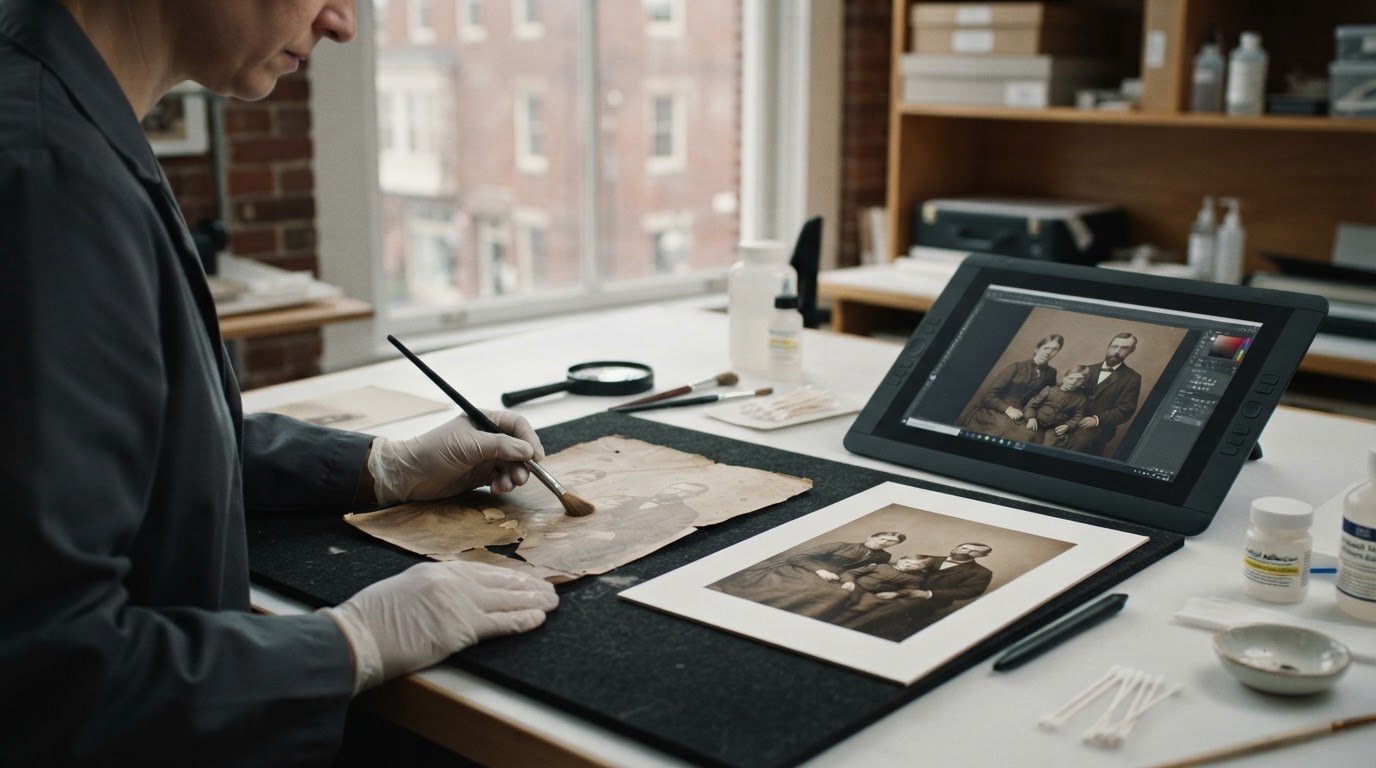
Can an old photograph be made clearer without losing the details that give it historical meaning? That’s the central question behind historical photo restoration Newburyport families consider when a treasured image has faded, torn, or scratched. Careful restoration aims to improve visible damage while respecting the photograph’s original character. What can be improved depends on the image’s condition.
It’s understandable to feel cautious about a fragile original. Handling it too much or attempting repairs without the right approach can add risk. Digital enhancement also has limits: it can’t reliably recreate details that are no longer visible. A thoughtful process starts by preserving the photograph as it is and setting realistic expectations for a restored version.
In this guide, you’ll learn what restoration may improve, how to prepare an old photograph for professional attention, and how to protect its story for sharing. Image-Tec, based in Methuen and serving Newburyport, provides professional historical image restoration. We’ll also consider how to balance a clearer image with the authenticity and evidence that make a historical photograph worth preserving.
Key Takeaways
- Learn how careful digital restoration can improve a photograph’s legibility while respecting its historical and personal character.
- Understand why restoration can’t reliably recreate details missing from the source image, and how digital edits differ from physical conservation.
- Compare safe storage, basic digital adjustments, and professional restoration to choose an approach suited to your photograph.
- Prepare an old photograph by documenting what you know and handling it carefully. Avoid writing on, flattening, cleaning, or altering a fragile original.
- Explore historical photo restoration Newburyport families can access through Image-Tec, a Methuen-based studio serving the area.
Why Historical Photo Restoration Matters to Newburyport Families
A family portrait may have faded until faces are difficult to make out. A community photograph may be creased, stained, or too fragile to pass around. These images can hold more than memories: a building in the background, a familiar street, or a handwritten date may connect a family story to Newburyport’s wider history. It’s natural to want a clearer version while worrying that restoration could change details that matter.
Historical photo restoration is the careful digital improvement of an image, with the aim of making it easier to see while retaining its documentary and personal character. The original can offer clues that aren’t obvious at first glance, so restoration should follow what is actually visible rather than assumptions about what a scene or person ought to look like.
Digital restoration improves a photographic image file; it does not repair or treat the physical print. That distinction matters. A digital working copy can be adjusted without changing the original object, while physical conservation involves caring for the print itself. The Conservation and restoration of photographs overview discusses both the physical care of photographs and digital approaches.
What makes an old photograph historically meaningful?
Names, dates, locations, clothing, signs, and architectural details can help identify who or what appears in a photograph. A picture of a relative may also document how a home or neighborhood looked at a particular point in time. For Newburyport families, these visual details can anchor personal recollections in familiar places and community history, even when the image can’t tell the whole story on its own.
Keep the original alongside any digital working copy. The print remains the source, while a digital version can be easier to view and share with relatives. Preserving both keeps the image’s original material distinct from its improved digital interpretation.
Which visible problems can prompt restoration?
Fading, discoloration, scratches, creases, dust, and small tears are common reasons people consider restoration. Digital work may improve the appearance or legibility of some affected areas, but the result depends on the condition and detail of the source image. A mark crossing an area with visible information presents a different challenge from damage in a plain background.
Some information may be obscured or missing entirely. Digital editing can’t reliably recover details that the source no longer contains, and not every mark or damaged area can be removed without affecting the photograph’s character. For historical photo restoration Newburyport families can use to preserve a meaningful image, the goal is a considered improvement, not a polished reconstruction that presents guesswork as fact.
That balance protects the image’s value as both a personal keepsake and a visual record. Careful restoration respects what can be seen, makes appropriate improvements, and leaves uncertainty where the photograph provides no clear answer.
What Historical Photo Restoration Can, and Cannot, Recover
Digital restoration can make an old photograph easier to read by adjusting contrast, reducing the visual impact of some marks, or improving the balance of its tones. It works with information that survives in the source. If a face is fully obscured by damage or a section of the print is missing, software or manual editing can’t reliably determine what was there.
Restoration quality depends on the image information that survives and the treatment you want. A restrained edit might clarify details while preserving a faded, historically revealing appearance. A more extensive treatment may change more of the image’s look. The right choice depends on the photograph’s condition and whether your priority is legibility, faithful appearance, or a particular use for the restored version.
This distinction also addresses a common concern: responsible restoration shouldn’t present invented details as documented facts. An editor may make an area look more complete, but that doesn’t prove the reconstructed detail is accurate. For family and community photographs, it’s better to retain uncertainty than to mistake a plausible interpretation for evidence.
How fading, scratches, and stains affect the image
Fading can reduce contrast between a subject and its surroundings, making facial features or clothing harder to distinguish. Discoloration may shift the overall tone, while scratches and stains can interrupt edges, expressions, or background details. Digital cleanup may lessen some visible distractions, but removing a mark is not the same as recovering the information it covers.
Keep an untouched source file when working digitally, and make edits on a separate copy. This preserves a reference for comparison and lets you reconsider adjustments without replacing the original digital image. If there are multiple photographs of the same person or place, they may offer helpful context, but they shouldn’t be treated as proof of details that aren’t visible in the image being restored.
Where restoration has limits
Extensive damage creates genuine uncertainty. A large tear across a person’s face, a missing corner that contains a sign, or a stain covering a distinctive object may leave too little visual information for a reliable reconstruction. Software can generate plausible-looking content, but plausibility is not historical accuracy. Indistinct faces, clothing, and settings shouldn’t be identified as fact based on a digital guess.
Known context can help guide a respectful treatment. Share names, dates, locations, family notes, or the reason the image matters, and distinguish confirmed information from a best guess. For example, a known date may help frame the photograph’s context, but it can’t establish what an unclear object is. In historical photo restoration Newburyport projects, that care helps keep improvements useful without overstating what the photograph can tell us.
Image-Tec provides professional historical image restoration for photographs that deserve careful attention. Learn about the studio’s historical image restoration service and how restoration can help preserve an image’s story while respecting the limits of the source.
How to Assess Restoration Approaches for a Newburyport Photograph
Not every old photograph needs digital enhancement. The right approach depends on the print’s condition, the details you hope to see, and whether your priority is protecting the physical object or improving an image for viewing and sharing. These goals are related, but they require different kinds of care.
| Approach | Likely benefit | Limitation |
|---|---|---|
| Keep the original safely stored | Protects the print from avoidable handling and damage. | Doesn’t improve the image’s appearance or legibility. |
| Make a basic adjustment to a digital copy | May make a copy easier to view by adjusting its overall appearance. | Limited adjustments can’t reliably address complex damage or recover missing detail. |
| Commission professional restoration | Offers a more considered approach to difficult damage and image details. | Results remain limited by what survives in the source photograph. |
When preservation alone may be the right first step
If the print is fragile, curled, flaking, or otherwise unstable, begin by minimizing handling. Keep it in a clean, protected place and avoid pressure, adhesives, aggressive cleaning, or attempts to flatten it. These actions can cause further damage. Protecting the physical photograph is not the same as improving a digital image made from it, and digital edits don’t stabilize or repair the print itself.
For an image that’s in reasonable condition but hard to share, a digital copy may be enough for basic viewing. Keep that copy separate from the original, and don’t treat routine brightness or contrast adjustments as conservation. They change how the digital image looks, not the condition of the paper photograph.
When professional digital restoration may help
Professional restoration may help when scratches, discoloration, fading, or other damage makes important parts of a photograph difficult to read. Detailed work can address specific areas more carefully than a broad, one-step adjustment, while keeping the treatment focused on the image rather than the physical print. Any edits should remain grounded in visible information and the historical context you can provide.
A careful digital workflow keeps an unaltered source distinct from edited versions, making it easier to compare the restoration with the image as it was received. The extent of improvement still depends on surviving detail; professional work can’t establish missing information as fact. For Newburyport families weighing whether a photograph needs more than basic adjustment, professional historical image restoration explains the service in more detail.
Consider the intended use, too. A copy for family sharing may call for improved legibility, while an image valued as a documentary record may call for a more restrained treatment. For historical photo restoration Newburyport families, the soundest choice serves the photograph’s purpose without confusing digital improvement with physical preservation.

How to Prepare an Old Photograph for Restoration in Newburyport
A little preparation can give a restoration specialist useful context while helping you avoid unnecessary handling of a fragile print. You don’t need to clean or repair the photograph first. Focus on protecting it, recording what you know, and clearly identifying details that are uncertain.
Handle and document the original carefully
Work on a clean, dry surface. If the print can be handled safely, use clean, dry hands and support it by the edges. If it’s brittle, curled, flaking, or stuck to another surface, don’t force it. Avoid household cleaners, adhesive repairs, pressure, and attempts to flatten it. These actions can damage the image or change the original.
Use this checklist to prepare useful information without writing on the photograph:
- Set the print down gently on a clean, stable surface, and limit handling.
- Record known names, dates, locations, and family or community context in a separate note.
- Mark uncertain details as possibilities, not facts. For example, write “possibly taken near the waterfront” rather than labeling the location as certain.
- Note whether the image is an original print, a copy, or an existing digital scan, and identify any other versions you have.
- Keep your notes with the photograph’s identifying information, but don’t attach anything to the print itself.
Share useful context without changing the photograph
Context can help explain why particular details matter. A name written in a family record, a date recalled by a relative, or a likely location may guide attention during restoration. Keep the source of each detail clear, and separate what you know from what you’ve inferred. That way, a possible identification won’t become a factual caption simply because it appears in your notes.
Existing copies or scans can also provide useful comparison, especially if one version shows details that are faint in another. Identify which version is the original and which are copies. If professional image capture is needed for artwork intended for reproduction, art reproduction for New England artists has a distinct purpose from restoring a historical photograph. The two workflows aren’t interchangeable.
Keep preparation simple: avoid altering the print, record useful context, and keep uncertain details clearly labeled. Image-Tec is a Methuen-based studio serving Newburyport, with professional historical image restoration among its services. Explore Image-Tec’s historical image restoration to take the next step in preserving a meaningful photograph.
Historical Photo Restoration in Newburyport with Image-Tec
Newburyport residents looking to restore a meaningful family or community photograph can work with Image-Tec, a photography and art reproduction studio based in Methuen, Massachusetts, and serving Newburyport. Image-Tec also serves Boston and Manchester, New Hampshire. Professional historical image restoration is among the studio’s services. The work is best approached with care: the photograph’s surviving detail, its known history, and your intended use all help define what a respectful restoration should aim to achieve.
A restoration can have different priorities. You may want a faded portrait to be easier for relatives to view, or you may value preserving the image’s documentary character above making it look pristine. Neither goal requires treating uncertain details as fact. Sharing what you know, and distinguishing it from what you’re unsure about, gives the project useful context without asking the image to tell more than it can.
A regional studio serving Newburyport
Image-Tec’s Methuen location serves Newburyport, Boston, and Manchester, New Hampshire. For families in these communities, the studio provides professional historical image restoration. The studio also works in photography and art reproduction, but restoration of a historical photograph is a distinct service and should not be confused with art scanning or reproduction methods.
Before starting, consider what matters most about the photograph: its readable details, its resemblance to the print you remember, or its value as a historical record. A clear goal can help frame the work while keeping expectations grounded in the condition of the image. The surviving information and the damage affect what digital restoration can reasonably improve.
What to share when starting a restoration project
Useful context can be straightforward. Describe visible damage, such as fading, scratches, discoloration, or a crease, and share any known names, dates, or locations. Note which details are confirmed and which are family recollections or possibilities. If the photograph has an original print and existing copies, identify them separately so the source image and other versions aren’t mistaken for one another.
It also helps to state your main priority. You might want the image to be easier to read, prefer a restrained treatment that retains its aged appearance, or hope to create a version that’s easier to share with family. These preferences explain what success would look like for you without presuming a specific technical process or result.
For historical photo restoration Newburyport families can access through a regional studio, Image-Tec offers professional restoration with a careful, project-focused perspective. Explore Image-Tec’s historical photo restoration service to take the next step in preserving your photograph’s story.
Give a Meaningful Photograph a Thoughtful Next Step
Choosing restoration doesn’t mean making an old photograph look new. It means deciding what you hope to preserve, what you’d like to see more clearly, and how closely the final image should retain the character of its source. Those priorities can guide a considered restoration, especially when the photograph’s history matters as much as its appearance.
Before moving ahead, gather the information you already have and clearly mark uncertain details. You don’t need to solve every mystery in the image first. A name, a remembered place, or a family note can provide helpful context, while the photograph itself remains the guide to what can be responsibly improved.
For historical photo restoration Newburyport families can pursue with Image-Tec, take the next step by exploring the studio’s professional service. A careful approach can make a treasured image easier to appreciate and share while respecting the story it carries. Explore Image-Tec’s historical photo restoration service to give your photograph’s story room to endure.
Frequently Asked Questions
Can a severely torn historical photograph be restored?
It may be possible to improve a severely torn photograph digitally, but the outcome depends on what remains visible. A tear through a plain background may be less difficult to address than one crossing a face or a distinctive object. For historical photo restoration Newburyport families should set the goal as careful improvement, not guaranteed reconstruction. Comparing the damaged area with another known photograph may provide context, but it can’t prove missing details.
Will restoring an old photo change or damage the original print?
Digital restoration works on an image file, not directly on the physical print. To keep the original unchanged, avoid physical cleaning or repair unless you’ve deliberately chosen a separate treatment for the object. Preserve an unedited digital capture as a reference, then keep any restored version separate. That makes it easier to compare edits and decide whether a change, such as stronger contrast, still feels faithful to the source.
Can a faded or sepia photograph be restored without losing its historic appearance?
Yes, a faded or sepia image can be adjusted with the aim of retaining its aged tonal character. Sepia isn’t necessarily damage: it may be part of the photograph’s appearance and appeal. Before work begins, decide whether you want subtle improvement for easier viewing or a more noticeable change. For example, you might prefer clearer faces while keeping the warm overall tone rather than making the picture look newly photographed.
Can missing details in an old photograph be recreated accurately?
Not with certainty from the photograph alone if the information is missing. A family portrait with an obscured face, for instance, may invite a guess based on another image, but resemblance doesn’t establish identity. Share reliable references or records if you have them, and label what they support. Keep interpretation distinct from documented fact so a later viewer can understand which details come from the photograph and which rely on outside evidence.
Should I scan an old photograph before asking about restoration?
A digital copy can be useful, but don’t risk a fragile print to make one. A curled, brittle, or flaking photograph may be damaged by pressure or handling during home scanning. If you already have a scan, keep the original file and note how it was made; avoid overwriting it with edits. Image-Tec provides professional historical image restoration and BetterLight scanning for high-resolution art reproduction. Art-scanning equipment and historical photo restoration serve distinct purposes.
Can a restored historical photograph be printed after the digital work?
A restored digital image can often be printed, but suitability depends on the detail in the file and the intended print size. A small image enlarged substantially may not retain the clarity you expect, so consider the output after assessing the usable image. Image-Tec provides Giclée printing, including canvas prints up to 60 inches wide, and custom framing. Restoration and printing are distinct steps, and the appropriate print choice depends on the project.






Leave A Comment
You must be logged in to post a comment.