

What should a shopper be able to tell from a product photo before adding an item to a cart? Effective ecommerce photography helps customers see important details, understand scale, and get a realistic sense of what will arrive. When lighting, framing, or backgrounds shift from one listing to the next, even good products can be harder to assess.
A polished image matters, but a reliable image plan also needs to represent products accurately and create a consistent experience across your store. This guide explains how to plan around product types and customer questions, choose suitable image formats for your products and sales channels, and give each shoot a clear purpose.
You’ll find practical guidance on standard product views, detail shots, lifestyle images, and when 360-degree photography may be useful. For businesses in Methuen, Boston, Manchester, New Hampshire, and Newburyport, Image-Tec is an independent commercial photography studio based in Methuen, Massachusetts, offering product photography in-studio or on-location. Start with your products, the details shoppers need to see, and the requirements of the channels where you sell.
Key Takeaways
- Plan ecommerce photography around what shoppers need to identify, inspect, and compare, while setting realistic expectations for the product.
- Set repeatable visual guidelines for lighting, framing, and backgrounds, but preserve meaningful differences between product variants.
- Compare standard, lifestyle, detail, and 360-degree formats to choose images that answer product-specific questions.
- Build a practical photography brief with a product list, required angles, channel needs, styling boundaries, references, and a review plan.
- Evaluate photography partners by relevant experience, communication, production approach, and deliverables. Then decide whether in-studio or on-location work suits your products.
Ecommerce Photography: What It Includes and What It Needs to Achieve
Ecommerce photography is product-focused imagery that helps online shoppers identify, inspect, and evaluate an item before they buy. Unlike general brand imagery, it has a practical job: show what the product is, make relevant features visible, communicate proportions, and give customers a fair expectation of what will arrive.
Product photography often uses still life techniques, arranging and lighting objects carefully to reveal their form. The Still life photography overview also identifies product photography as an example of the genre. In ecommerce, the composition should serve the shopper first. A polished image that hides a closure, changes the appearance of a finish, or suggests an accessory that isn’t included may look appealing but give customers the wrong impression.
What should ecommerce product photos help shoppers understand?
Each view should answer a likely question. A front view can identify the item, while a close-up can clarify texture, finish, controls, stitching, or other construction details. A side or back view can reveal components hidden from the main angle. If dimensions matter, show scale clearly and truthfully. Make sure props or hands don’t imply that something is included when it isn’t.
Accuracy applies to variants, too. Keep the presentation consistent, but show genuine differences in color, material, configuration, or proportions. The goal isn’t to make every listing look identical. It’s to make each item easy to assess.
How do listing images differ from brand and lifestyle photography?
Listing images are catalog and product-page assets. They keep the item prominent and make it straightforward to inspect. Detail images focus on specific features, while lifestyle images place the product in a setting that suggests its use or scale. Lifestyle imagery adds context, but it shouldn’t replace clear product views.
- Standard listing views: identify the product and show its overall form.
- Detail images: draw attention to materials, finishes, or components.
- Lifestyle images: show the item in a relevant environment.
- Interactive imagery: 360-degree photography can let shoppers examine a product from multiple angles when that format suits the item and sales channel.
These formats can work together, but the right mix depends on the product and where the images will appear. Channel requirements differ and may change, so verify current image specifications before production. A clear format plan makes ecommerce photography more useful for shoppers and more practical to produce.
Build Trust with Accurate, Consistent Ecommerce Product Photography
A cohesive catalog helps shoppers compare products without being distracted by changes in presentation. Repeatable lighting, framing, and backgrounds create a clear visual standard across product pages. That consistency should make the catalog easier to navigate, not make every item look interchangeable.
Accurate product images set clearer expectations by showing shoppers what they can actually expect to receive. A consistent visual approach supports that accuracy, as long as it doesn’t hide real differences in color, finish, shape, or included components.
Which visual standards make a product catalog feel consistent?
Document the choices that should repeat: camera angle, crop boundaries, lighting direction and quality, and background treatment. For variants, keep the overall framing and lighting consistent while making the differences easy to see. For example, represent color options distinctly rather than adjusting them to look uniform.
Before applying the approach across a full product range, compare sample images with the actual items and approved product information. Check that the subject is positioned consistently, details remain visible, and the background doesn’t compete with the product. Reviewing samples gives the team a chance to refine the visual standard before using it for a larger production.
How can photographs answer shoppers’ product questions?
Choose views according to what customers need to assess. A close-up can reveal surface texture or a fastening; a side view can clarify shape; a scale cue can help communicate proportions. Show the components that are included, and avoid props or styling that could suggest extras come with the item. Check each frame against the physical product and its approved description.
Lifestyle context can help explain where or how an item is used, but it should support, not replace, straightforward product views. A carefully styled scene may communicate context, while a clear listing view lets shoppers inspect the item itself. Both have a role, provided the styling doesn’t misrepresent appearance or scale.
Color needs particular care. Lighting, camera capture, editing, and display settings can all affect how a color appears onscreen. Establish a consistent capture and review process, use reliable references where available, and avoid promising an exact screen-to-product match. The practical aim is faithful, repeatable color representation, not control over every shopper’s display.
For businesses planning a more consistent catalog, a professional commercial photography project can include a discussion of product needs, visual standards, and production logistics before the full shoot begins.
Compare Ecommerce Photography Formats Before Planning a Shoot
The best image format depends on what shoppers need to understand and what the product can show clearly. Start with straightforward still images, then add context, close-up views, or an interactive format when each answers a distinct question. This keeps the production plan focused instead of adding formats simply for variety.
| Format | What shoppers learn | Useful for | Production considerations |
|---|---|---|---|
| Standard product views | The item’s overall form, appearance, and key sides. | Catalog listings and products that need clear, repeatable presentation. | Set consistent angles, framing, and backgrounds. Capture views that identify the item without obscuring its shape. |
| Detail images | Close-up information about texture, finish, construction, or function. | Products with features that aren’t clear in a full-item view. | Choose details that answer real questions, with focus and lighting clear enough to show them accurately. |
| Lifestyle images | How an item may look in context, including its use or relative scale. | Products whose setting or application adds useful information. | Plan props and surroundings so they don’t distract from the product or imply components that aren’t included. |
| 360-degree photography | How the product looks from multiple sides as the viewer explores it. | Physical products with forms or features that benefit from all-around inspection. | Consider product shape, the viewing experience, and the image assets and presentation the channel requires. |
When are standard, detail, and lifestyle product photos useful?
Use standard views as the foundation for identifying an item and presenting it consistently across a catalog. Add detail shots when close inspection can clarify construction, finish, or function. Lifestyle imagery is useful when context makes the product easier to understand, such as showing how an object sits in a setting or is used. Keep a direct product view alongside it so the context doesn’t have to do the work of identification.
When is 360-degree ecommerce photography worth considering?
A 360-degree view can help shoppers explore multiple sides of a suitable physical product. It may be useful when shape, rear details, or the item’s all-around form matter to evaluation. It isn’t a universal replacement for still photographs: customers may still need a clear primary view and close-ups, and the interactive experience must suit the sales channel. Image-Tec offers 360-degree imaging for suitable projects. For more on the format, see the separate guide to 360-degree photography.
Before choosing formats, list the questions each image should answer. If two formats provide the same information, prioritize the one that best fits the product and production plan. This keeps ecommerce photography purposeful, with each asset contributing a distinct view of the item.
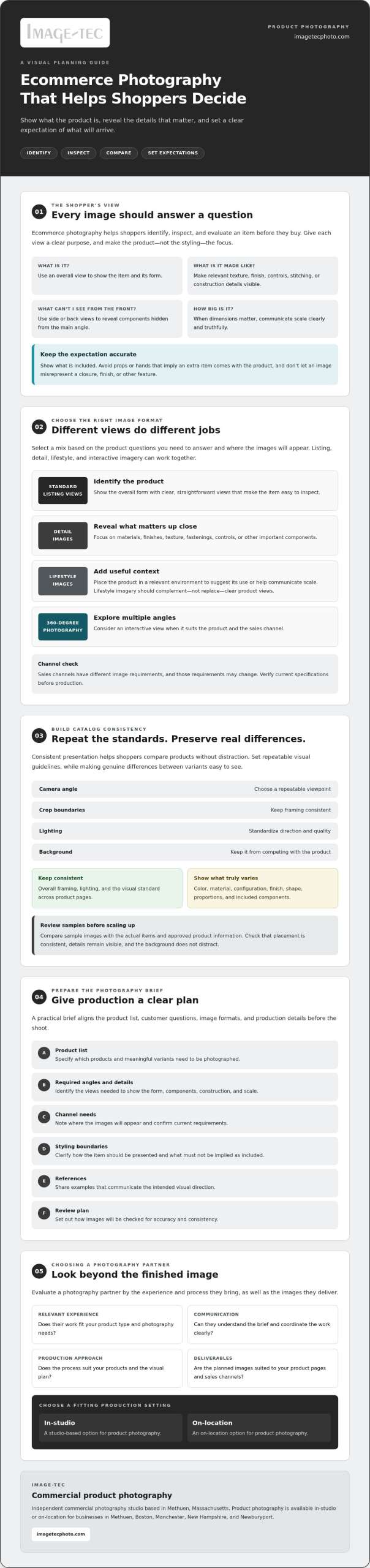
Plan an Ecommerce Photography Brief That Keeps Production on Track
A well-prepared brief turns a broad request for product images into a shared production plan. It helps the photographer understand what needs to be shown, how the images will be used, and who will review the results. For ecommerce photography, clear instructions up front can prevent missing views, confusing variant differences, and avoidable back-and-forth.
What information belongs in a product photography brief?
Build the brief in five steps. Keep it practical. The goal is to make expectations clear, not to prescribe every creative decision.
- Set the goals. State what shoppers should understand and what the images need to accomplish, such as introducing a product range or replacing outdated listing images.
- List the products. Include product categories, item identifiers, variants, and any differences that must appear accurately.
- Create the shot list. Specify required angles, detail views, lifestyle context, and any 360-degree views. Note which views are essential for each product.
- Document channel needs. Identify where each image will be used, such as product pages or other sales channels. Record required dimensions, formats, and other specifications, then verify current channel requirements before production.
- Set the review plan. Name the person who approves sample images and gathers feedback. Agree on how comments will be consolidated so the team isn’t working from conflicting instructions.
Include visual references, background preferences, prop guidance, and styling boundaries. References can show the desired framing or mood, while written notes should clarify what must not change, such as a product’s finish or the appearance of a variant. Be specific about required angles and intended image uses.
How should a business prepare products and files?
Before the shoot, confirm that each item is production-ready, clean, complete, and clearly identified. Share accurate product details and flag anything delicate, reflective, unusually sized, or difficult to handle. If components are sold separately or aren’t included, make that distinction clear in the brief so styling doesn’t create a misleading impression.
Agree on file delivery needs and image specifications with the photography partner. Requirements can vary by channel, so check them close to production instead of relying on old notes.
- Goals and intended image uses are documented.
- Products and variants are labeled and ready.
- Required angles, details, references, and styling limits are recorded.
- Channel specifications and delivery needs are confirmed.
- Review responsibility and feedback process are clear.
Use this checklist as a starting point, then adapt it to the products and production scope. The Image-Tec website provides a place to discuss product types, image requirements, and shoot logistics.
Choose a Local Ecommerce Photography Partner for Your Business
A strong photography partnership should make production easier to understand and manage. Look beyond a portfolio’s overall style: ask whether the photographer can show the features your products need to communicate, explain how the shoot will be organized, and confirm which final files will be delivered for your intended uses.
What should you ask a product photography studio?
Ask how the photographer would approach your product category and requested image formats. Clarify whether the work is better handled in-studio or on-location, what preparation is expected, and how you’ll review the results. Before production, confirm the project scope, deliverables, intended image uses, and who will consolidate feedback. These conversations help establish shared expectations before products are photographed.
For more guidance on assessing a local provider’s facilities and approach, see this commercial photography studio guide.
How can Image-Tec support ecommerce photography near Boston?
Image-Tec is an independent commercial photography studio based in Methuen, Massachusetts, serving businesses in Methuen, Boston, Manchester, New Hampshire, and Newburyport. Commercial product photography is available in-studio or on-location. Discuss the items to be photographed and the practical project requirements when considering which setting may suit the work.
Image-Tec also offers 360-degree imaging for suitable projects. Whether it fits depends on the product and how customers will view the images, so consider it as one possible format rather than a default for every listing.
As you compare partners, look for clear answers about process, communication, and deliverables. A focused discussion of your product range and intended channels can help you decide whether the photographer’s approach suits your needs.
Learn more about Image-Tec’s photography services and the available production approach.
Make Your Next Product Shoot More Purposeful
Strong ecommerce photography begins with a clear purpose: help shoppers understand what a product looks like, which details matter, and what they can expect to receive. A consistent visual plan makes listings feel cohesive, while a practical brief keeps product requirements, image formats, and review steps aligned before production begins.
Choose each image type for the information it provides. Straightforward product views establish what’s for sale; detail, lifestyle, or 360-degree images can add useful context when the product calls for them. Accuracy remains central, especially when showing variants, scale, color, or included components.
For businesses in Methuen, Boston, Manchester, New Hampshire, and Newburyport, Image-Tec is based in Methuen, Massachusetts, and offers commercial product photography in-studio or on-location. Discussing your products, intended channels, and shoot logistics is a practical first step toward a focused production plan.
Discuss your ecommerce photography project with Image-Tec to plan your product imagery and production approach.
Frequently Asked Questions
What is ecommerce photography?
Ecommerce photography is product-focused imagery created to help online shoppers understand and evaluate items before buying. It shows what a product looks like, highlights relevant features, and helps communicate its shape, finish, or scale. Unlike general brand imagery, these photographs keep the item central and support product listings or catalog pages. Accurate views help customers form realistic expectations about what they’re considering.
What types of photos should an ecommerce product listing include?
A product listing may use a clear primary view, additional angles, and close-ups of details shoppers need to inspect. Depending on the item, a lifestyle image can show it in context, while a scale cue can help communicate proportions. Show variants accurately and make clear which components are included. The right selection depends on product features, customer questions, and the image specifications of each sales channel.
Is professional ecommerce photography worth it for a small business?
Professional photography may be worthwhile when existing images make products difficult to assess or vary noticeably across listings. A planned shoot can establish repeatable lighting and framing, capture product details, and create a useful set of views. Consider the number and variety of products, where images will appear, and how long the imagery will serve the business. The value depends on your needs and production scope, not business size alone.
How do I prepare products for an ecommerce photography shoot?
Prepare items by making sure they’re clean, complete, and clearly identified, especially when several variants will be photographed. Share accurate product information, note delicate or reflective surfaces and unusually sized items, and provide a shot list with required angles. Include reference images and styling boundaries, such as background preferences or props to avoid. Confirm channel specifications, file needs, and who will review sample images before production starts.
Can a photographer create ecommerce product images on location?
Yes. On-location photography can suit products that are difficult to transport or need a particular setting to be shown clearly. A studio may be more practical when controlled presentation and repeatable backgrounds are priorities. Discuss product handling, intended images, and shoot logistics with the photographer to determine a suitable approach. Image-Tec offers commercial product photography both in-studio and on-location, with the project requirements guiding the choice.
When should a business use 360-degree product photography?
Consider 360-degree photography when shoppers would benefit from examining multiple sides of a physical product, particularly if its overall shape or features aren’t clear from a few fixed views. It works best when the sales channel can present the interactive format and the product’s design makes a rotating view useful. It isn’t necessary for every listing and should complement, rather than automatically replace, clear still photographs.
How do I choose an ecommerce photography studio near Boston?
Review a studio’s product photography experience, examples relevant to your items, communication approach, production options, and planned deliverables. Ask how it would handle your required formats, whether the project suits studio or on-location work, and how image reviews will be managed. Image-Tec is based in Methuen, Massachusetts, and serves businesses in Methuen, Boston, Manchester, New Hampshire, and Newburyport. Discuss your product range and shoot needs before deciding on fit.






Leave A Comment
You must be logged in to post a comment.