

A museum-grade print is only as permanent as the materials encasing it. If you have ever watched vibrant pigments shift under ordinary glass, or opened an order to find delicate cotton paper warped inside a budget moulding, you know how easily fragmented production ruins fine art. Coordinating custom framing and giclee printing within a single, color-managed workflow eliminates these vulnerabilities, protecting delicate substrates and securing absolute color fidelity from the very first proof.
You shouldn’t have to juggle separate print shops and frame suppliers, doubling shipping risks just to ensure your piece is preserved correctly. In this complete guide, you’ll discover how museum-grade giclée printing and custom archival framing unite under one roof to preserve, protect, and showcase your artwork flawlessly. We will examine the critical role of acid-free fine art media, optical-grade UV glazing, and the seamless studio process required to keep your work looking true to the original for decades to come.
Key Takeaways
- Learn why combining custom framing and giclee printing within a single professional studio preserves color accuracy and eliminates transit-related paper damage.
- Discover the mechanical differences between dye-based inks and archival pigment formulas designed to resist fading and environmental degradation for decades.
- Find out how to select the right substrate for your project, from textured watercolor rag to primed canvas prints scaled up to 60 inches wide.
- Explore the critical archival framing standards required to protect fine art, including acid-free matting, specialized degassing periods, and UV-filtering glazing.
- Understand how an integrated local production workflow streamlines art reproduction from initial high-resolution digital capture through to ready-to-hang framing.
What Is Giclée Printing and How Does Custom Framing Protect It?
High-end digital reproduction demands far more than feeding a file into a home desktop printer. Understanding what is giclée printing begins with its industrial baseline: fine art output rendered through specialized wide-format machinery using archival, pigment-based inks on acid-free media. Standard consumer photo labs rely on dye-based inks, which dissolve in liquid vehicles and quickly break down under light exposure. Archival pigment inks suspend microscopic mineral particles in solution, delivering exceptional lightfastness alongside a wide dynamic range. Without a sealed conservation environment, however, even the finest pigment work remains completely exposed to environmental decay.
This reality makes pairing custom framing and giclee printing a functional requirement rather than a decorative luxury. Archival framing serves as a protective enclosure, isolating vulnerable paper fibers and canvas weaves from ambient threats.
The Anatomy of True Archival Giclée Prints
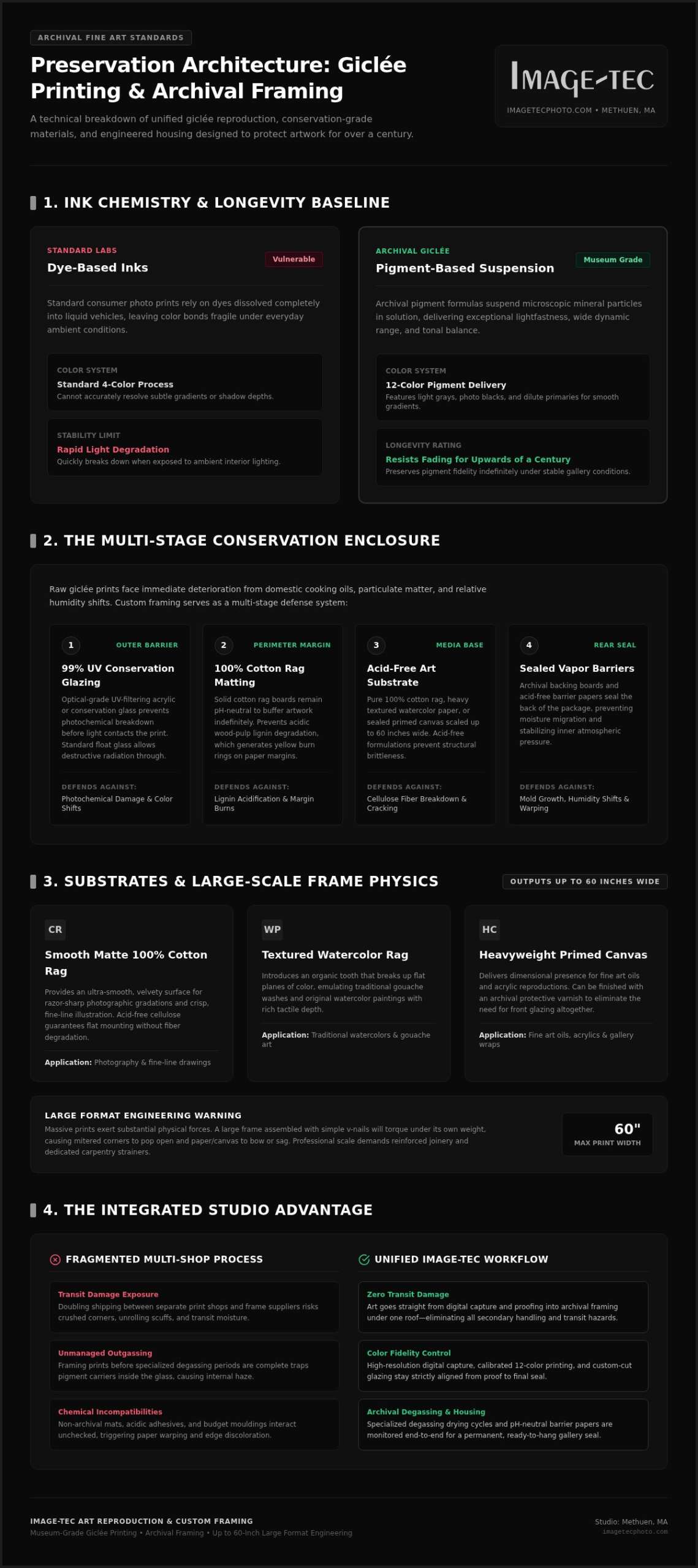
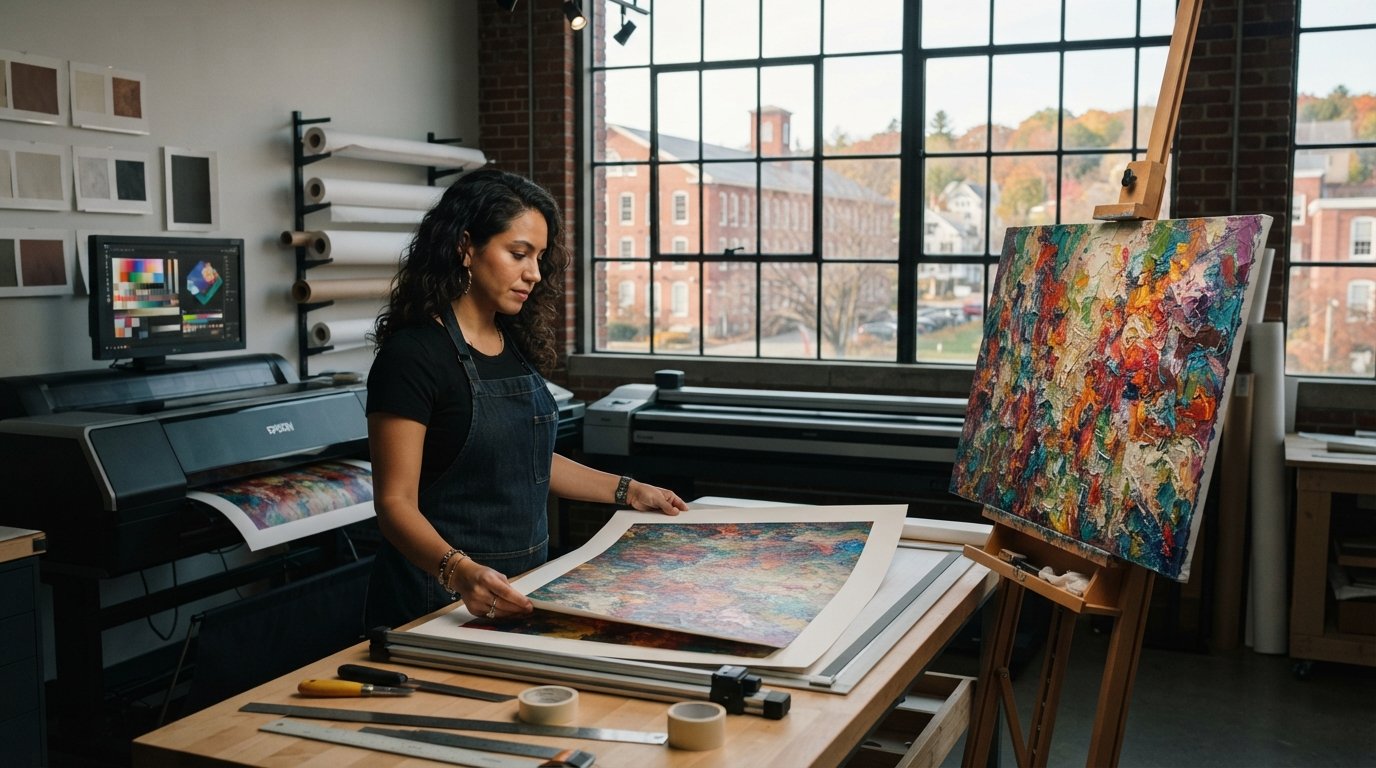
Authentic reproduction relies on 12-color pigment delivery systems that incorporate specialized shades like light grays, photo blacks, and dilute primaries. This setup resolves smooth tonal gradients and complex shadow details that four-color process printing simply cannot track. The chosen substrate establishes tactile depth: pure 100% cotton rag provides an ultra-smooth, velvety surface for fine-line illustration, while textured watercolor papers and heavyweight canvas lend dimensional presence to fine art oils and acrylics. In stable gallery conditions, these pigment-paper combinations resist fading for upwards of a century.
Why Framing Is an Essential Conservation Layer
Raw prints face persistent atmospheric hazards the moment they leave the studio table. Airborne particulate matter, domestic cooking oils, and sudden humidity fluctuations trigger dimensional changes in unsealed cellulose fibers. Professional framing forms a multi-stage defense system:
- Conservation Glazing: Standard float glass allows destructive ultraviolet radiation to penetrate the frame package. Installing 99% UV-filtering acrylic or conservation glass prevents photochemical damage and color shifts before light contacts the print surface.
- 100% Cotton Rag Matting: Wood-pulp matting contains lignin, an organic polymer that degrades into acid over time, producing distinct yellow burn rings along print margins. Solid cotton rag boards remain pH-neutral, buffering the artwork indefinitely.
- Sealed Vapor Barriers: Archival backing boards and acid-free barrier papers block moisture migration through the rear of the frame, stopping mold growth and warping.
Investing in custom framing and giclee printing within a unified studio guarantees these protective components integrate cleanly, eliminating chemical incompatibilities before the frame is sealed.
Substrates & Frames: Paper to Canvas Prints Up to 60 Inches
Executing large-scale fine art reproduction requires precise alignment between the physical substrate and the surrounding frame moulding. As print sizes increase, paper tension, canvas weight, and frame physics interact directly. Standard online framers usually top out at modest dimensions, unable to manage massive formats without bowing or surface sagging. Achieving professional scale demands mastering custom framing and giclee printing together, ensuring prints up to 60 inches wide remain perfectly flat and structurally sound under glass or across heavy stretchers.
Fine Art Paper vs. Canvas: Choosing the Ideal Medium
Selecting the right base depends entirely on the aesthetic goals of the artwork. Smooth matte cotton rag renders fine photographic gradations and crisp linework with razor sharpness. Textured watercolor paper introduces organic tooth, breaking up flat planes of color to mimic traditional gouache or watercolor washes. Canvas offers dimensional weight, eliminating the need for glazing altogether when properly sealed with a protective archival varnish. If you are debating between paper textures or fabric weaves, explore choosing the right canvas for large format prints to evaluate durability and aesthetic balance.
Engineering Frames for Large Format Displays
Massive prints exert substantial physical forces on their housing. A large frame assembled with simple v-nails will torque under its own weight, popping open at the mitered corners. Engineering oversized displays requires dedicated carpentry techniques:
- Reinforced Joinery and Strainers: Oversized mouldings necessitate internal cross-strainers and hardwood spline joinery. This internal skeleton prevents long frame rails from bowing inward under tension.
- Weight Mitigation with Optical Acrylic: Traditional glass becomes dangerously heavy and brittle above 30×40 inches. Optical-grade acrylic offers equal clarity and UV filtering at half the weight, preventing structural failure on your hanging hardware.
- Precision Floater Frames: Stretched canvas prints up to 60 inches wide demand deep-profile floater frames. These custom mouldings cradle the stretched canvas from behind, providing a clean reveal around the perimeter without touching the printed surface.
Selecting the proper profile ensures your large-scale installations look intentional rather than fragile. If you’re planning a massive project, consult with the craftsmen at Image-Tec to match your oversized canvas or rag paper with properly engineered framing hardware.
The Integrated Studio Advantage: Eliminating Color Shifts and Shipping Risks
Splitting production between an online print vendor and a separate local frame shop introduces costly blind spots. When printers don’t speak to framers, small discrepancies multiply. A slight paper trim error creates gaps beneath mat windows, or an aggressive shipping carrier drops an unmounted roll on its edge, crimping fibers before assembly even starts. Unifying custom framing and giclee printing within a single professional facility eliminates handoff risks entirely, consolidating creative accountability under one roof.
Color Management Across Capture, Print, and Display Lighting
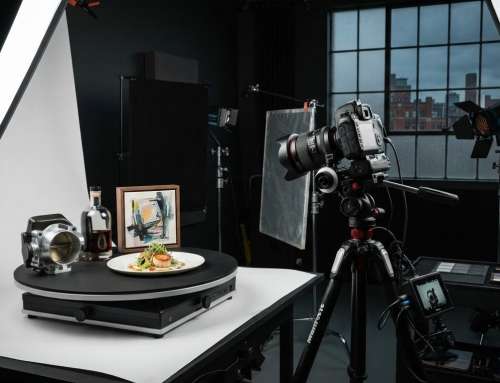
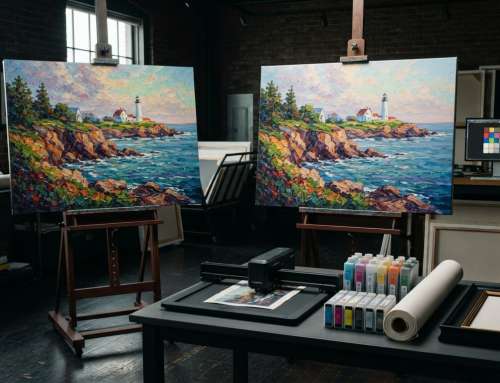
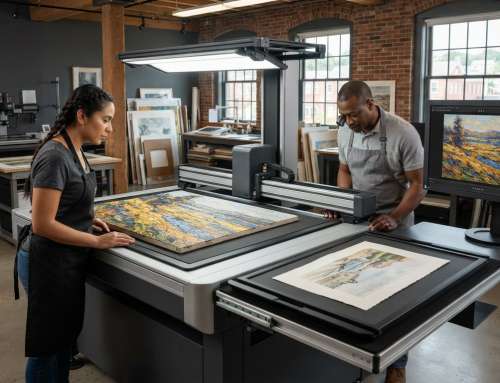
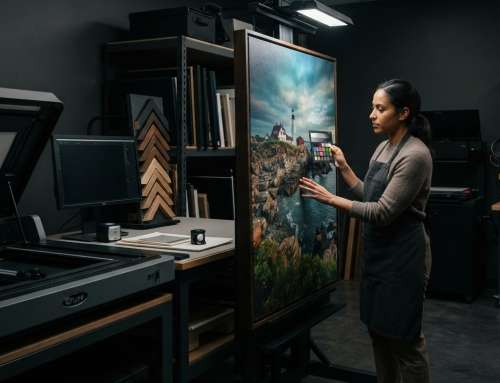
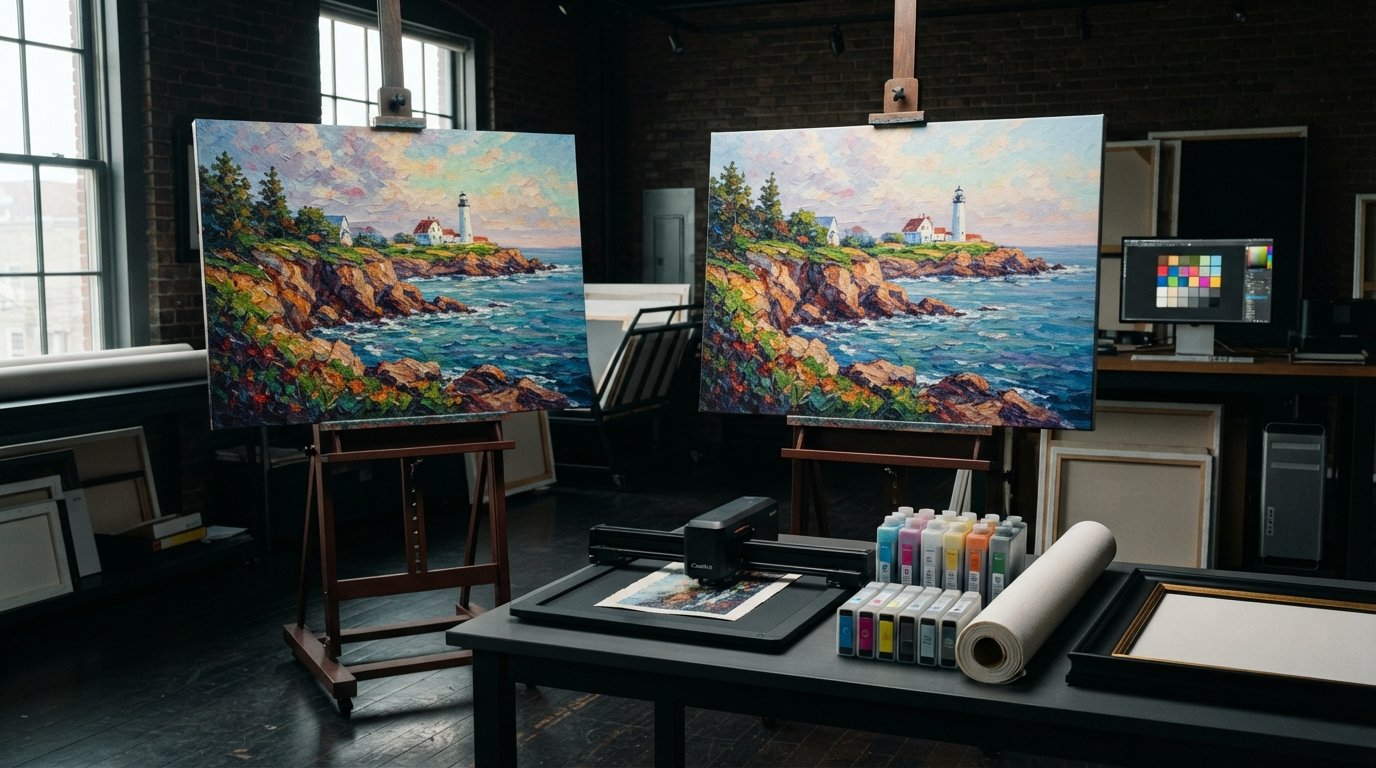
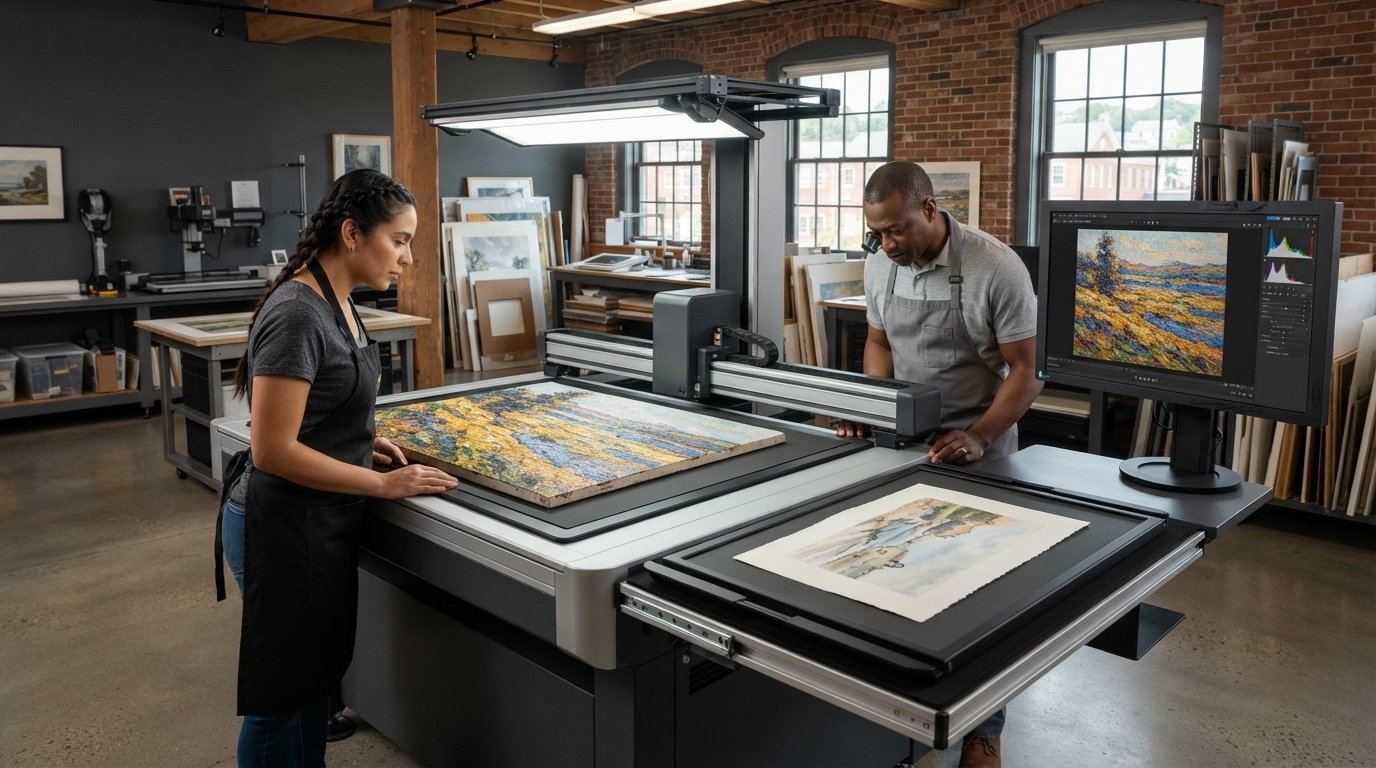
Precise color reproduction depends on a strictly calibrated chain of hardware and software. Each fine art paper and canvas formulation responds to pigment inks differently, requiring custom ICC profiles built specifically for that substrate. When reproducing original artwork, the process begins upstream with precise digital capture. Utilizing specialized BetterLight scanning art reproduction ensures razor-sharp detail and linear color response before printing starts. In an integrated studio, the master printer and framer evaluate physical proofs together under standard D50 gallery lighting, ensuring mat boards and frame finishes balance the print’s tonal warmth rather than flattening its dynamic range.
Zero Transit Damage: The Single-Facility Benefit
Shipping loose, unmounted prints through mail-in networks is an exercise in damage control. Large fine art papers retain memory when curled tightly into shipping tubes, making them susceptible to surface creasing during unrolling. Disparate handling invites several distinct defects:
- Edge and Corner Crushing: Heavy cotton papers have delicate corners that crush easily when parcel packages shift during high-volume courier sorting.
- Micro-Scuffing: Unvarnished pigment prints rub against protective glassine sheets in transit, creating permanent abrasions across dark ink densities.
- Debris Entrapment: Moving unsealed art between different workshops increases dust exposure right before final glazing.
An integrated workflow bypasses transit risks entirely. Once pigment inks dry in a clean-room environment, the piece moves directly onto the framing bench for mounting, matting, and glazing. You receive a fully sealed, structurally stable artwork fitted with heavy-duty hanging hardware, ready to hang straight out of the crate.
Centralizing your project protects your investment. Pairing custom framing and giclee printing through an all-in-one studio gives you direct access to the artisans crafting your presentation, guaranteeing consistent standards from file capture to wall display.
Step-by-Step Custom Framing Workflow for Giclée Art Prints
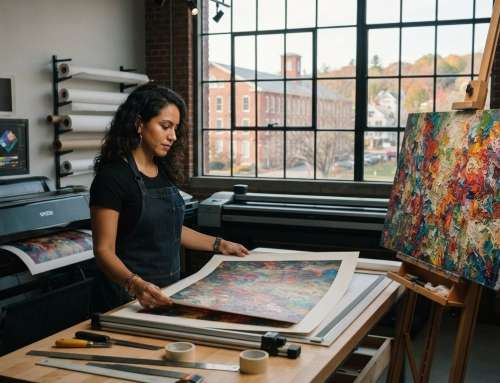
Preserving fine art requires systematic execution at every bench. Rushing the assembly or cutting corners on mounting compromises months of creative effort. When you align professional custom framing and giclee printing within a disciplined production cycle, every mechanical phase serves both visual impact and long-term stabilization.
- Inspection and Proofing: Technicians inspect the master digital file or original work, verifying color balance against calibrated reference monitors under standardized D50 illumination.
- Pigment Printing and Degassing: The image is rendered using fine art pigment sets on the chosen substrate. Prints rest in a humidity-controlled space for a mandatory degassing period, allowing ink solvents to fully evaporate before housing.
- Conservation Mounting: The dry print is secured to an acid-free backing substrate using non-destructive, reversible hinges that accommodate atmospheric expansion.
- Enclosure Assembly: Conservation glazing and precision matting or spacers are joined to the moulding, ensuring the print face never touches glass.
- Sealing and Fitting: A continuous dust barrier encloses the frame rear, followed by heavy-duty D-rings, coated steel wire, and wall bumpers.
Reversible Mounting Techniques That Preserve Value
Permanent dry mounting adheres the entire reverse of a print to foam board using heat-activated adhesives. While this creates a flat surface, it permanently damages paper collectibility and eliminates resale value. Archival framing relies strictly on reversible methods, such as Japanese kozo paper hinges adhered with wheat starch paste, or archival polyester corners. These techniques anchor the artwork securely along the top edge while allowing the bottom corners to expand and contract naturally as room humidity shifts, preventing severe paper rippling.
Glazing, Spacers, and Protective Backing Enclosures
Trapped moisture is an invisible predator inside sealed frames. If unvarnished cotton rag touches glazing directly, atmospheric condensation transfers onto the pigment layer, causing physical sticking and glossy patches. Framers prevent this by using window mats or inert acrylic frame spacers to maintain an air buffer. Behind the print, acid-free barrier boards deflect moisture migration, while a puncture-resistant paper dust cover seals the rear perimeter against insects and soot.
Executing this multi-stage assembly correctly demands both specialized equipment and disciplined hand craftsmanship. To protect your limited editions with museum-grade care, start your framing project with Image-Tec today.
Local Excellence: Working with Image-Tec in Methuen, MA
Achieving true gallery standards requires more than automated online ordering forms. Situated near the intersection of Interstate 93 and Route 495, Image-Tec has served New England artists, collectors, and commercial clients since 1994. Operating from a fully equipped facility in Methuen, MA, the studio bridges technical commercial photography, digital capture, and preservation finishing. Managing custom framing and giclee printing within a single regional facility gives clients direct access to master printers and framing technicians throughout every phase of production.
Serving Artists, Galleries, and Collectors Across Massachusetts and New Hampshire
Physical consultation remains the gold standard for high-end art reproduction. Rather than guessing color values on uncalibrated home monitors, clients from Boston, Newburyport, and Manchester, NH visit the studio to examine physical paper swatches, canvas textures, and real moulding corner samples under standard illumination. Regional creators, ranging from Newburyport maritime painters to Boston corporate collections, rely on this collaborative approach. You can review regional framing capabilities and design options through custom art framing in Methuen MA to see how localized finishing protects your work.
From High-Resolution Scanning to Ready-to-Hang Masterpieces
The reproduction workflow starts with exacting input. Image-Tec utilizes a specialized BetterLight digital scanning system to capture original artwork with linear color accuracy and sharp optical resolution, bypassing the lens distortion common in standard digital photography. For damaged or aging originals, in-house historical image restoration repairs blemishes and tonal decay before any ink touches paper. Once digitized, reproduction capabilities include:
- Archival Media Options: Heavyweight smooth rag, textured watercolor paper, and durable canvas.
- Expansive Scale: Wide-format giclée printing spanning up to 60 inches wide on canvas.
- Integrated Custom Framing: Archival matting, UV filtration, and heavy-duty corner joinery completed on-site.
Preparing a project is straightforward. You can deliver original paintings for direct scanning or supply high-resolution digital files for evaluation. By uniting archival custom framing and giclee printing under one roof, the studio ensures your artwork transitions from initial capture to a finished, ready-to-hang piece without logistical friction or compromised quality. Contact the craftsmen at Image-Tec to schedule a studio consultation and review your upcoming project in person.
Elevate and Preserve Your Fine Art with Unified Studio Craftsmanship
Protecting the integrity of fine art requires more than simply producing a vibrant print; it demands a deliberate conservation environment. Aligning custom framing and giclee printing under one roof safeguards delicate pigment layers, eliminates third-party shipping hazards, and guarantees your visual presentation endures for decades.
Since 1994, Image-Tec has supported artists, collectors, and galleries across Greater Boston, Newburyport, and Southern New Hampshire with over 30 years of photographic and reproduction craftsmanship. From unmatched capture precision via BetterLight high-resolution scanning to wide-format paper and canvas prints up to 60 inches wide, our Methuen studio executes every production phase in-house with disciplined technical standards.
Take the uncertainty out of your creative presentation. Discuss Your Art Reproduction and Custom Framing Project with Image-Tec today and give your fine art the museum-grade preservation it deserves.
Frequently Asked Questions
What makes a giclée print different from a standard photo print?
A giclée print uses specialized wide-format machinery and archival pigment inks rather than water-soluble dye inks found in standard photo lab prints. Pigment inks deposit microscopic mineral particles that resist fading under gallery lighting for decades. In addition, giclées print directly onto acid-free, 100% cotton rag papers or archival primed canvas. Standard photo prints rely on chemically processed, resin-coated papers that degrade, yellow, and lose tonal depth much faster.
Why is custom framing necessary if my giclée print already uses archival inks?
While pigment inks resist fading, the underlying substrate remains susceptible to ambient threats. Pairing custom framing and giclee printing creates a sealed conservation barrier that shields bare fibers from humidity spikes, airborne soot, and physical contact. Unframed prints absorb moisture and collect dust, while improper framing with acidic backing boards can chemically discolor print borders over time. Professional conservation enclosures ensure the physical paper lasts as long as the pigment.
Can Image-Tec produce and frame canvas prints up to 60 inches wide?
Yes. Image-Tec specializes in wide-format giclée printing, producing custom canvas and fine art paper prints spanning up to 60 inches wide. Beyond printing, our Methuen workshop builds heavy-gauge internal stretchers and reinforced floater frames tailored specifically to support oversized installations. This single-studio workflow gives artists across Greater Boston, Newburyport, and Southern New Hampshire complete structural integrity without relying on fragile third-party parcel shipping for massive art packages.
How do you prevent paper artwork and giclée prints from rippling inside the frame?
Paper naturally expands and contracts as room temperature and humidity fluctuate. To prevent unsightly buckling or rippling, prints should never be glued down flat or trapped tightly along all four edges. Professional framers employ reversible Japanese paper hinges or archival polyester corners attached solely to the top edge of the substrate. This technique suspends the print naturally, allowing the lower portion of the sheet to breathe and move without warping.
What type of protective glass or acrylic do you recommend for fine art framing?
We recommend 99% UV-blocking conservation acrylic or anti-reflective museum glass. Standard float glass blocks only a fraction of destructive ultraviolet radiation and adds extreme weight to larger pieces. For prints exceeding 30×40 inches, optical-grade acrylic is ideal because it is lightweight, optically clear, and shatter-resistant. Both options halt pigment photodegradation while eliminating harsh glare, ensuring your artwork looks vibrant from every viewing angle in the room.
Can you digitize my original painting before printing and framing it?
Yes. Image-Tec uses a proprietary BetterLight digital scanning system designed specifically for ultra-high-resolution art reproduction. Unlike standard digital cameras that produce optical edge distortion and uneven exposure, the BetterLight scanner captures linear color data and crisp texture across the entire surface. Artists throughout Massachusetts and New Hampshire deliver original oils, watercolors, and mixed media to our Methuen studio for direct digitizing prior to fine art reproduction and custom framing.
How do I care for and clean my framed giclée print once installed?
Maintain your framed artwork by hanging it away from direct sunlight, heating radiators, and damp exterior walls. When cleaning the frame, never spray liquid glass cleaners directly onto the moulding or glazing, as moisture can seep beneath the edges. Instead, mist a clean microfiber cloth with a dedicated acrylic or glass cleaner and wipe gently. For regular dusting, a soft, dry ostrich-feather duster or lint-free cloth is sufficient.



Leave A Comment
You must be logged in to post a comment.