
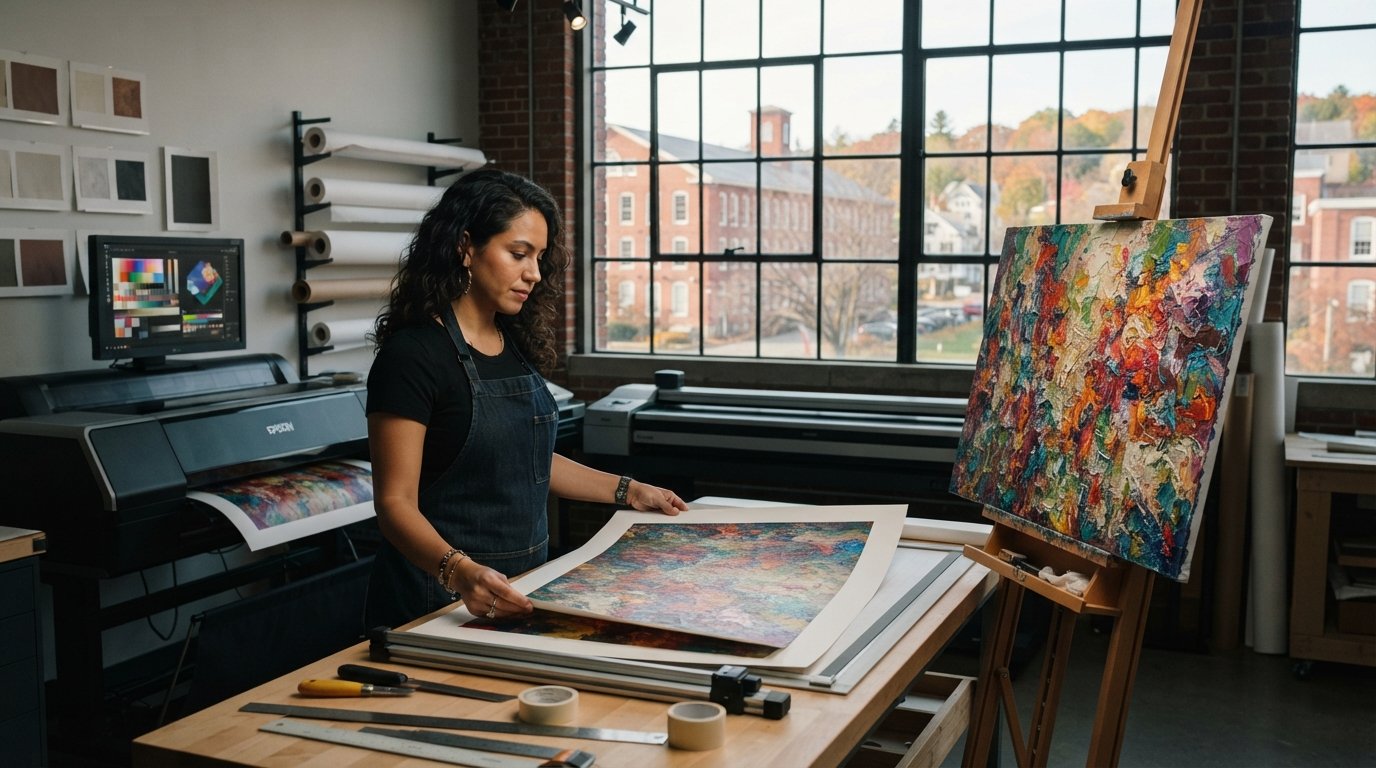
An anonymous web upload portal cannot translate the nuanced brushwork, depth, and tonal balance of an original painting. For creators across the Merrimack Valley and the North Shore, finding an experienced fine art print studio northern MA artists can visit in person offers the tactile, hands-on collaboration that distant labs simply can’t replicate.
You already know the frustration of unboxing print orders only to discover shifted hues, fragile paper stock, and flattened textures that fall short of gallery standards. Entrusting irreplaceable original artwork to a commercial parcel carrier or leaving color fidelity to uncalibrated monitors frequently leads to compromised results. You deserve a predictable, collaborative printmaker who treats your work with the exact same discipline and care you brought to the easel.
This guide demonstrates how to evaluate regional print studios for archival Giclée production, direct digital capture, and museum-grade custom framing under one roof. We outline critical equipment benchmarks, substrate permanence criteria, and the decisive quality advantages of attending personal proofing sessions right here in Northern Massachusetts.
Key Takeaways
- Learn how true archival Giclée printmaking differs from quick-print shops through multi-channel pigment systems and certified substrate permanence.
- Discover key technical benchmarks when choosing a fine art print studio northern MA artists can trust for wide-format production up to 60 inches wide.
- See why specialized capture systems like BetterLight linear scanning preserve edge-to-edge sharpness and surface texture far better than standard digital cameras.
- Explore the logistical advantages of managing high-resolution scanning, in-person proofing, and custom framing within a single regional production facility.
What Defines a Professional Fine Art Print Studio?
A true fine art print studio operates as a specialized production lab combining precision digital capture, certified archival printing, and museum-grade finishing. It serves as an exacting partner for painters, illustrators, and fine art photographers seeking limited-edition reproductions that mirror their original physical works. This work requires dedicated color science, archival materials, and controlled studio environments designed to protect artistic integrity.
Many commercial options fail to deliver this level of craftsmanship. The differences between production facilities dictate the longevity and commercial value of your prints:
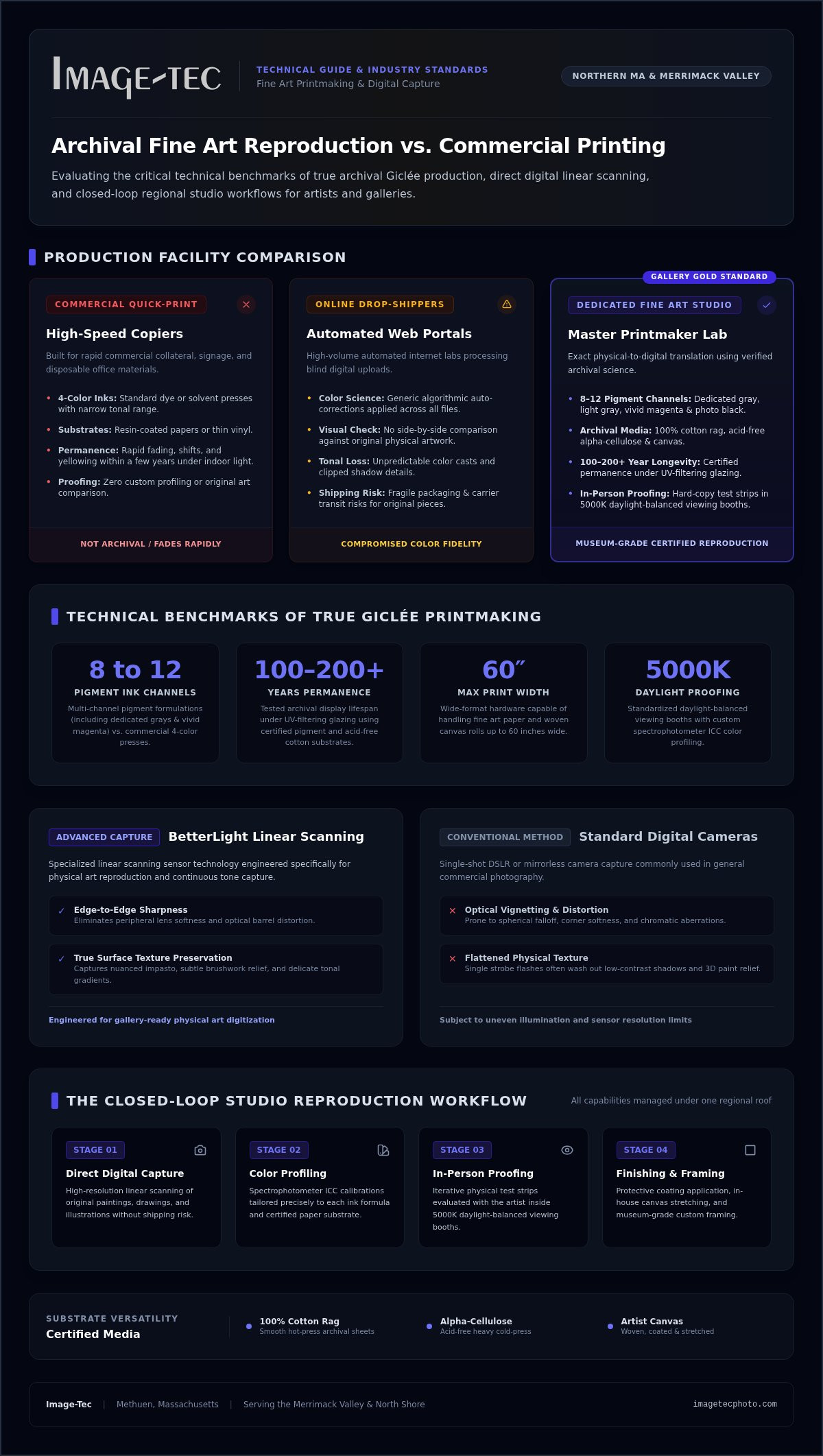
- Commercial Quick-Print Shops: These shops rely on high-speed digital copiers and four-color dye or solvent inks. They print on resin-coated papers or thin vinyl that degrade, fade, and yellow under modest indoor lighting within a few years.
- Online Drop-Shippers: High-volume internet labs process automated file uploads with algorithmic auto-corrections. They offer zero visual comparison against the original work, leading to clipped shadow details and unpredictable color casts.
- A Dedicated Fine Art Print Studio: A master printmaker evaluates the physical brushwork, sets custom color profiles for every media roll, and works directly with you through iterative physical test strips.
For artists working throughout the Merrimack Valley and the North Shore, finding a local fine art print studio northern MA painters can access in person keeps control firmly in their hands. It eliminates shipping hazards, protects delicate originals, and provides the rigorous standards necessary to satisfy private collectors and gallery curators.
The Core Technology Behind True Giclée Printing
True Giclée reproduction relies on high-density, multi-channel pigment ink systems. Unlike standard commercial four-color presses, these archival pigment systems utilize 8 to 12 distinct channels, including dedicated gray, light gray, vivid magenta, and photo black. This broad gamut allows the printer to render subtle tonal shifts and deep, rich blacks that hold detail in low-contrast areas. Paired with 100% cotton rag, acid-free alpha-cellulose papers, or premium artist canvas, these pigment formulations achieve tested display permanences exceeding 100 to 200 years under UV-filtering glazing.
Color Management, ICC Profiling, and Environmental Controls
Precision printmaking requires tightly managed ambient conditions. Professional studios generate custom ICC color profiles for every exact ink-and-paper combination using spectrophotometer readings. They evaluate physical test proofs inside dedicated 5000K daylight-balanced viewing booths, ensuring the light source reveals the print’s genuine chromatic fidelity against your original canvas. Studios also maintain stable temperature and humidity controls to prevent fine cotton paper fibers from expanding or contracting during high-resolution production runs.
Key Criteria for Selecting a Print Studio in Northern Massachusetts
Selecting the right production partner requires looking past generic consumer reviews and sign-shop marketing. A dependable printmaker operates with documented archival standards, specialized hardware, and transparent workflows. Clear warning signs include facilities that rely strictly on digital web forms, lack certified archival media, or cannot verify how their monitors align with physical output. Partnering with a dedicated fine art print studio northern MA artists can visit directly ensures your creative vision translates accurately to every finished piece.
Assessing Print Dimensions and Substrate Versatility
Production capacity begins with hardware scale. Look for facilities running wide-format fine art printers capable of handling fine art paper and canvas up to 60 inches wide. Breadth of media matters just as much as dimension. A professional studio stocks diverse surfaces, including smooth hot-press rag, heavy textured cold-press sheets, and woven canvas. Verify whether the studio applies protective coatings and performs canvas stretching in-house so finished reproductions remain durable for years.
Evaluating the Proofing and Collaboration Workflow
Digital displays lie. Even calibrated screens don’t fully simulate how room light interacts with physical paper textures. A master printer insists on producing physical, hard-copy test strips before running an entire edition. You need a collaborator who willingly adjusts tonal curves and shadow density alongside you at the viewing booth. Inquire about their master file archiving policies as well, which allow you to order subsequent limited-edition prints on demand with identical color fidelity.
Regional Accessibility Across Northern MA and Southern NH
Studio location plays a massive logistical role when transporting fragile, high-value art. Selecting a facility situated along major transit corridors like Interstate 93 and Route 495 saves valuable time and eliminates freight anxiety. Artists traveling from Newburyport, Andover, or Manchester can hand-deliver their originals without risking carrier damage or dealing with expensive transit insurance. To discuss your project workflow directly with an experienced regional team, connect with Image-Tec in Methuen to inspect material samples and review hard-copy proofs firsthand.
The Art Reproduction Process: From Original Painting to Finished Print
Translating an original physical artwork into a collection of exhibition-ready prints requires an orderly, multi-stage production pipeline. Rather than treating reproduction as an automated push-button task, a qualified fine art print studio northern MA painters rely on treats every phase as an exact craft. Precision across each step ensures the finished editions reflect the palette, depth, and tactile qualities of the original canvas.
- Intake and Surface Assessment: The printmaker inspects physical dimensions, varnish reflectivity, impasto thickness, and structural vulnerability.
- Digital Capture: The piece undergoes direct optical digitization using specialized lighting setups designed to eliminate surface glare while preserving texture.
- Mastering and Digital Proofing: Tonal curves, white points, and color densities are calibrated directly against the physical art to generate precise master files.
- Archival Media Printing: The final image is printed on acid-free cotton rag or premium canvas using multi-channel pigment inkjet equipment.
- Finishing and Preservation: Prints receive protective sealants, custom canvas stretching, or archival mounting.
Original Artwork Assessment and Surface Preparation
Every piece presents unique physical challenges. Heavy impasto oil paints, reflective gloss varnishes, and delicate watercolor papers cannot be treated identically. During initial intake, the studio evaluates fragile perimeter edges and plans proportional aspect-ratio scaling to prevent accidental composition cropping. Handling protocols ensure sensitive historic mediums and freshly cured originals remain pristine throughout the capture setup.
Color Correction and Master File Preparation
Raw digital captures demand meticulous finishing. Master printmakers balance micro-contrast and adjust individual hue channels under controlled 5000K lighting to mirror subtle pigment blends. Retouching technicians clean away environmental dust particles and unnatural specular reflections while keeping the painter’s intentional textural marks intact. The resulting uncompressed master TIFF files remain securely archived, ready for future gallery reprint requests without requiring repeat captures.
Finishing: Canvas Coating, Stretching, and Custom Framing
Fine art finishing seals and protects your investment. Canvas prints receive protective UV-inhibiting topcoats that safeguard delicate pigment layers against airborne humidity, handling scuffs, and ambient light exposure. Studios build sturdy wooden stretcher bars engineered to resist warping during humid New England summers. Consolidating printing with custom art framing in Methuen MA ensures that handling, matting, UV glazing, and presentation framing happen securely under one roof without unnecessary handoffs.
High-Resolution Art Capture: Why Scanning Technology Matters
Every exceptional Giclée reproduction begins with optical capture fidelity. If the initial digital file lacks tonal separation or introduces lens distortion, no amount of post-production editing can restore what was lost. Working with a dedicated fine art print studio northern MA painters rely on ensures your original work is digitized with purpose-built scanning hardware rather than general-purpose photographic gear.
Many general studios rely on standard handheld DSLRs or flatbed office scanners. These tools introduce significant compromises:
- Flatbed Scanners: These devices require placing original works face-down against glass. This creates friction risks for delicate pastels, charcoal, or wet varnishes, while their shallow depth of field leaves textured oil strokes soft and out of focus.
- Standard DSLR and Mirrorless Cameras: Single-exposure camera lenses suffer from optical field curvature and edge softness. Their sensors rely on Bayer-pattern interpolation, meaning neighboring pixels estimate color values rather than recording true optical RGB data.
- BetterLight Digital Scanning Backs: Mounted to large-format view cameras, these linear scanning systems move a tri-linear sensor smoothly across the focal plane. They record pure red, green, and blue data directly at every pixel location with uniform sharpness across the entire composition.
BetterLight Scanning vs. Standard DSLR Art Capture
Linear scanning technology eliminates the chromatic aberration, corner vignetting, and optical geometric distortion common in standard camera lenses. Because a BetterLight digital scanning back captures uncompressed, direct optical information, it records crisp brushwork and subtle tonal gradations without artificial digital sharpening artifacts. This level of resolution allows artists to scale their work into oversized editions without losing edge clarity. You can explore how this linear capture workflow integrates into professional art reproduction printing services for working painters.
Overcoming Common Digital Capture Challenges
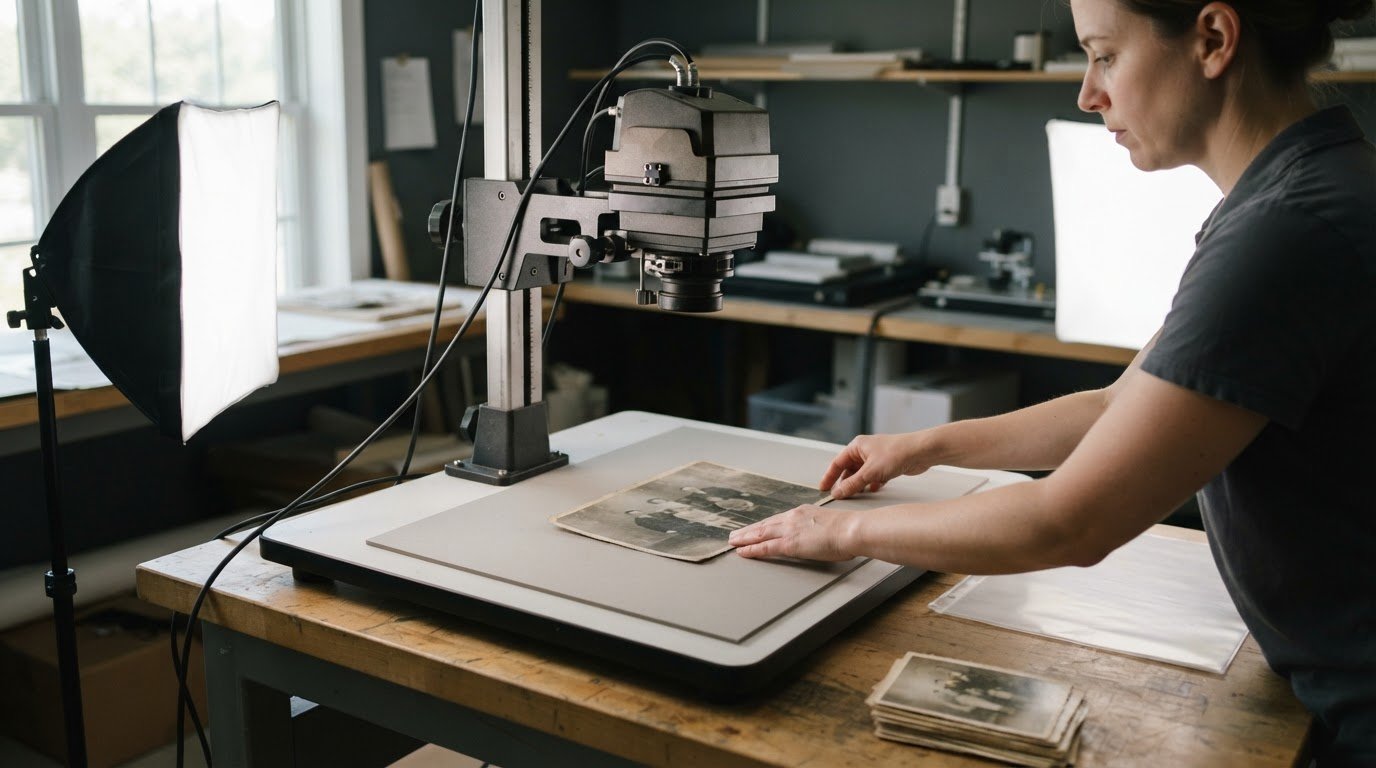
Capturing reflective artwork requires specialized illumination. Varnished oils, high-gloss acrylics, and metallic leafing cause specular glare that washes out underlying pigments. Professional studios deploy cross-polarized lighting configurations that extinguish surface reflection entirely, exposing the true pigment value beneath the sheen. Modulating continuous light angles lets technicians highlight intentional impasto knife work or soften distracting directional shadows. Fragile antique watercolors and heirloom photographs remain vertical and untouched during capture, preserving their physical structure. To capture your original work with this optical precision, schedule a capture consultation with Image-Tec.
Partnering with Image-Tec: Proven Printmaking and Reproduction in Methuen
Operating continuously since approximately 1994, Image-Tec serves as a dedicated regional resource for artists demanding uncompromising technical precision. Located in Methuen, Massachusetts, near the intersection of Interstate 93 and Route 495, the studio provides a central production hub for creators across Greater Boston, Newburyport, the North Shore, and Southern New Hampshire. Rather than coordinating across separate photographers, online print portals, and frame shops, artists work with an established team that manages every production phase under one roof.
Longevity matters in fine art reproduction. Decades of technical experience translate into deliberate handling of delicate originals, mastered color profiles, and predictable output. As an independent, full-service fine art print studio northern MA painters have relied on for generations, Image-Tec combines specialized infrastructure with personal, collaborative service on every project.
Comprehensive Reproduction and Large-Format Printing
Studio infrastructure includes wide-format pigment inkjet equipment capable of printing archival canvas and fine art paper up to 60 inches wide. This capability supports both standard gallery editions and ambitious exhibition installations. Artists can study the specifics of managing oversized media in our guide to large format fine art printing. Every run includes hands-on consultations, allowing artists to inspect physical proofs, confirm edge alignments, and approve canvas coatings before full production begins.
Custom Framing and Historical Image Restoration Under One Roof
Finishing original art and limited editions requires the same care as capture and printing. Image-Tec delivers complete in-house custom framing using acid-free mounting boards, museum-grade matting, and conservation glazing designed to protect prints from environmental contaminants and UV exposure. In addition to contemporary art reproduction, the studio provides historical image restoration, bringing faded, torn, or damaged archival family heirlooms and historical records back to life with optical fidelity.
Consolidating capture, printing, and framing eliminates handoffs between third parties, protecting your physical artwork from excessive handling and transit hazards. To discuss an upcoming edition run or review substrate options in person, Schedule a studio consultation with Image-Tec.
Bring Precision and Permanence to Your Next Edition
Producing gallery-grade limited editions requires true collaboration between artist and master printmaker. By moving past uncalibrated online upload portals, you gain the technical consistency of BetterLight digital scanning, custom ICC color management, and physical proofing under standard daylight illumination. Consolidating wide-format Giclée printing up to 60 inches wide with conservation custom framing protects your original artwork from shipping hazards while guaranteeing enduring quality on every run.
Serving Massachusetts and New England creators since circa 1994, Image-Tec provides the seasoned expertise and specialized infrastructure needed to reproduce your physical art faithfully. When you are ready to work with an established fine art print studio northern MA artists trust for exhibition standards, connect with the Image-Tec team in Methuen to discuss your next fine art print project. Your original work deserves craftsmanship that stands the test of time.
Frequently Asked Questions
What is the difference between a fine art Giclée print and a standard color print?
A fine art Giclée print utilizes archival pigment-based inks and 100% acid-free fine art papers, whereas standard color prints rely on dye-based inks on chemical photo paper or commercial copy sheets. Multi-channel pigment formulations deliver broad color gamuts and decades of fade resistance. Standard commercial prints quickly suffer from color shifts, paper yellowing, and optical degradation under normal ambient room lighting.
Can a fine art print studio reproduce textured oil or acrylic paintings without surface glare?
Yes, an experienced fine art print studio northern MA artists visit utilizes cross-polarized lighting paired with specialized digital capture systems to extinguish surface reflections. Gloss varnishes, metallic highlights, and heavy palette-knife impasto often create blinding glare under standard photographic strobes. By cross-polarizing the light source against the camera lens, the studio captures true underlying pigment values while maintaining the artist’s deliberate directional texture.
How should I transport my original artwork to a Northern MA print studio for scanning?
Transport original artwork wrapped securely in acid-free glassine paper, sandwiched between rigid sheets of foam core or corrugated cardboard. Never wrap raw bubble wrap directly against delicate paint layers or soft pastels. For artists driving from Boston, Newburyport, or Manchester NH, keeping flat pieces horizontal and cushioned inside your vehicle ensures they arrive at the Methuen facility safe and ready for capture.
What file resolution is required if I provide my own digital file for fine art printing?
Files submitted for production should ideally deliver a native resolution of 300 DPI at true 1:1 reproduction scale. While high-end pigment printers can produce acceptable results from 240 DPI files on textured cotton substrates, higher pixel density preserves fine micro-details and line definition. Submitting uncompressed 16-bit TIFF files in Adobe RGB or ProPhoto RGB color spaces ensures maximum dynamic range during the printing process.
How long do archival Giclée prints last compared to standard photo prints?
Archival Giclée prints produced with professional pigment inks on certified cotton rag substrates can last between 100 and 200 years without noticeable fading when displayed under UV-filtering glazing. Standard dye-based or solvent photo prints typically show noticeable fading and chromatic shifting within 5 to 15 years. Archival ratings require acid-free, lignin-free papers that resist atmospheric yellowing over time.
Is it better to frame a fine art print with regular glass or UV-filtering conservation glass?
UV-filtering conservation glass is always the superior choice for protecting fine art prints. Standard float glass shields art from surface dust but lets through harmful ultraviolet rays that break down pigment bonds over time. Conservation-grade glazing blocks up to 99% of incoming UV radiation. This level of protection prevents premature fading and color shifts, preserving your limited editions for decades on display.
Can an art reproduction studio print on both textured watercolor paper and stretched canvas?
Yes, a dedicated fine art print studio northern MA painters rely on routinely handles cold-press textured watercolor papers, smooth rag, and archival canvas. Equipment supports roll media up to 60 inches wide, giving creators immense flexibility in scale. Studios finish canvas reproductions with protective clear coats and custom wooden stretcher bars, while paper prints are prepared for museum-grade mounting and framing.





Leave A Comment
You must be logged in to post a comment.