

Is the fear of shipping your original canvas to a distant warehouse keeping your best work locked away in a private collection? It’s a common anxiety for New England creators who need professional art reproduction printing services but don’t want to risk their legacy in transit. You’ve likely found that standard digital scans often strip away the texture and color depth that define your style. This is especially frustrating when you’re attempting to scale up to large-format sizes over 40 inches, only to find the results look flat and uninspired.
We understand that your reputation depends on the quality of every edition you sell. This guide will show you how to transform your original artwork into museum-quality Giclée prints that are virtually indistinguishable from the source. We’ll explore the technical precision of BetterLight scanning, the necessity of archival-grade materials for longevity, and the benefits of working with a local partner who handles everything from capture to custom framing. By the end, you’ll have a clear roadmap for producing high-end reproductions that satisfy the most discerning collectors and preserve your artistic vision for decades.
Key Takeaways
- Learn why BetterLight scanning is the gold standard for capturing every brushstroke and texture of your original work without the distortion of standard photography.
- Understand the technical requirements for archival Giclée prints, including the critical difference between pigment-based and dye-based inks.
- Discover the logistical benefits of partnering with a local studio for art reproduction printing services to ensure the safety of your originals and the accuracy of physical proofs.
- Explore how to scale your portfolio with large-format canvas prints up to 60 inches wide and professional in-house custom framing.
- See how decades of technical experience in historical restoration translate into superior precision for your fine art reproductions.
The Anatomy of Professional Art Reproduction Printing Services
Art reproduction is the sophisticated technical process of digitizing and replicating an original work of art while maintaining absolute fidelity to the source. It’s more than a simple scan. It’s a bridge between the physical original and a digital edition. For many artists, moving from curiosity to selecting a partner for Giclée printing standards is a significant step toward commercial growth. This transition requires a shift in perspective from consumer-level convenience to professional-grade precision.
The process rests on two critical pillars: high-fidelity digital capture and archival-grade output. While consumer-grade inkjet printers have improved, they lack the precision, color gamut, and longevity required for professional gallery sales. Professional art reproduction printing services utilize specialized equipment and pigment-based inks that ensure a print remains vibrant for decades, often exceeding 100 years under proper conditions. This technical infrastructure is what allows a local studio to produce work that meets the demands of serious collectors.
The Workflow: From Canvas to Collector
A professional studio workflow begins with the physical original. We use specialized lighting and high-resolution sensors to capture every nuance of the artist’s hand. Once the digital file is created, we move into the color correction phase. This ensures the digital representation matches the physical painting exactly. A color-managed workflow is a systematic process where every device in the production chain, from the scanner to the monitor and the printer, is calibrated to ensure consistent and accurate color reproduction. Finally, the work is proofed on the intended substrate to verify the results before the final edition is produced.
Why Artists Invest in Professional Reproductions
Investing in high-quality reproductions allows artists to expand their revenue streams without parting with their original work. Limited edition prints make art accessible to a broader audience while the artist retains the master piece for exhibition or private sale. Professional services also ensure that every print meets the rigorous archival standards demanded by museums and serious collectors. This includes using acid-free papers and canvas that won’t yellow or degrade over time. By offering reproductions that are virtually indistinguishable from the original, artists build trust and value in their brand. It’s a practical strategy for long-term career stability. Just as professional art capture preserves a creator’s legacy, those celebrating major life milestones can check out Thomas Kim Photography for high-quality visual narratives that stand the test of time.
BetterLight Scanning: The Foundation of High-Resolution Capture
Many artists assume a high-end DSLR is sufficient for digitization. While modern cameras are impressive, they rely on a single moment of capture that often introduces lens distortion and chromatic aberration. Professional art reproduction printing services require a more methodical approach to ensure every pixel is accurate. BetterLight art scanning is a specialized digital capture technology that functions as a scanning back rather than a traditional camera. It moves a linear array sensor across the image plane, capturing pure data without the interpolation found in standard digital sensors.
This method differs fundamentally from flatbed scanning or standard photography. A flatbed scanner requires physical contact, which is risky for textured or fragile media. Conversely, a DSLR uses a “Bayer pattern” sensor that effectively guesses a large portion of the color data. BetterLight captures true red, green, and blue values for every single pixel. This results in a file with superior color depth and clarity, providing the perfect foundation for large-format output that remains sharp even when scaled up significantly. Artists seeking professional artwork scanning in Massachusetts will find that this level of technical precision is what separates a true digital twin from a mere photograph of a painting.
Texture and Detail: The BetterLight Advantage
Standard photography often flattens the physical presence of a painting. BetterLight captures the three-dimensionality of oil and acrylic works by recording the minute shadows and highlights of individual brushstrokes. This is achieved through a combination of the linear sensor and highly controlled studio lighting. Because the sensor moves in a consistent, linear fashion, it eliminates the “hot spots” and edge softness common in wide-angle lens photography. This level of detail is essential for creating Giclée prints that retain the tactile feel of the original canvas. It’s the difference between a flat image and a reproduction that feels alive.
Digitizing Oversized and Fragile Artwork
Size is often a barrier in the reproduction world. Most flatbed scanners are limited to standard document sizes, and many artists are rightfully wary of placing fragile work face-down on glass. Our studio setup allows for the digitization of oversized pieces up to 60 inches wide without any physical contact. This non-contact method is vital for preserving the integrity of delicate antique pieces or historical documents that might be damaged by traditional handling. If you’re curious about how your larger works can be accurately captured, you might explore our BetterLight art scanning options to see the precision firsthand.
Giclée Printing Standards: Achieving Archival Excellence
Professional Giclée printing is defined by three technical pillars: high-resolution digital capture, pigment-based archival inks, and acid-free substrates. While many consumer-grade “photo prints” rely on dye-based inks that fade when exposed to light, professional art reproduction printing services utilize pigment inks. These inks contain microscopic solid particles of color that sit on the surface of the paper or canvas, providing superior resistance to UV light and atmospheric contaminants. This choice is fundamental for artists selling to galleries or collectors who expect their investment to remain vibrant for generations.
Our studio specializes in large-format output, maintaining these rigorous standards for prints up to 60 inches wide. Scaling an artwork to this size requires not only the BetterLight scan discussed previously but also a printer capable of managing heavy-duty rolls of premium canvas or fine art paper without compromising color accuracy. We ensure that the ink-to-substrate bond is perfect, preventing the flaking or cracking that can occur with lower-quality materials during the stretching or framing process. This technical reliability is why established artists trust us with their most ambitious projects.
Canvas vs. Fine Art Paper: Choosing Your Substrate
Selecting the right material is a balance of aesthetic preference and the medium of the original work. Canvas is often the preferred choice for oil and acrylic reproductions because it mimics the texture of the original support. It provides a “painterly” feel that works exceptionally well for large-format displays. Conversely, cotton rag papers are the gold standard for watercolors, charcoal drawings, and fine-line illustrations. These papers provide a smooth or slightly textured matte finish that absorbs ink in a way that replicates the look of the artist’s original paper choice. We help artists in choosing the right canvas for large format prints to ensure the final product matches their creative intent.
Longevity and Archival Ratings
To be considered “museum-quality,” a reproduction must be printed on substrates that are both acid-free and lignin-free. Lignin is a natural component of wood pulp that causes paper to yellow and become brittle over time. By using 100% cotton rag or specially treated alpha-cellulose papers, we ensure the print remains chemically stable for decades. Under standard gallery lighting conditions, pigment-based Giclée prints on these archival materials have an expected lifespan of 100 to 200 years. This longevity is what distinguishes what is a giclee print from a temporary commercial reproduction, ensuring your legacy remains intact for future collectors.
Local Studio vs. Online Print Hubs: A Decision Framework
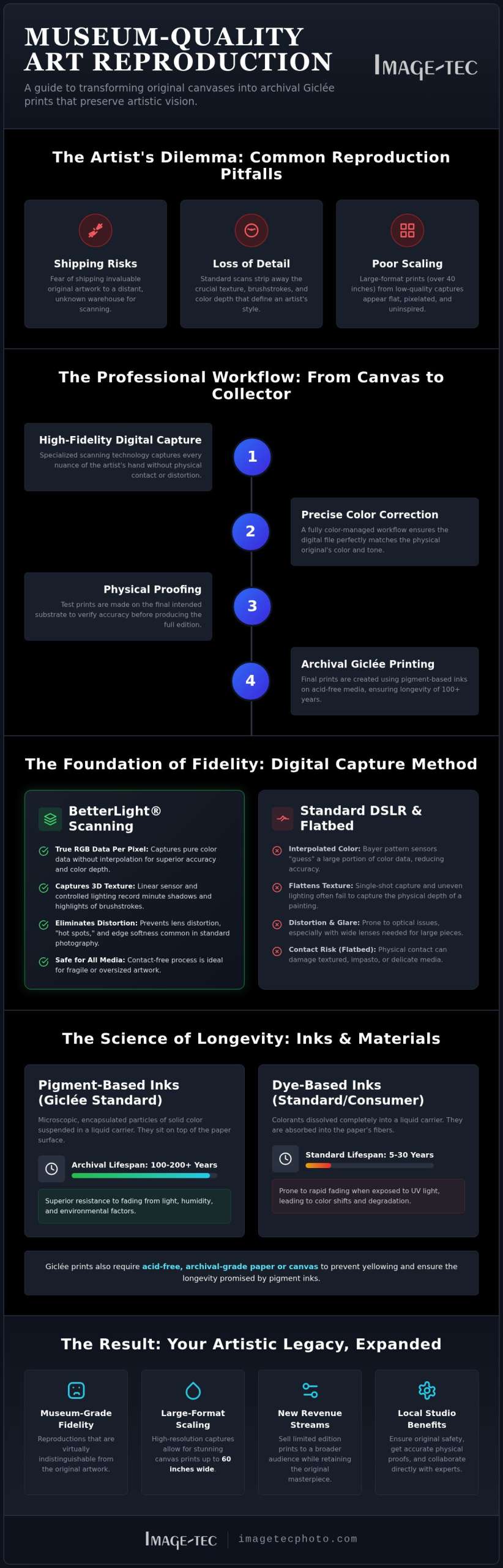
Choosing a partner for art reproduction printing services often comes down to a fundamental question of trust. Many artists feel a justified sense of anxiety when considering shipping their original work to a distant, high-volume warehouse. Online print hubs typically treat original artwork as a commodity, focusing on throughput rather than the nuance of individual pieces. In contrast, a local studio environment prioritizes the safety of your asset. You can hand-deliver your work, discuss its specific requirements in person, and eliminate the risk of damage or loss during transit. This face-to-face accountability is something a digital interface simply cannot replicate.
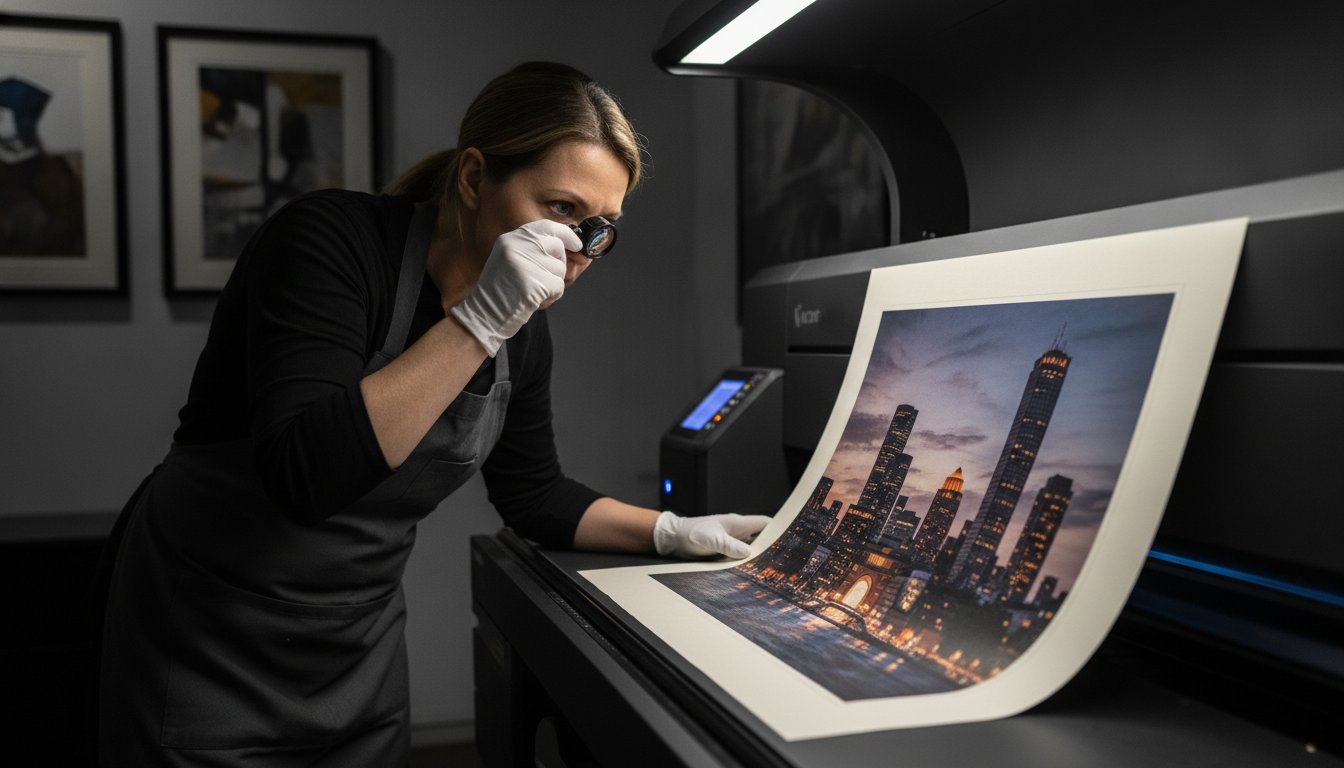
The “touch and feel” of local proofing is another critical differentiator. Online orders are often a “blind” process where you upload a file and hope for the best. If the color balance is off or the texture doesn’t meet your expectations, the correction process is slow and repetitive. By working with a local partner, you can review physical proofs on the exact substrate you’ve chosen. This allows for immediate, precise adjustments to the color-managed workflow before the final edition is printed. It’s a methodical approach that ensures the finished product aligns perfectly with your creative vision.
The New England Artist Advantage
Artists based in Methuen, Boston, Manchester NH, and Newburyport have a distinct logistical advantage. By sourcing your reproductions locally, you bypass the significant costs and risks associated with crating and shipping large-scale pieces. This is particularly vital for oversized works up to 60 inches wide, which require specialized handling and expensive freight services if sent long distances. Building a long-term relationship with a local master printer creates a shorthand for quality and consistency. We understand your portfolio, your preferred color palettes, and the specific standards of the New England galleries where you exhibit. Artists and brands in the region who also require high-end visual assets for marketing or product launches will find that working with a commercial photography studio near Boston that integrates advanced capture technology with expert production offers the same commitment to technical excellence and brand consistency.
Integrated Services: Restoration and Framing
Efficiency in art production is found when you can manage the entire lifecycle of a project in one location. Our studio doesn’t just offer scanning and printing; we provide a comprehensive suite of services that includes custom framing and historical image restoration. This integrated approach means your artwork never has to leave a secure, climate-controlled environment. Whether you are preparing a new series for a solo show or need to restore a delicate family archive, having these capabilities under one roof ensures technical continuity. If you’re ready to see how professional handling can elevate your portfolio, we invite you to explore our reproduction services today.
A finished print is only complete once it’s properly presented. Understanding the 5 Benefits of Custom Framing for Fine Art Prints can help you make informed decisions about how to protect and showcase your work. From selecting acid-free mounting materials to choosing the right glass for UV protection, a local consultation provides the expertise needed to turn a high-quality print into a gallery-ready masterpiece.
The Image-Tec Approach to Fine Art Reproduction
Image-Tec has served as a cornerstone for the New England creative community since 1994. Our studio was founded on the principle that technical excellence should never be a barrier to an artist’s commercial success. Over more than three decades, we’ve refined a methodical approach that combines high-end infrastructure with seasoned, master-level craftsmanship. Our art reproduction printing services aren’t just about operating machinery. They’re about providing a stable, reliable partnership for artists who require their editions to meet the highest gallery standards. When you bring your work to our Methuen studio, you’re benefiting from decades of experience in color science and substrate behavior.
We believe that longevity is the ultimate proof of quality. This commitment is reflected in our choice of archival-grade materials and our investment in the “gold standard” of capture technology. By maintaining a controlled, professional environment, we ensure that every project, whether it’s a single oversized canvas or a limited edition run of fine art prints, receives the same level of technical scrutiny. Our role is to act as a trusted guide, helping you navigate the complexities of digitization and production so you can focus on your creative practice.
Custom Solutions for Professional Artists
Every medium presents unique challenges during the reproduction process. A subtle watercolor requires a different scanning profile and paper selection than a high-contrast acrylic painting. We tailor our scan resolution and print settings to the specific characteristics of your original work. This personalized approach includes dedicated artist proofing sessions where we review color accuracy and detail together. This collaborative step is vital for ensuring the final Giclée print captures the intended mood and depth of your portfolio. If you’re ready to begin your first edition, you can schedule a consultation at our Methuen studio to discuss your specific needs.
Preserving History through Digital Restoration
Our expertise extends beyond contemporary art into the specialized field of historical image restoration. We combine the precision of BetterLight art scanning with advanced digital restoration skills to save damaged, faded, or fragile historical images. This process allows us to preserve family archives and historical documents for future generations without risking the physical integrity of the original item. By applying the same archival standards to restoration that we use for fine art, we ensure these recovered images remain stable for another century. You can learn more about our Art Reproduction Services and how we help preserve both modern legacies and historical records.
Elevating Your Portfolio for the Next Generation
Mastering the art of reproduction is a strategic investment in your professional legacy. By prioritizing high-resolution BetterLight scanning and archival Giclée standards, you ensure that every edition you release maintains the integrity of your original vision. Transitioning from one-off sales to a scalable print model requires a partner who understands the technical nuances of color management and substrate behavior. It’s about more than just making a copy. It’s about creating an archival asset that holds its value for collectors.
Choosing professional art reproduction printing services shouldn’t involve the anxiety of shipping your best work across the country. Working with a local studio in Methuen allows you to benefit from in-person proofing and master-level expertise. Whether you’re producing large-format canvas works up to 60 inches wide or seeking precise historical restoration, the right technical foundation makes all the difference. We invite you to View our Art Reproduction and Giclee Printing Services and discover how our integrated scanning and custom art framing in Methuen, MA can support your growth. Your work deserves a reproduction process as deliberate and refined as your creative process itself.
Frequently Asked Questions
What is the difference between art scanning and regular photography?
Art scanning uses a linear array sensor that captures pure data without the distortion common in standard camera lenses. Regular photography relies on a single-point perspective that often misses subtle textures and color depth. Our BetterLight system ensures every pixel reflects the true pigment of the original. This technical precision is essential for professional art reproduction printing services where gallery-quality fidelity is the primary goal.
How large can you reproduce my original painting?
We can produce canvas and fine art prints up to 60 inches wide. Because we capture the original using high-resolution BetterLight technology, the digital files contain enough data to scale your work significantly without losing sharpness. This capability allows artists to offer oversized statement pieces for commercial or residential installations while maintaining the archival standards expected by serious collectors and museum curators.
Will my original artwork be safe during the scanning process?
Your artwork remains entirely safe because our BetterLight capture is a non-contact process. Unlike flatbed scanners that require placing work face-down on glass, our studio setup digitizes the piece while it is securely mounted on an easel. This eliminates the risk of physical abrasion or pressure. Since we are a local studio, you also avoid the logistical dangers of shipping your original canvas to a distant facility.
What is a Giclée print and why is it better than a standard print?
A Giclée print is a museum-quality reproduction created using pigment-based inks on acid-free, archival substrates. Standard prints typically use dye-based inks and non-archival papers that are prone to fading and yellowing over time. The Giclée process offers a wider color gamut and superior longevity. This makes it the industry standard for artists who want to sell limited edition prints that meet rigorous gallery requirements for durability.
How long do archival Giclée prints last before fading?
Under proper gallery or residential conditions, archival Giclée prints are rated to last between 100 and 200 years. We use pigment-based inks and 100% cotton rag or acid-free canvas to ensure this level of permanence. These materials are chemically stable and resist the UV damage that causes standard prints to degrade. This lifespan ensures that your reproductions remain a lasting and valuable part of a collector’s portfolio.
Can you reproduce artwork that is already framed?
We generally recommend removing the artwork from the frame to achieve the highest quality capture. Glass or acrylic can create reflections and glare that interfere with the scanning sensor’s ability to record fine detail. However, if the piece is extremely fragile, we can assess it in our Methuen studio to determine if a specialized capture is possible. Our in-house custom framing service can then professionally reassemble or upgrade the presentation.
Do I need to provide a digital file, or can you scan the original?
We can work with either, but scanning the original in our studio provides the most accurate results. Most artist-provided digital files lack the resolution or color calibration necessary for high-end art reproduction printing services. By performing a professional BetterLight scan, we control the lighting and color-managed workflow from the start. This ensures the final print is a faithful and professional representation of your physical original.
How do I prepare my artwork for a professional scan?
Ensure the original is clean and free of loose dust or debris before bringing it to the studio. If the work is an oil or acrylic painting, it should be completely dry to prevent any surface damage during handling. For works on paper, keeping them flat rather than rolled helps avoid permanent creasing. We handle the technical aspects of alignment and lighting once the piece arrives at our climate-controlled production space in Methuen.




Leave A Comment
You must be logged in to post a comment.