
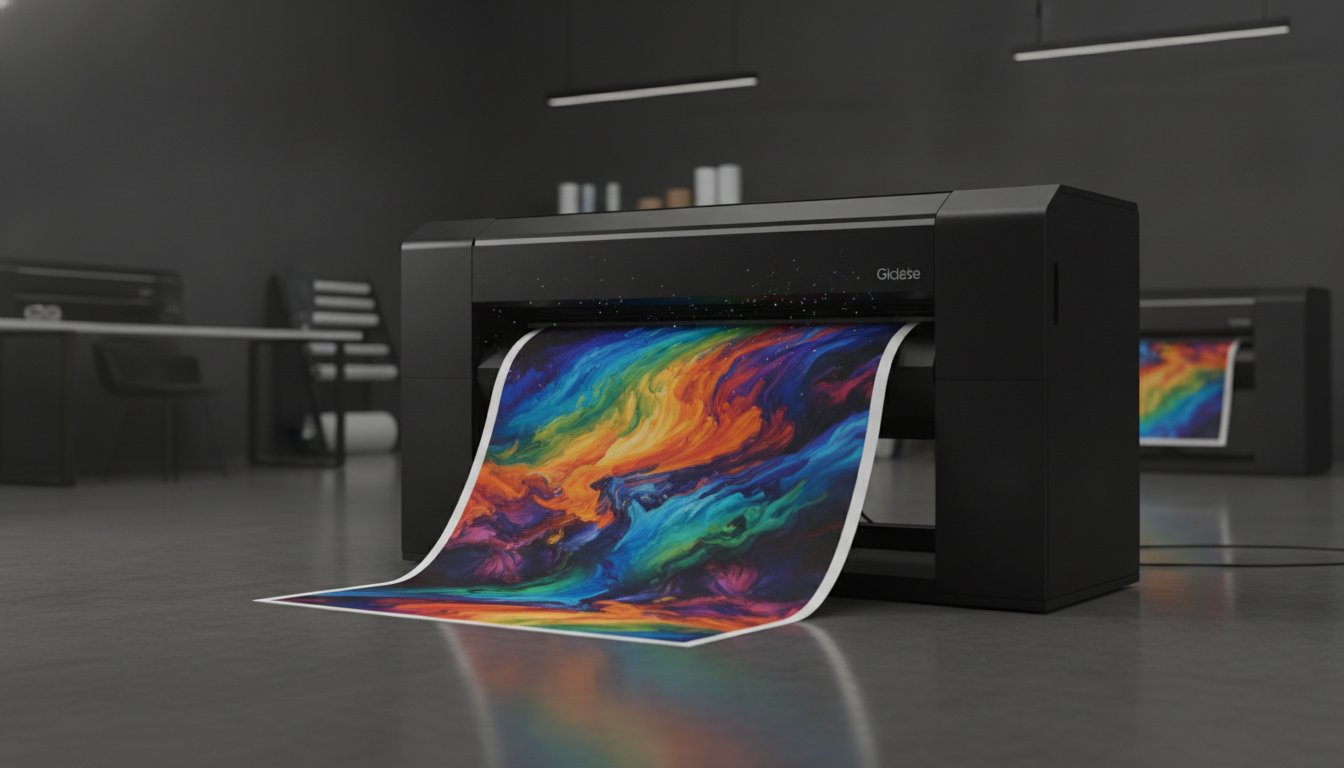
A common misconception in the art world is that any high-quality inkjet output qualifies as a fine art reproduction. If you’ve ever wondered exactly what is a giclee print, you likely understand that true archival quality requires more than just a standard office setup. For artists and collectors, the stakes are high. There’s a legitimate fear that a beautiful reproduction might lose its depth or begin to yellow within just a few years. You want your work to endure, yet the technical gap between a home printer and a professional studio often feels vast.
We believe a reproduction should be as resilient as the original masterpiece. This expert guide explores the technical requirements, archival benefits, and lasting value that define the Giclée standard. We’ll clarify the essential differences between pigment and dye-based inks while explaining why acid-free substrates are non-negotiable for longevity. You’ll also discover how specialized scanning technology captures the finest textures of a physical painting for digital output. This methodical overview provides the clarity you need to move forward with your next project with absolute confidence.
Key Takeaways
- Learn exactly what is a giclee print and why it requires high-resolution files of at least 300 DPI to meet professional archival standards.
- Understand the critical difference between standard dye inks and archival pigment inks, which can preserve artwork for up to 200 years.
- Discover how a 10-12 color printing process achieves a wider gamut and smoother transitions than traditional four-color CMYK methods.
- Identify why high-end reproductions must begin with BetterLight scanning to capture every brushstroke and texture without the glare of standard photography.
- Gain practical insights on how to verify print authenticity and the benefits of utilizing custom framing for a complete, gallery-ready solution.
Defining the Giclée Print: Beyond the Standard Inkjet
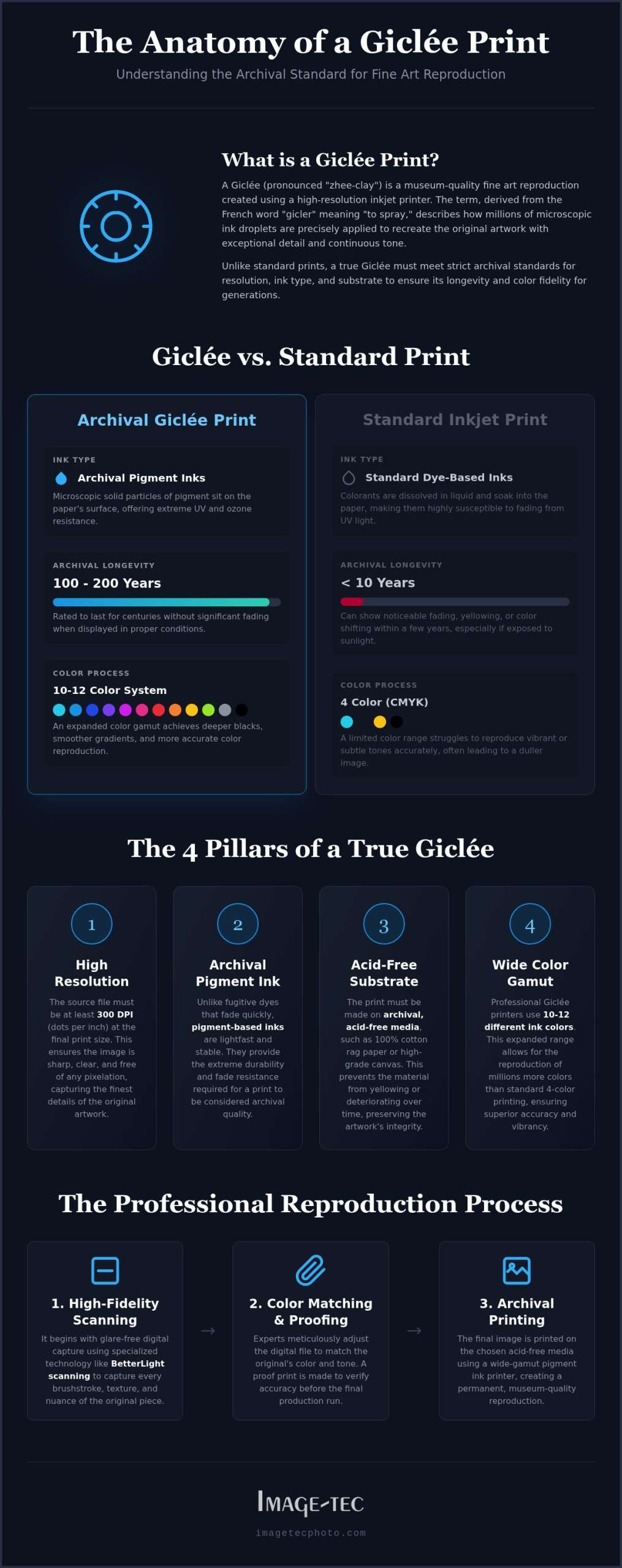
A Giclée print is a high-resolution archival reproduction that utilizes specialized inkjet technology to achieve museum-quality results. While the term is sometimes used loosely in consumer circles, a true Giclée must adhere to strict technical standards regarding resolution, ink chemistry, and the acidity of the substrate. When artists and collectors ask what is a giclee print, they are generally looking for a product that bridges the gap between digital precision and traditional fine art longevity. These prints are widely accepted by global galleries and institutions as the professional standard for reproducing original paintings and photography.
The term Giclée printing was coined in 1991 by Jack Duganne; it is derived from the French word “gicler,” which translates to “to spray” or “to squirt.” This etymology describes how the printer’s microscopic nozzles apply millions of droplets of pigment-based ink onto the paper or canvas. Unlike the visible halftone dots found in standard commercial printing, this process creates a continuous tone. It effectively mimics the fluid appearance and depth of an original work, making it difficult to distinguish the reproduction from the source material without close inspection.
The History and Evolution of the Process
The process evolved from the Iris printer, a machine originally designed for prepress proofing in the early 1990s. Artists quickly realized the potential for high-fidelity output on traditional art papers, which sparked a shift in how limited editions were produced. Today, the industry has transitioned to modern large-format pigment printers. These machines offer a significantly wider color gamut and better stability than their predecessors. This technological leap has empowered artists to create high-fidelity limited editions that maintain their integrity across every numbered print in a series.
Why Artists and Collectors Choose Giclée
Professional artists favor this method for its unrivaled color accuracy and practical benefits. Understanding what is a giclee print involves recognizing these three core advantages:
- Precision: Modern Giclée systems use 10 to 12 individual colors to replicate complex palettes that traditional lithography often misses.
- Efficiency: The ability to print on demand allows artists to produce work as it sells, reducing the financial risk of large, unsold inventories.
- Permanence: When produced on acid-free paper with pigment inks, these reproductions are rated to last 100 years or more in gallery conditions without significant fading.
This combination of technical excellence and logistical flexibility makes the Giclée the preferred choice for those who value both craft and commercial viability. It provides a reliable way to share art with a wider audience while maintaining the spirit of the original creation.
The Four Technical Pillars of Archival Giclée Printing
A Giclée isn’t just a category; it’s a technical specification. To understand what is a giclee print, you must look at the specific standards that differentiate it from consumer-grade output. These pillars ensure the reproduction remains faithful to the artist’s vision while providing the longevity collectors expect. Without adhering to these four requirements, a print is simply a high-quality inkjet, not a professional Giclée.
The first pillar is resolution. High-resolution source files are the foundation of any successful reproduction. The industry standard requires a minimum of 300 dots per inch (DPI) at the final print dimensions. This level of detail ensures that even when scaled up, the image remains sharp and free of pixelation. This precision is especially important for large-format works where every brushstroke must be clearly visible.
Pigment vs. Dye-Based Inks: The Longevity Factor
Standard desktop printers often use dye-based inks. These consist of colorants dissolved in a liquid. While vibrant initially, these inks soak into the paper fibers and are highly susceptible to UV degradation, often fading within a decade. In contrast, professional Giclée printing utilizes pigment-based inks. These contain microscopic particles of ground minerals that sit on the surface of the substrate. This composition provides extreme durability and resistance to light. As noted in this guide on Everything You Need to Know About Giclee Prints, these pigment systems are what allow a print to achieve archival status. Our studio utilizes advanced multi-channel ink systems, often featuring 8 to 12 colors, to manage these pigments. This results in superior gradients and a color depth that standard CMYK printers cannot match.
Archival Substrates: Paper and Canvas Quality
The choice of material is just as critical as the ink. True Giclée prints require substrates that are 100% acid-free and pH neutral to prevent yellowing or “burning” over time. Professional grade papers are typically made from cotton rag or alpha-cellulose rather than wood pulp. It is also vital to avoid optical brighteners (OBAs). These are chemicals that make paper look whiter but can break down and cause discoloration. For those producing large-scale works, we offer canvas prints up to 60 inches wide, providing a robust and tactile surface for expansive reproductions. If you are unsure which material best suits your work, our team can help you select the ideal archival substrate for your specific project. Establishing what is a giclee print ultimately comes down to these rigorous technical benchmarks, ensuring each piece is gallery-ready.
Giclée vs. Standard Prints: Why Quality Matters for Your Art
Determining what is a giclee print versus a standard inkjet comes down to visible quality and measurable endurance. Standard commercial prints usually rely on a four-color CMYK process, which is effective for high-volume marketing materials but lacks the nuance required for fine art. Giclées utilize 10 to 12 individual color channels. This expanded palette allows for a much broader color gamut, capturing subtle shifts in hue that a standard printer simply cannot replicate. While a standard print may begin to show noticeable fading within five to ten years, a Giclée is rated to maintain its integrity for 100 to 200 years under gallery conditions.
Another defining characteristic is the continuous tone effect. Cheaper printing methods use halftone screens, which create images using patterns of tiny, visible dots. Professional Giclée technology sprays ink in such a refined manner that these dot patterns are eliminated. This results in a smooth, fluid appearance that mirrors the transitions found in original oil or watercolor paintings. For collectors, this museum-grade status is vital; it ensures the reproduction retains its aesthetic and financial value over time.
The Color Gamut Advantage
The sophisticated ink systems used in our studio capture “impossible” colors that fall outside the range of traditional lithography. Deep, saturated oranges and vibrant teals are rendered with striking accuracy. We manage this through a precise RGB color space workflow, which preserves the digital file’s original vibrancy throughout the production process. This level of control is essential for reproducing the heavy textures of palette-knife oil paintings or the delicate, transparent washes of a watercolor. It ensures the final output isn’t just a copy, but a faithful representation of the artist’s intent.
Museum Standards and Archival Certification
For a reproduction to be considered “museum quality,” it must pass rigorous testing by independent labs. Organizations like Wilhelm Imaging Research provide the data that verifies the lightfastness and stability of specific ink and paper combinations. This technical superiority is why institutions prioritize archival fine art prints for their permanent collections. Professional framing serves as the final step in this preservation process. By utilizing UV-protective glazing and acid-free mounting, we create a sealed environment that protects the print from environmental pollutants and light damage. When you understand what is a giclee print in this context, it’s clear that the investment supports both the artist’s legacy and the collector’s peace of mind.
How to Identify and Care for Authentic Giclée Prints
Identifying a true Giclée requires an eye for technical detail. While the definition of what is a giclee print focuses on the production process, the physical characteristics of the final product reveal its quality. A professional reproduction should possess a weight and texture similar to the original substrate. If the work was originally on heavy cotton rag, the Giclée should feel substantial and tactile, not flimsy or overly smooth like a standard photo print.
When inspecting a piece, use a magnifying glass to look for smooth transitions. Standard commercial prints utilize halftone screens that create visible dot patterns. In contrast, an authentic Giclée features a continuous tone where colors blend seamlessly. You should also verify the studio’s credentials. A reputable partner will be transparent about using industrial-grade printers with 8 to 12 color channels and archival pigment inks. If a studio cannot specify their ink type or paper brand, the print may not meet archival standards.
Best Practices for Handling Fine Art Prints
Handling fine art requires a methodical approach. Always use white cotton gloves to prevent skin oils and acids from marking the pigment. These oils can lead to permanent staining or chemical degradation over time. When displaying the work, avoid direct sunlight and high-humidity environments like bathrooms or kitchens. Standard glass offers little protection; only UV-protective glazing should be used for high-value Giclées to shield the minerals in the ink from light damage. For long-term storage, use acid-free interleaving tissue to prevent ink transfer between stacked pieces.
Limited Editions and Certificates of Authenticity
Artists often use Giclée technology to create numbered limited editions, which adds market value and exclusivity to the reproduction. Each piece should be accompanied by a Certificate of Authenticity (COA). A valid COA includes the artist’s name, the image title, the edition number, and the specific paper and ink brands used. You may also encounter “Artist’s Proofs” (APs). These are the first prints produced to verify color accuracy. APs are typically limited to 10% of the total edition size and often command a higher price due to their role in the creative process. Understanding what is a giclee print in the context of the art market helps collectors recognize the value of these authenticated series.
Protecting your investment is just as important as the print itself. You can ensure the longevity of your collection by choosing professional custom framing designed specifically for archival preservation.
The Image-Tec Difference: From BetterLight Scanning to Finished Frame
A fundamental oversight in many discussions regarding what is a giclee print is the quality of the initial digital capture. The finest archival printer in the world cannot compensate for a low-resolution or poorly lit scan. While standard desktop scanners and traditional photography often struggle with glare and color distortion, our studio utilizes a specialized approach to preserve the integrity of the original work. This phase is where the technical standard of a Giclée is truly established, ensuring the digital file contains every nuance of the physical masterpiece.
Standard flatbed scanners often fail fine art by flattening the physical texture of the paint and losing detail in the shadows. We address this through our BetterLight scanning technology, which functions as a large-format digital camera system. This process allows us to produce museum-grade canvas prints up to 60 inches wide, ensuring that even large-scale works are reproduced with absolute clarity. By focusing on the “input” as much as the “output,” we provide a level of fidelity that generic printing services simply cannot match.
BetterLight Scanning: The Ultimate Art Capture
BetterLight scanning captures 100% of the color data from original oil paintings and watercolors. Unlike traditional digital photography, which can suffer from lens distortion or uneven lighting, this scanning method moves a high-resolution sensor across the artwork. This eliminates digital noise and artifacts, which is critical for ultra-crisp large-scale enlargements. By utilizing professional studio lighting, we preserve the “soul” of the work, capturing every brushstroke and the specific nuances of the artist’s technique. This high-fidelity input is the essential first step in defining what is a giclee print at a professional level.
A Complete Solution for New England Artists
We’ve served as a local pillar for the New England art community since 1994, providing technical expertise from our studio in Methuen, MA. Our services extend beyond the print itself to include in-house custom framing. This ensures your Giclée prints are protected and ready for gallery display immediately. We take pride in being a trusted partner for artists in Boston, Manchester NH, and Newburyport, offering a steady and reliable reproduction process that prioritizes technical excellence. Whether you’re reproducing a single heirloom or a full limited edition series, we have the infrastructure to manage your project with precision. Start your art reproduction project with Image-Tec today to experience the difference that professional scanning and archival printing can make for your portfolio.
Preserving Your Artistic Legacy with Professional Standards
Understanding what is a giclee print empowers you to make definitive choices for your portfolio’s future. It’s a technical marriage of high-fidelity digital capture, archival pigment inks, and pH-neutral substrates. These standards work together to ensure your work remains lightfast and vibrant for decades. By adhering to these museum-grade requirements, you preserve both the aesthetic integrity and the market value of your reproductions.
Image-Tec offers the technical infrastructure and seasoned expertise required to deliver these results. We utilize BetterLight high-resolution scanning to capture every brushstroke, producing fine art and canvas prints up to 60 inches wide. Based in Methuen, our studio has served as a reliable pillar for the New England art community since 1994. We complement our printing with custom framing and restoration services to provide a complete, professional solution. We invite you to Request a Quote for Professional Giclée Printing at Image-Tec and begin your next project. Your creative vision deserves a reproduction standard that stands the test of time.
Frequently Asked Questions
Is a Giclée print just an inkjet print?
Technically, a Giclée is a type of inkjet print, but it must meet specific archival criteria to earn the name. While a standard inkjet uses dye-based inks and non-archival paper, a Giclée requires pigment inks and acid-free substrates. It also relies on a higher resolution of at least 300 DPI. These technical standards define what is a giclee print and ensure it’s suitable for professional gallery sales.
How long do Giclée prints last before fading?
Professional Giclée prints are rated to last between 100 and 200 years when stored under gallery conditions. This longevity depends on the combination of pigment-based inks and acid-free, pH-neutral papers. Unlike standard prints that might yellow or fade within a decade, these archival reproductions resist UV degradation and environmental pollutants. Proper framing with UV-protective glass is essential to reaching these maximum lifespan estimates in a home or office environment.
Why are Giclée prints so expensive compared to standard prints?
The cost reflects the premium materials and specialized labor involved in the process. Archival pigment inks and 100% cotton rag papers are significantly more expensive than standard commercial supplies. Additionally, the process includes high-resolution scanning and meticulous color matching by a technician. When you consider what is a giclee print in terms of durability, you’re investing in a product designed for longevity and professional-grade fidelity rather than a disposable copy.
Can I make a Giclée print from a photograph?
You can certainly produce a Giclée from a digital photograph as long as the file meets the resolution requirements. The term describes the printing process and material quality rather than the original medium. Photographers often choose this method to create limited edition prints on textured fine art papers or canvas. It provides a depth and color range that standard photographic silver halide or dye-sublimation prints simply can’t achieve.
What is the best paper for a Giclée print?
The best paper depends on the original artwork’s texture, but it must be 100% acid-free and pH-neutral. Common choices include cotton rag or alpha-cellulose papers from reputable brands like Hahnemühle or Epson Archival. For watercolors, a textured cold-press paper is often ideal, while detailed photography might benefit from a smooth, semi-gloss surface. We always recommend avoiding papers with optical brighteners to ensure the print doesn’t yellow or change over time.
Do Giclée prints increase in value over time?
A Giclée print’s value is primarily tied to the artist’s reputation and the edition’s scarcity. While the print itself is a high-quality reproduction, it doesn’t automatically appreciate like an original painting. However, limited edition Giclées that are signed and numbered often hold their value better than open-edition prints. Collectors value them because the archival standards guarantee the piece will remain in excellent condition for future resale or display in a collection.
What size can a Giclée print be?
Giclée prints can range from small postcards to expansive large-format works. Our studio produces prints up to 60 inches wide on various substrates, including canvas and fine art paper. The primary limiting factor is the resolution of the original digital capture. If the source file was created using high-end technology like BetterLight scanning, it can be enlarged significantly without losing the sharp detail or texture found in the original piece.
Is Giclée better than lithography for art reproduction?
Giclée offers several advantages over traditional lithography, particularly for smaller runs and color accuracy. It allows for “print on demand,” which eliminates the high setup costs of creating lithographic plates. This makes it more accessible for independent artists. Additionally, the 10-12 color ink systems used in Giclée printing provide a wider color gamut than the standard four-color process used in most lithography. It’s the modern choice for precision.






Leave A Comment
You must be logged in to post a comment.