
Most standard digital captures fail the artist’s eye because they treat texture as an afterthought. You’ve likely felt the frustration of seeing a vibrant, tactile painting flattened into a dull, color-shifted file that loses the subtle nuance of your brushwork. It’s disheartening to spend weeks on a masterpiece only to have a standard scan strip away its depth and vibrancy. We understand that for a professional artist, a digital reproduction isn’t just a copy; it’s a legacy that must mirror the original’s integrity without compromise.
This guide explains how professional art scanning Methuen services utilize specialized BetterLight technology to preserve every pigment grain and linen thread. You’ll discover the technical superiority of linear digital capture and how it ensures your original work remains safe while producing museum-quality Giclée prints. We will walk through the methodical process of creating a digital file that’s indistinguishable from your original painting. By focusing on precision and technical excellence, you can secure the high-resolution files needed to share your work with the world in 2026 while maintaining the highest standards of craftsmanship.
Key Takeaways
- Understand why BetterLight linear CCD technology outperforms standard DSLR photography by eliminating lens distortion and chromatic aberration in your digital captures.
- Learn the specific steps to prepare your portfolio for professional art scanning Methuen to ensure the safest handling and most accurate reproduction of your original work.
- Discover how to achieve a digital file that captures the true depth of your brushstrokes and pigment details, making it suitable for museum-quality Giclée prints up to 60 inches wide.
- Identify the common pitfalls of flatbed scanners and why high-resolution data capture is fundamentally different from simply taking a high-resolution photograph.
- Explore the advantages of a full-service local studio that integrates high-end scanning with archival printing and custom framing for a seamless reproduction workflow.
The Critical Role of Professional Art Scanning in Fine Art Reproduction
For a professional artist, the transition from a physical canvas to a digital file is a high-stakes moment. Many creators initially attempt to use high-resolution DSLR photos or consumer-grade flatbeds, but these tools often fail to capture the nuances of professional work. Professional art scanning Methuen isn’t just about taking a picture; it’s about the systematic recording of raw data. While standard Image Scanner Technology found in home offices uses basic sensors designed for documents, a professional studio environment uses specialized equipment to document the specific spectral values of every brushstroke.
This rigorous capture process is essential for high-quality Giclée printing. Without a high-fidelity scan, the final output on canvas or fine art paper will lack the vibrancy of the original. Our studio’s 30 years of experience serving the New England art community has shown that the quality of the scan dictates the success of every subsequent step. A precise digital file serves as a permanent archival record, ensuring that your work’s legacy remains intact even after the original piece has moved to a private collection. Professional art scanning Methuen provides the technical foundation required to scale your work for gallery-sized prints while maintaining the integrity of the original medium.
Understanding Color Gamut and Pigment Accuracy
Professional-grade sensors are designed to handle the complex pigments found in artist-grade paints. Consumer cameras often struggle with specific hues, leading to a “compressed” look where subtle color shifts are lost. Standard digital sensors often clip vibrant reds or deep blues, resulting in a flat reproduction that lacks life. By implementing rigorous color management profiles, we ensure that the digital file matches the original work exactly. This precision prevents the need for expensive, manual color corrections during the printing stage, which can often be a frustrating and costly experience for artists. It’s much more efficient to capture the correct data at the start than to attempt to fix inaccurate colors later.
Capturing Texture: Beyond Simple Resolution
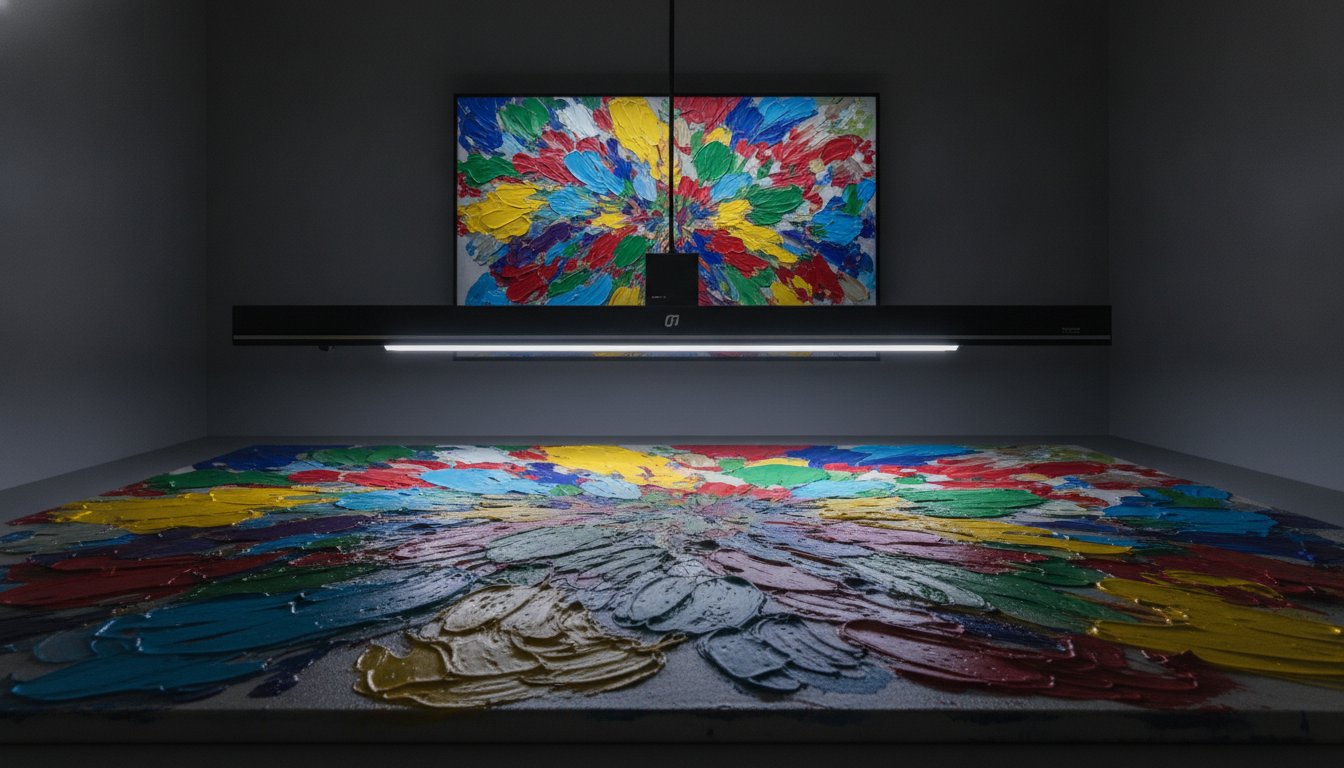
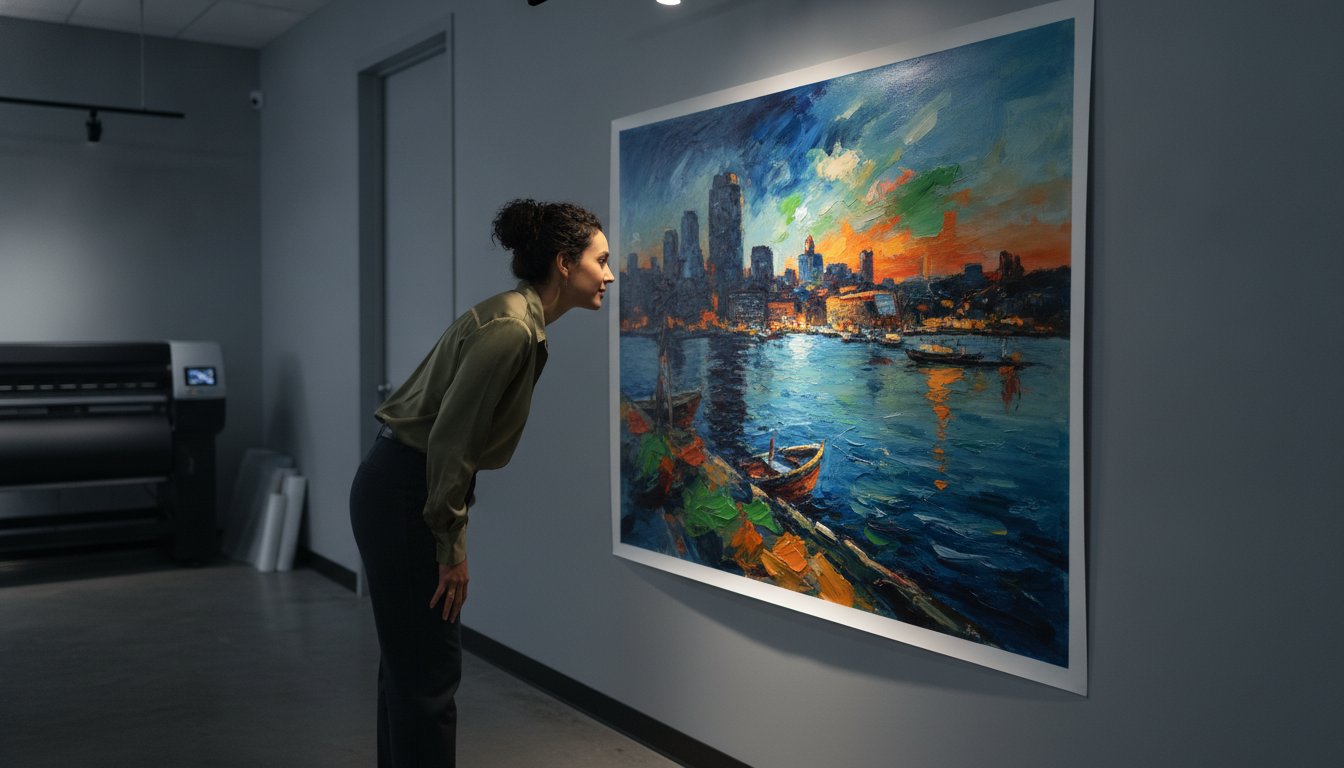
Digitizing the physical presence of a painting presents unique challenges, especially when dealing with heavy impasto or the specific grain of watercolor paper. Standard photography can flatten these details, making a rich oil painting look like a simple poster. We use controlled, directional lighting to reveal the depth of the medium without introducing unwanted reflections or hot spots. Professional scanning utilizes sophisticated lighting and sensor movement to translate the physical relief of brushstrokes into a digital format that retains its tactile character. By documenting these minute shadows and highlights, the scan creates a visual record that preserves the three-dimensional soul of the work on a two-dimensional surface.
The BetterLight Advantage: Mastering High-Resolution Digital Capture
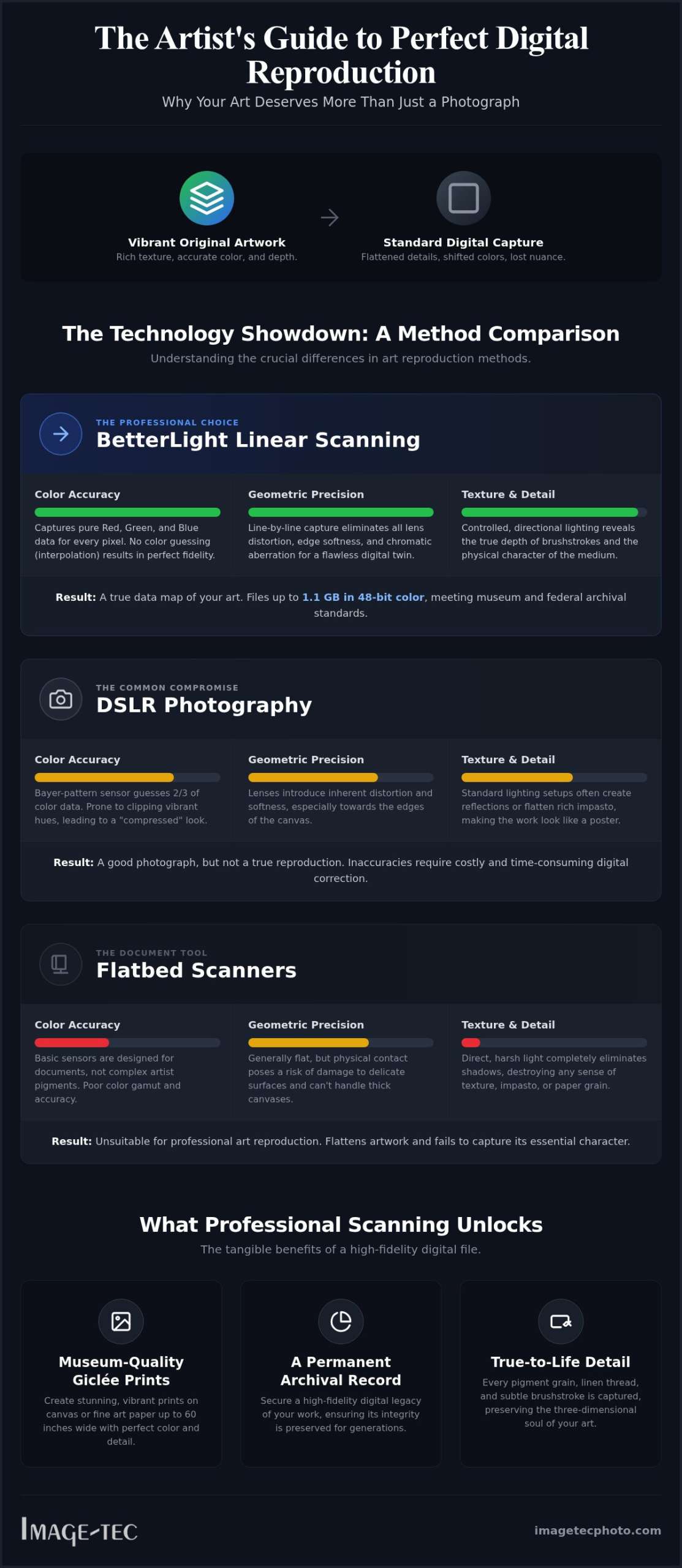
While many studios rely on high-end mirrorless cameras, we utilize the BetterLight Super 8K-HS scanning back. This technology represents a significant departure from standard photography. Instead of capturing an entire scene in a fraction of a second, the linear CCD moves methodically across the image plane. This deliberate movement allows for professional art scanning Methuen that creates files up to 1.1 GB in 48-bit color. By capturing data line-by-line, we eliminate the lens distortion and edge softness often found in traditional area-array sensors. It’s a technical craft that prioritizes accuracy over speed, ensuring that the periphery of your canvas is just as sharp as the center.
How BetterLight Technology Works for Artists
Traditional cameras use a Bayer pattern to guess color data through a process called interpolation. In contrast, the BetterLight system captures pure Red, Green, and Blue data for every single pixel. This results in a file with zero digital noise and incredible color fidelity that mimics the physical properties of your paint. This level of precision aligns with the Federal Digitization Standards used by major cultural institutions like the Library of Congress. For artists, this means your digital reproduction is a true data map of your original work, not just a photographic interpretation. It remains the gold standard for museum-quality reproductions because it avoids the digital artifacts that plague consumer sensors.
Large Format Capabilities in Methuen
Scaling a small scan for a large print usually results in pixelation or a loss of clarity. Because our system captures massive amounts of raw data, we can produce Giclée prints up to 60 inches wide while maintaining a crisp 300 DPI or higher. You don’t have to worry about the “stitching” errors that occur when multiple photos are merged together in software. The scanning back moves across the entire original in a single pass, ensuring perfect edge-to-edge sharpness regardless of the original’s size. If you’re preparing for a large-scale exhibition, our BetterLight scanning provides the resolution needed for high-impact gallery displays. This ensures your 60-inch canvas prints look as sharp and detailed as the original study, preserving your artistic voice at any scale.
BetterLight Scanning vs. Flatbed and DSLR: A Technical Comparison
Artists in New England often choose between three main digitization paths: DSLR photography, flatbed scanning, or professional linear capture. While a DSLR setup is fast, it often introduces the “DSLR problem” of chromatic aberration, where color fringing appears around fine lines and high-contrast edges. Standard lenses also struggle with barrel distortion, which can make straight lines on a canvas appear slightly curved. Flatbed scanners present a different set of challenges, primarily the “flatbed limit” that requires artwork to be pressed against a glass plate. This isn’t just a size restriction; it’s a safety risk for delicate impasto or fragile works that shouldn’t be compressed. For professional art scanning Methuen, the non-contact approach is the only way to ensure both safety and fidelity.
For professional art scanning Methuen, we utilize a system that places the sensor behind a high-precision lens on a large-format camera. This method aligns with the Federal guidelines for art digitization, ensuring that the original remains untouched and perfectly parallel to the focal plane. Unlike a flatbed, this setup allows for even, polarized lighting that eliminates glare on oil paintings and captures the true texture of watercolor paper without the harsh shadows common in standard photography. It provides a level of control that simply cannot be matched by consumer-grade equipment or automated office scanners.
Resolution and Detail Retention
A high-end mirrorless camera might boast 50 or 100 megapixels, but these are area-array sensors that must interpolate color data. BetterLight captures hundreds of megapixels of native, non-interpolated data. Upscaling a smaller file in software creates a soft, digital look that collectors and gallery owners can spot instantly. Native resolution is the most critical factor for gallery sales because it allows for larger reproductions without losing the crispness of the artist’s original intention. By starting with a massive, native file, we ensure that every pencil mark and pigment grain is rendered with absolute clarity.
Color Fidelity and Dynamic Range
Bit-depth is a technical specification that defines how much color information a file can hold. Most consumer files are 8-bit, which significantly limits the range of colors available. We scan at 16-bit per channel, which captures trillions of color combinations and ensures smooth gradients in sky or skin tones. This high bit-depth is vital for reproducing deep blues and vibrant reds that often clip or appear muddy on standard sensors. When combined with professional studio lighting, we achieve a dynamic range that captures the deepest shadows and the brightest highlights of your original work without losing detail in either extreme.
Preparing Your Portfolio for Professional Scanning in Methuen
Preparing for a session of professional art scanning Methuen involves a few practical steps to ensure the safety of your work and the accuracy of the digital capture. We’ve spent 30 years refining this intake process to make it as seamless as possible for New England artists. Before you visit the studio, you should secure your originals between rigid boards or within a protective portfolio. For works on paper, using acid-free glassine is a standard best practice to prevent smudging or surface transfer during transit. It’s better to over-protect your work than to risk a crease or a scuff during the short drive to the studio.
Once you arrive, we’ll walk through a methodical intake process. This includes verifying the dimensions of each piece and discussing your long-term goals for the files. If you’re planning for a gallery show in 2026, we need to know your target print sizes early. This allows us to calibrate the BetterLight system for the specific resolution required for Giclée prints that can reach up to 60 inches wide without any loss of clarity. The transition from physical art to digital data is a collaborative effort between the artist and the technician.
Physical Preparation of Original Art
Cleanliness is the first step toward a perfect scan. We recommend using a soft hake brush or a specialized air puffer to remove loose dust and debris from the surface of your painting. While our scanning process is non-contact, any dust present on the canvas will be captured in high-resolution detail, which can lead to unnecessary digital retouching later. If your work is varnished, let us know the type of finish used; the BetterLight system is excellent at managing glare, but knowing the surface characteristics helps us set the polarized lighting correctly. For the most accurate edge-to-edge sharpness, we generally recommend de-framing your work. Frames can cast subtle shadows or obscure the very edges of the canvas, which limits our ability to capture the full bleed of your work.
Communication with Your Scanning Specialist
Every artist has specific “critical areas” in their work, such as a particular color transition or a focal point of heavy texture. Identifying these areas during your visit ensures the technician pays special attention to those spectral values during the capture. We’ll also discuss your preferences for archival paper or canvas. Whether you’re looking for a smooth matte finish or a textured watercolor paper, the scan must be optimized for that specific output. You can learn more about this integration by reading our guide on Mastering Art Reproduction for New England Artists. After the initial scan, the typical timeline involves color correction and the creation of a physical proof for your approval, ensuring the final Giclée prints meet your exact standards. To get started on your next project, you can view our full range of scanning and printing services at our Methuen studio.
Image-Tec: Methuen’s Premier Studio for Archival Art Reproduction
Image-Tec has served as a cornerstone for the New England art community for over 30 years. Based in Methuen, our studio provides a specialized environment where technical precision meets artistic intent. We don’t just provide a service; we act as a dependable partner for artists from Boston to Manchester, NH, and out to Newburyport. By maintaining a local presence, we offer the personal service and safe handling that national labs simply can’t replicate. Professional art scanning Methuen is the first step in a larger journey of creation and reproduction that we’re proud to facilitate for our regional creative community.
The Full Scan-to-Frame Workflow
One of the primary advantages of working with Image-Tec is our ability to manage the entire reproduction lifecycle in-house. When we integrate our BetterLight scanning with our large format fine art printing, we maintain absolute control over the final output. We don’t have to guess how a digital file will react to a specific archival canvas or textured fine art paper because we’re the ones performing the calibration. This “under one roof” approach ensures that the color profiles established during the scan are perfectly translated to the final Giclée print. To complete the presentation, our in-house custom framing team builds gallery-ready solutions that protect and showcase your work. You can explore our full range of finishing options in our guide on Custom Art Framing and Giclée Printing in Methuen, MA.
Why Artists Trust Image-Tec
Artists trust our studio because we prioritize craftsmanship over flashy trends. Our expertise extends beyond contemporary works to include historical image restoration, where we handle delicate, aged originals with the utmost care. This experience with fragile materials informs our approach to every project, ensuring your artwork is never at risk during the capture process. Whether you’re a professional painter preparing for a solo exhibition or a collector looking to archive a family heirloom, our commitment to technical excellence remains the same. Professional art scanning Methuen is more than a technical requirement; it’s a way to preserve your vision for future generations. To book your scanning session or discuss a custom reproduction project, contact our Methuen studio today to schedule a consultation with our technical team.
Elevate Your Artistic Legacy with Precision Reproduction
Securing a high-fidelity digital record of your work is the most effective way to ensure your artistic vision remains intact as it moves from the studio to the gallery. By choosing the specialized linear capture of BetterLight technology, you avoid common pitfalls like lens distortion and color inaccuracy. This methodical approach to professional art scanning Methuen provides the massive native resolution required for stunning Giclée prints up to 60 inches wide, preserving every subtle texture of your original canvas or paper.
With over 30 years of experience serving the New England art community, Image-Tec offers a complete, in-house solution that includes archival printing and custom framing. We’ve built our reputation on technical excellence and the careful handling of every original piece entrusted to us. Whether you’re preparing for a major exhibition or archiving a lifetime of work, we’re here to provide the expertise your craft deserves. Book Your Professional Art Scanning Session in Methuen today to begin the process. We look forward to helping you share your masterpieces with the world in their most accurate and vibrant form.
Frequently Asked Questions
What is the difference between art scanning and regular photography?
Professional art scanning Methuen utilizes linear CCD technology to capture raw data line-by-line, which is fundamentally different from standard area-array photography. This process eliminates the lens distortion and edge softness common in traditional camera sensors. While a standard photo interpolates color data, our scanning system records pure RGB values for every pixel. This results in a digital file with superior color fidelity and detail that is specifically optimized for museum-quality reproduction.
Can you scan large paintings that are over 40 inches wide?
Yes, we can scan large-scale originals and produce prints up to 60 inches wide. Our BetterLight system is designed to capture massive amounts of data in a single pass, which avoids the stitching errors found in other methods. This capability makes it an ideal solution for artists in the Boston and Manchester areas who work on oversized canvases. We ensure that even at these large scales, the final reproduction maintains a high resolution of 300 DPI or more.
How much does professional art scanning cost in Methuen?
The investment for professional art scanning Methuen depends on the specific requirements of your project, such as the size of the original and the desired final file resolution. We provide high-resolution archival files and web-ready versions as part of our standard service. Because every piece of art has unique technical needs, we recommend contacting our Methuen studio directly for a detailed estimate. This ensures your project receives the precise technical attention it requires for successful Giclée reproduction.
Do I need to remove my painting from the frame before scanning?
We generally recommend removing artwork from its frame to ensure the most accurate digital capture. Frames can cast subtle shadows on the edges of the canvas or obstruct the sensor’s view of the entire piece. Additionally, glass or acrylic can create unwanted reflections that interfere with color accuracy. De-framing allows our technicians to achieve perfect edge-to-edge sharpness and even lighting across the entire surface of your original work.
What file format will I receive after my artwork is scanned?
You will receive your artwork in a high-resolution, uncompressed TIFF format, which is the industry standard for archival storage and professional printing. This file preserves all the captured data without the loss associated with compression. We also provide a web-resolution JPEG version for your convenience, making it easy to share your work on social media or your personal portfolio. These files ensure your work is ready for both physical gallery prints and digital displays.
Is BetterLight scanning safe for old or fragile historical documents?
BetterLight technology is exceptionally safe for fragile or historical materials because it is a non-contact scanning process. Unlike flatbed scanners, your original work is never pressed against glass or subjected to high heat. This makes it the preferred method for our historical image restoration services. We handle every delicate item with the seasoned professionalism earned over 30 years of serving the New England art community, ensuring your legacy is preserved without risk.
How long does the art scanning process typically take?
The timeline for art scanning typically involves the initial high-resolution capture followed by a methodical color correction process. While the scan itself is a deliberate, line-by-line procedure, the total turnaround time also includes the creation of a physical proof for your approval. We prioritize technical excellence over speed to ensure the final digital file is indistinguishable from your original. Most projects are completed within a standard production window that we discuss during your initial intake.
Can you scan three-dimensional objects or very thick impasto paintings?
Our scanning system is specifically designed to handle the depth and texture of thick impasto paintings. By using controlled, directional studio lighting, we can emphasize the three-dimensional character of your brushwork without creating harsh glares. While the system is optimized for two-dimensional art, it can also capture shallow three-dimensional objects with incredible detail. This flexibility allows us to document a wide range of media, from oil paintings to mixed-media assemblages, with absolute precision.






Leave A Comment
You must be logged in to post a comment.