

Your high-end DSLR might be a miracle of modern engineering, but it’s often the wrong tool for preserving the soul of a physical painting. When you invest in a fine art digital scanning service, you’re looking for more than a simple photograph; you’re seeking a digital clone that respects every brushstroke and subtle tonal shift. Many artists worry about losing detail in dark shadows or seeing their vibrant palettes shift into muddy digital approximations. It’s a natural fear, especially when the safety of a fragile original is on the line during the digitization process.
We understand that a successful reproduction begins with technical excellence rather than flashy trends. You deserve a digital file that remains indistinguishable from your original work when it finally hits the paper or canvas. This article explores how professional scanning technologies like the BetterLight system compare to standard DSLR methods to ensure your artwork is captured with museum-grade precision. We will break down the mechanics of color accuracy, the necessity of archival-quality files, and the specialized handling required for large-scale works. By the end, you’ll know exactly how to secure a digital legacy that stands the test of time and meets the highest professional standards.
Key Takeaways
- Understand why a professional fine art digital scanning service using linear array technology outperforms standard sensors by eliminating color interpolation and digital noise.
- Learn the technical differences between instant capture and scanning to avoid common pitfalls like lens distortion and chromatic aberration in your reproductions.
- Discover the essential pre-scan steps artists can take to safely prepare their original work for the digitization process.
- Identify the distinction between scanning for immediate Giclée print production versus creating archival-grade files for long-term preservation.
- Explore the logistical advantages of a localized studio that manages the entire workflow from high-resolution scan to custom-framed result.
The Challenge of Fine Art Digitization: Why Quality Matters
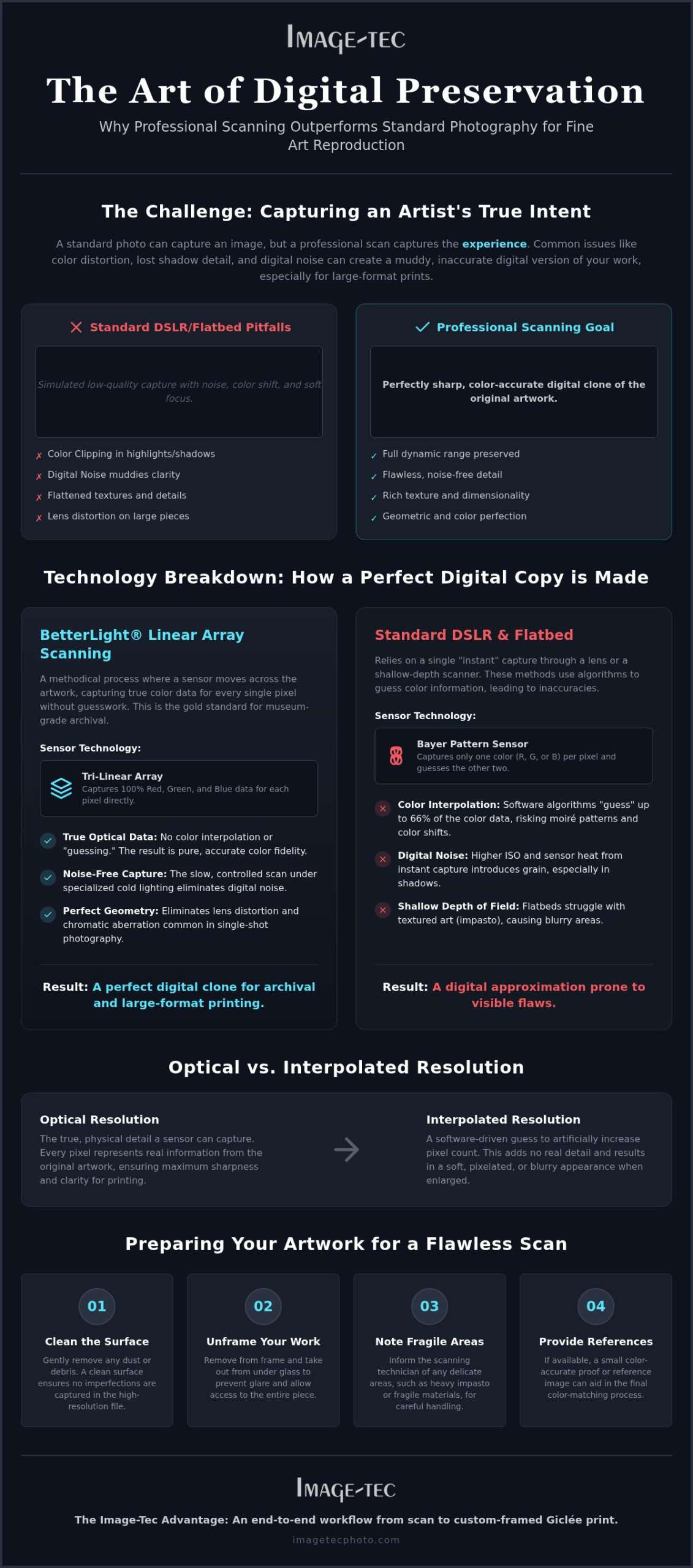
Transitioning from a physical canvas to a digital file requires more than a high-resolution camera. In a market where collectors often discover and purchase work through screens, the quality of your digital imaging determines the value and perceived professionalism of your portfolio. A standard “copy” merely captures the image; a professional reproduction captures the experience. Without a specialized fine art digital scanning service, you risk losing the very details that define your style.
Consumer-grade equipment often suffers from color clipping, where subtle gradients in highlights or deep shadows are flattened into solid blocks of color. Digital noise is another common enemy, introducing grain that muddies the clarity of the work. These defects become glaringly obvious when you attempt large format fine art printing. High-dynamic-range files are essential because they hold the data necessary to replicate the luminosity and depth of the original medium across different scales.
Preserving Artistic Intent Digitally
Every brushstroke and impasto peak carries the artist’s intent. Traditional photography often flattens these textures, but archival-grade scanning is the foundational step in mastering art reproduction. Our process prioritizes non-destructive capture, ensuring that even the most fragile or aged works are never at risk. By using controlled, cold lighting and specialized optics, we preserve the nuanced interplay of light and shadow on the canvas surface without the heat or contact that can damage delicate pigments.
The Limitations of Standard Equipment
Many artists initially turn to flatbed scanners, but these devices fail when confronted with large-scale or heavily textured canvases. The shallow depth of field in consumer scanners means that any part of the art not perfectly flush with the glass will appear blurry. Stitching multiple small scans together often results in visible seams or geometric distortions that are impossible to fix perfectly in post-production. It’s also vital to understand the difference between optical and interpolated resolution:
- Optical Resolution: The actual detail the scanner’s sensor can see.
- Interpolated Resolution: A mathematical “guess” by software to fill in gaps, which often results in a soft, pixelated look.
Relying on a professional fine art digital scanning service ensures that every pixel of your file is backed by real optical data, providing the clarity needed for gallery-quality output. This technical foundation is what allows a digital file to remain indistinguishable from the original when printed.
BetterLight Scanning vs. Standard Methods: A Technical Comparison
Investing in a professional fine art digital scanning service means looking beyond simple megapixel counts to the actual method of data acquisition. At Image-Tec, we utilize the BetterLight scanning back system because it addresses the core limitations of standard digital capture. While many modern cameras have improved, the fundamental difference lies in how the sensor perceives light and color. Most digital cameras use a Bayer pattern sensor, which captures only one color per pixel and uses mathematical algorithms to “guess” the remaining data. In contrast, the BetterLight system uses a linear array that captures full red, green, and blue information for every single pixel in the file.
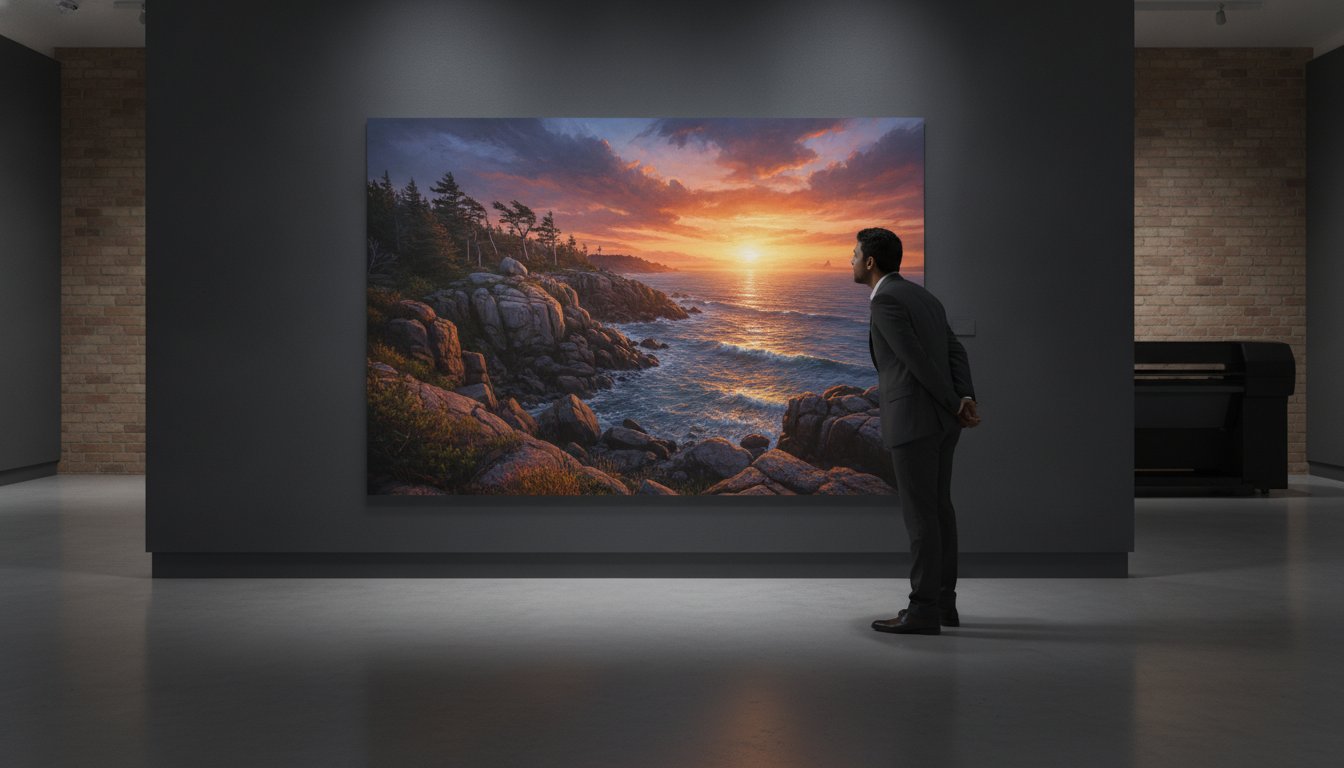
This direct capture method aligns with the Technical Guidelines for Digitizing Cultural Heritage Materials, ensuring that the digital file is a true record of the original rather than a software-generated approximation. By eliminating interpolation, we achieve a level of color fidelity and clarity that allows for Giclée prints up to 60 inches wide. These files possess the structural integrity required for large-scale reproductions, maintaining sharp edges and smooth gradients that Bayer-type sensors often struggle to replicate at extreme sizes.
How the BetterLight System Works
The BetterLight system operates through the methodical movement of a scanning bar across the image plane. This process is slower than a standard camera shutter, but the results are far superior for static subjects like paintings or drawings. Because the sensor collects pure digital data during its pass, there is no need for the aggressive post-processing or sharpening that can introduce artificial artifacts into a file. It’s particularly effective for complex mediums; it captures the heavy impasto of oil paintings and the delicate, transparent washes of watercolor with equal precision. If you want to ensure your work is preserved with this level of technical rigor, you can learn more about our reproduction services at our Methuen studio.
Standard Flatbed and CIS Scanning
Many artists attempt to use consumer flatbed scanners, but these devices often rely on Contact Image Sensors (CIS) which have a very shallow depth of field. If your canvas is slightly warped or has significant texture, parts of the scan will inevitably fall out of focus. Consumer scanners also frequently suffer from “hot spots,” where internal lighting is uneven across the scanning bed, leading to inconsistent color and exposure. These technical failures make standard scanning insufficient for custom art framing and high-end printing, where every millimeter of the digital file must be crisp and color-accurate to match the original work.
Professional Scanning vs. DSLR Art Photography
While modern mirrorless and DSLR cameras are capable of impressive results, they are designed for speed and versatility rather than the uncompromising precision required for art reproduction. The “instant capture” approach of a standard camera relies on a single shutter click to freeze a moment. In contrast, a fine art digital scanning service uses a methodical, continuous capture process that treats the artwork as a stationary landscape of data. This distinction is critical when you require a file that can be scaled up without revealing the technical limitations of a consumer lens.
Standard photography often introduces subtle lens distortion and chromatic aberration, which appear as color fringing around high-contrast edges. Lighting also presents a challenge; studio flashes can create specular highlights or “hot spots” on varnished surfaces. Professional scanning systems often utilize cross-polarization, a technique that effectively cancels out glare and allows the sensor to see through the reflection to the actual pigment beneath. This level of control ensures your digital file adheres to the FADGI technical guidelines, which prioritize objective data over the subjective “look” of a standard photograph.
The Problem with DSLR Geometry
Standard camera lenses are curved, which naturally leads to edge softness and keystoning where the corners of a rectangular painting appear slightly flared or compressed. A scanning back avoids these issues by maintaining a perfectly flat focal plane as it moves across the image area. This eliminates the need for software-based “lens correction” which can degrade image quality. Parallax error is the apparent displacement of an object when viewed from different angles; in art reproduction, it causes geometric inaccuracies that prevent the digital file from perfectly aligning with the physical original.
Color Accuracy and Bit Depth
The difference in bit-depth is perhaps the most significant advantage of scanning over photography. Most high-end cameras capture in 12-bit or 14-bit RAW, which is then often compressed to 8-bit for viewing. A professional fine art digital scanning service typically captures in true 16-bit, providing thousands of additional tonal levels. This extra “room” in the file is vital for several reasons:
- Smooth Gradients: It prevents “banding,” where subtle sky or skin tones break into visible steps.
- Vibrant Gamut: It captures a wider range of colors, ensuring your Giclée output matches the intensity of your palette.
- Editing Flexibility: It allows for precise color correction without destroying the integrity of the shadow and highlight data.
By choosing a scanning-based workflow, you ensure that every nuance of your work is preserved in a file that is robust enough for archival use and professional reproduction.
Pre-Scan Checklist: Preparing Your Artwork for Digitization
Success with a professional fine art digital scanning service starts long before your artwork reaches the studio. While the BetterLight system is designed to capture every subtle nuance of your medium, it also records every speck of dust or stray fiber on the surface. Proper preparation ensures that the final digital file is a clean record of your artistic vision rather than a catalog of environmental debris. Taking a methodical approach to physical prep and goal setting will streamline the workflow and guarantee the best possible reproduction.
Physical Preparation of the Original
Artists should use a clean, soft drafting brush or a light burst of compressed air to remove loose surface dust. Don’t use cleaning agents or damp cloths on the paint layer; leave any deep cleaning to professional restorers or our studio team. We generally recommend removing the artwork from its frame before your appointment. This allows the scanning bar to capture the entire edge of the canvas without shadows or obstructions from the frame’s lip. For estate or historical collections, ensure each piece is clearly labeled on the back with the artist’s name, medium, and title to maintain accurate documentation throughout the process.
Logistics also play a role in safety. When transporting large-scale works to our Methuen studio, use acid-free glassine paper to protect the surface and rigid corner protectors to prevent frame or canvas damage. If your work features high-gloss varnish, ensure it has fully cured. Even though our scanning technology handles reflections better than standard photography, a stable, dry surface is essential for the sharpest results.
Defining Your Digital Goals
Determining whether you need a “Scan-to-Print” or “Scan-to-Archive” file is a vital first step. A print-optimized file is calibrated for immediate output on our Giclée equipment, while an archival file is a high-bit-depth TIFF designed for long-term preservation. TIFF files are the industry standard for art reproduction because they preserve all data without the lossy compression found in JPEGs. If you’re managing a large portfolio or a commercial collection, you might find it helpful to consult our guide on professional product photography in Massachusetts to understand how professional budgeting works for volume projects.
Establishing these goals early allows us to tailor the scan resolution to your specific needs, whether you’re planning a limited edition run of 60-inch prints or simply need a high-quality digital backup for your records. If you’re ready to begin the digitization process, contact our studio to discuss the specific requirements for your collection.
Fine Art Scanning in New England: The Image-Tec Advantage
Artists across the Merrimack Valley and Greater Boston area often face a difficult choice between shipping their original works to national labs or settling for local consumer-grade shops. Image-Tec serves as a localized pillar of expertise, providing a high-end fine art digital scanning service that rivals any major metropolitan facility. By keeping your artwork in our Methuen studio, you eliminate the logistical risks of long-distance shipping and gain the ability to collaborate directly with the technicians handling your portfolio. This personal connection ensures that your specific vision is respected from the first scan to the final output.
A Full-Service Art Reproduction Workflow
Our studio provides a seamless transition from digital capture to gallery-ready product. Once the BetterLight scan is complete, the file moves directly to our master printer for calibration. We specialize in Giclée prints on canvas and archival paper up to 60 inches wide, ensuring the precision of our scan technology is fully realized in the physical print. To complete the presentation, we offer custom framing services designed to protect and enhance the finished work. This integrated approach guarantees consistency across multiple editions; if you need a second print run months later, the color profiles and framing materials will match your first edition perfectly.
Beyond new creations, we apply this same technical rigor to legacy works and estate collections. Our historical image restoration service utilizes our high-resolution scanning infrastructure to recover details from faded or damaged documents and photographs. Working directly with our team allows you to oversee the color-matching process, which is especially vital when restoring sensitive family heirlooms or museum-grade historical records that require a steady, professional hand.
Serving the Boston and Manchester NH Communities
Located conveniently near the intersection of I-93 and I-495, our facility is a primary destination for those seeking a fine art digital scanning service in Newburyport, the North Shore, and Manchester, NH. While most projects are handled in our controlled studio environment, we also maintain on-location capabilities for oversized murals or fixed installations that cannot be transported. This versatility allows us to act as a trusted guide for both individual artists and commercial clients navigating complex reproduction needs. Commercial clients requiring consistent brand imagery across product lines may also benefit from our food photography studio Massachusetts capabilities, which apply the same precision-driven workflow to high-end commercial imaging.
We invite you to schedule a consultation at our Methuen facility to discuss your upcoming project. This meeting allows us to evaluate your artwork’s unique textures and color requirements under professional studio lighting. By choosing a local partner that integrates scanning, printing, and framing under one roof, you ensure a higher standard of quality control and a more efficient path to seeing your work on the gallery wall.
Securing the Future of Your Creative Portfolio
Choosing the right fine art digital scanning service is a critical decision for any artist looking to preserve the integrity of their work. We’ve explored how BetterLight technology eliminates the guesswork of standard digital sensors, providing a file that’s structurally sound and color-accurate. By moving away from the limitations of consumer-grade equipment and “instant” photography, you ensure that every brushstroke is recorded with museum-grade precision. This technical foundation is essential for long-term archival use and high-end reproduction.
At Image-Tec, we combine over 30 years of New England art reproduction experience with a full-service workflow that takes your project from a high-resolution scan to a 60-inch wide Giclée print. This integrated approach allows for unparalleled quality control and consistency across your entire collection. Whether you’re digitizing a single masterpiece or an entire estate, we act as your technical partner and guide. Schedule your professional art scanning consultation at Image-Tec today to see the difference that professional craftsmanship makes. We look forward to helping you create a digital legacy that truly reflects your artistic vision.
Frequently Asked Questions
What is the highest resolution possible with a fine art digital scanning service?
The BetterLight system provides a resolution that far exceeds standard digital cameras, capturing hundreds of megapixels of pure optical data. This allows Image-Tec to produce Giclée prints up to 60 inches wide with absolute clarity. Artists in Methuen and the Boston area rely on this level of detail to ensure their large-format reproductions maintain the integrity of the original brushwork without the pixelation or softness common in consumer-grade captures.
Can you scan artwork that is already framed or behind glass?
We strongly recommend removing artwork from glass to achieve the highest quality results. While we can scan framed pieces, glass creates reflections and introduces a barrier that can slightly degrade the sharpness of the capture. For our fine art digital scanning service in Methuen, removing the glass allows our sensors to record the true texture and color of the pigment without the interference of a secondary surface or glare.
How long does the professional scanning process take for a single painting?
A professional scan typically requires between 30 and 60 minutes per piece, depending on the complexity of the setup. While the actual movement of the scanning bar takes only a few minutes, our technicians spend significant time on precise lighting calibration and color profiling. This methodical pace ensures that every artist from Newburyport to Manchester, NH, receives a file that is perfectly balanced and ready for archival use or immediate printing.
Is BetterLight scanning safe for old or fragile historical documents?
BetterLight scanning is exceptionally safe for fragile historical materials because it utilizes cold lighting and involves no physical contact with the document surface. Unlike traditional flatbed scanners that generate heat and require the document to be pressed against glass, our system is ideal for historical image restoration projects. We regularly handle sensitive estate collections and archival records for clients throughout New England with a focus on long-term preservation.
Do I own the digital files after the scanning service is complete?
You retain full ownership of the digital files created during your session at Image-Tec. Once the fine art digital scanning service is complete and the files are processed, we provide you with the high-resolution data for your own use. Whether you intend to use the files for online sales, museum archives, or future print runs, the digital assets are yours to manage as part of your professional portfolio.
What is the difference between a high-res scan and a high-res photo?
A high-resolution scan uses a linear array to capture full red, green, and blue data for every pixel, whereas a high-resolution photo uses a Bayer filter to interpolate color. This hardware-level difference means the scan contains more accurate color information and significantly less digital noise. This technical superiority is why professional artists in the Boston area choose scanning when they require museum-grade reproductions that remain sharp at large scales.
Can you digitize very large artworks, such as those over 40 inches?
Our Methuen studio is specifically equipped to handle oversized artworks, including pieces well over 40 inches in length or width. Because the BetterLight system is a studio-based capture method rather than a fixed-size flatbed, we can accommodate large canvases and murals with ease. We provide local artists with a reliable solution for digitizing their most ambitious works, ensuring that even massive paintings are captured with edge-to-edge sharpness and geometric accuracy.
What file format will I receive for my scanned artwork?
We provide scanned artwork in 16-bit TIFF format to ensure the highest possible archival quality and editing flexibility. TIFF files are non-compressed, meaning they retain every detail and tonal nuance captured by the sensor. This format is the industry standard for professional art reproduction, as it allows for smooth gradients and vibrant color depth that won’t degrade over time, unlike standard JPEG files which lose data every time they are saved.






Leave A Comment
You must be logged in to post a comment.