

Art-making space and professional art reproduction serve different needs. For artists looking for a local art reproduction studio in Manchester, NH, it helps to distinguish a community studio, which welcomes people and mediums, from a service focused on producing faithful fine-art copies. Manchester’s Community Studio is open Mondays from 6:30 PM to 9:15 PM, Tuesdays from 3:00 PM to 9:15 PM, Saturdays from 11:30 AM to 9:30 PM, and Sundays from 11:30 AM to 8:30 PM.
Artists value practical details as much as creative possibility: what kind of work a studio supports, who can take part, and when they can visit. This article explains the role of Manchester’s community art space, the artists and mediums it welcomes, and its listed hours. It also clarifies what professional reproduction involves, so you can understand when a reproduction studio is the right fit for artwork that needs to be captured and printed with care.
Key Takeaways
- Distinguish community art-making spaces from studios that produce professional reproductions, so you can choose the right kind of service.
- Learn which qualities of paintings, photographs, and documents affect how they can be reproduced.
- Understand how scanning and photography support accurate digital capture of original artwork.
- Use practical criteria such as reproduction needs and print quality to assess which studio is the best fit for your project.
Which local studios in Manchester, NH offer art reproduction or fine-art printing?
Manchester’s Mosaic Art Collective is a local arts resource, founded in 2022 in southern New Hampshire. Its Community Studio welcomes people working in different mediums, and some materials are provided when needed. That makes it a place for making art, rather than a service described around reproducing finished work. Artists seeking prints should distinguish those purposes before choosing a studio.
Fine-art reproduction means capturing an existing piece and producing a print from that image. A community workspace supports creating original work, but that alone does not establish that it offers scanning, artwork photography, or print production. The distinction matters when a painter needs prints of a finished canvas or a photographer wants prints from a digital file. These projects require reproduction services, not simply space to create.
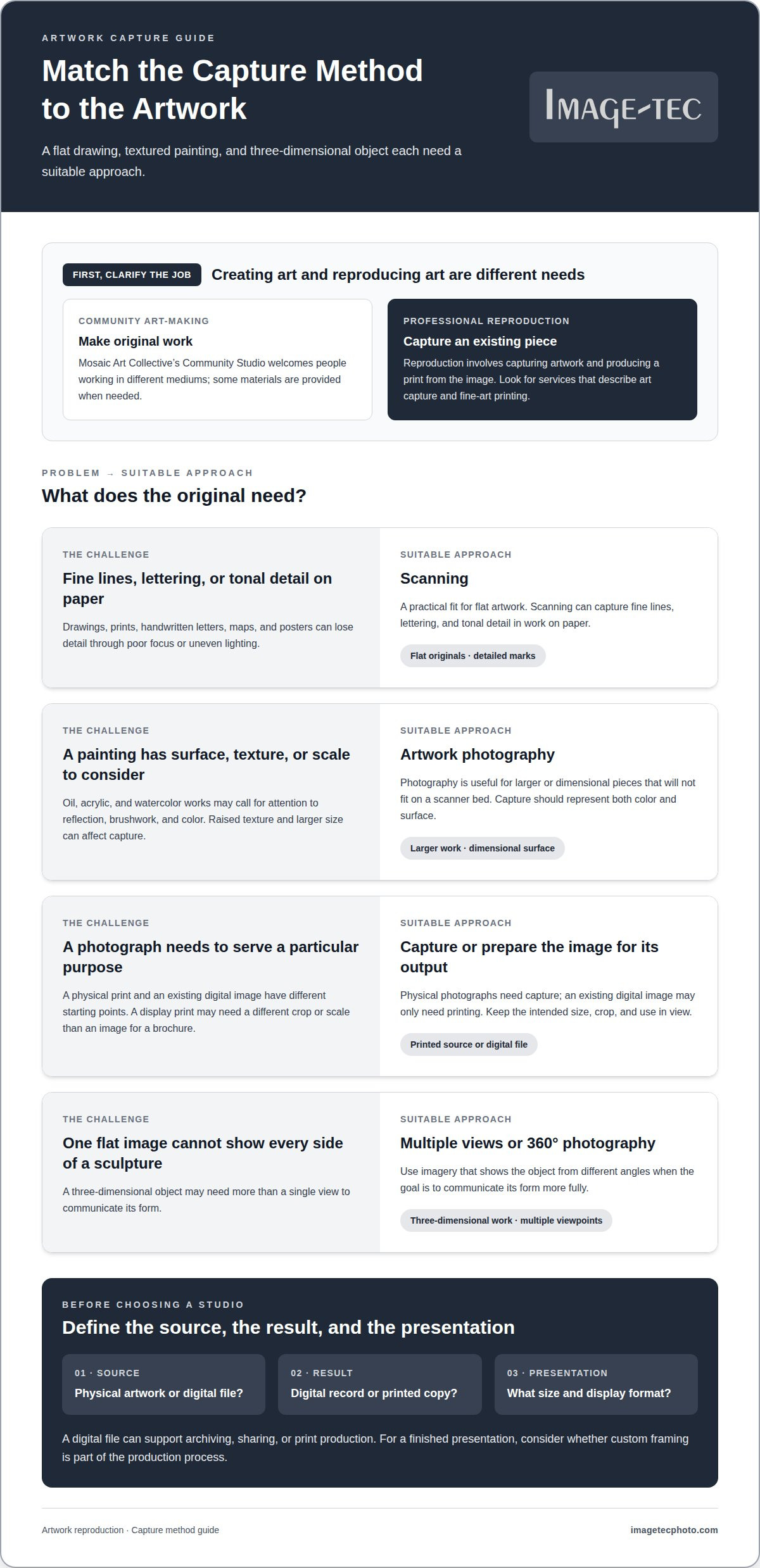
Start with the finished output you need. A large canvas reproduction requires printing suited to the intended dimensions; a framed print also requires a framing choice. Check that the studio’s services match the task, whether you need an original captured, a digital file printed, or a finished piece prepared for display.
- For creating: Mosaic Art Collective’s Community Studio welcomes varied mediums, with some materials available.
- For reproducing: Look for a studio that describes art capture and fine-art printing as services.
- For a finished presentation: Consider whether custom framing is part of the production process.
Before choosing a local art reproduction studio near Manchester, NH, define what you have and what you want back. A physical painting needs to be captured, while artwork already in digital form may only need printing. Identify the source format, desired output, and presentation to determine which capabilities matter. This helps distinguish an art-making space from a professional reproduction studio and gives you a clear starting point.
What types of artwork can Manchester, NH studios reproduce, such as paintings, photographs, or documents?
Reproduction may start with a painting, photograph, or work on paper, and each original has different capture needs. An oil painting, for instance, may reflect light in ways that affect how its color and texture appear in a photograph. A charcoal drawing has delicate tonal transitions, while a watercolor depends on subtle washes. The capture method and printing process should suit the source artwork rather than treat every original alike.
Photographs can be reproduced from a physical print or an existing digital image. A family photograph, an artist’s photograph, and a commercial product image serve different purposes and have different visual priorities. A print for display, for example, may need a different crop or scale than an image for a brochure. Faithful reproduction preserves the composition and tonal character while accounting for the intended output.
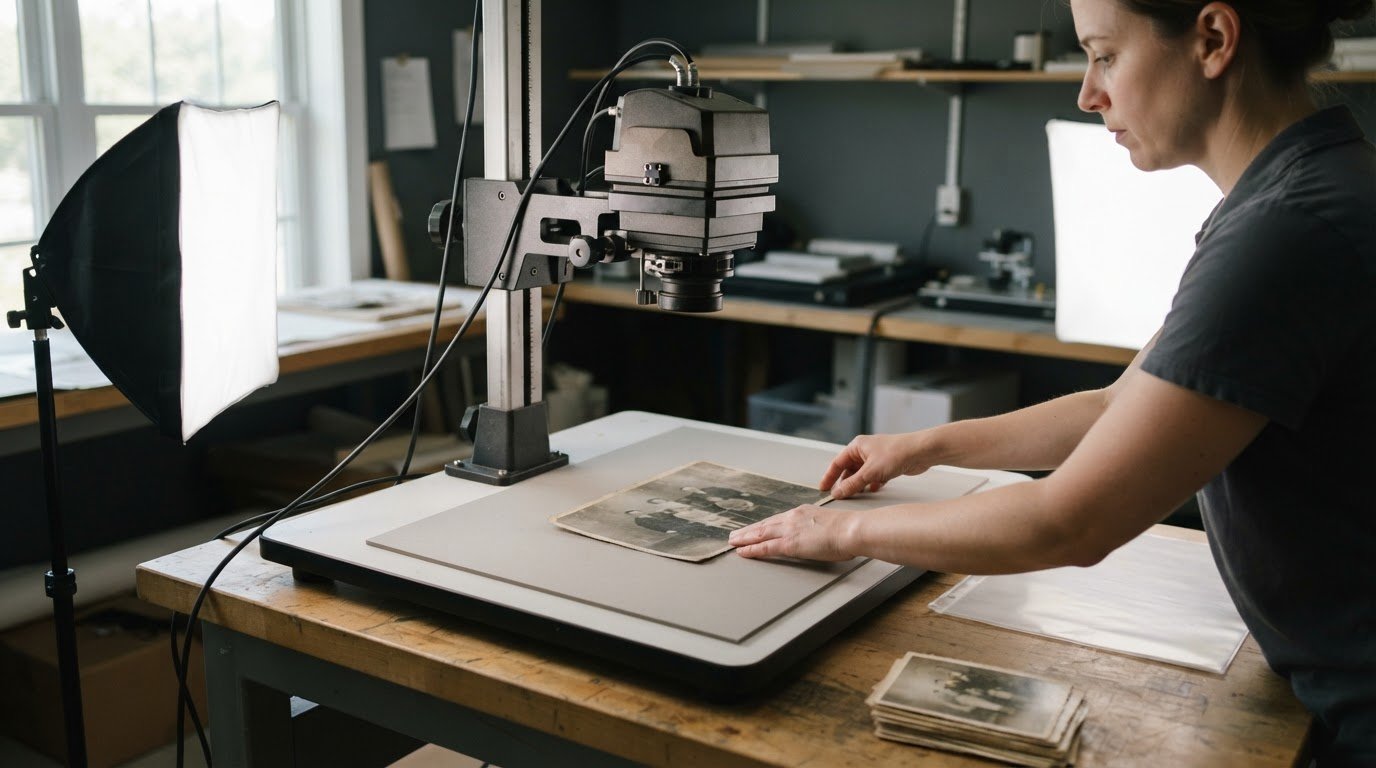
Documents and archival paper items may also be reproduced, depending on their condition and the capture process. Details in a handwritten letter, old map, or printed poster can be lost through uneven lighting or poor focus, and fragile paper requires careful handling. For these materials, distinguish digitization for later use from art reproduction intended to create a visual copy for display or distribution.
- Paintings: Oil, acrylic, and watercolor works can require attention to surface reflection, brushwork, and color.
- Photographs: Printed and digital images may be prepared for a chosen print size or display purpose.
- Works on paper: Drawings, maps, letters, and posters benefit from clear capture of fine lines and text.
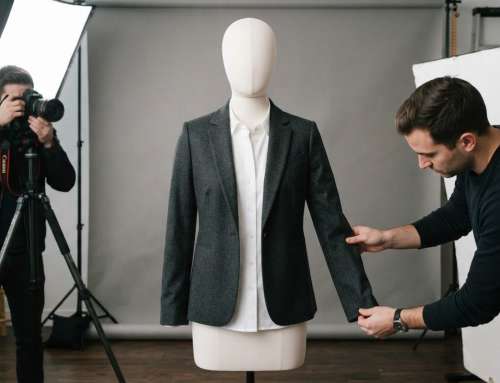
For a three-dimensional sculpture, a single flat reproduction cannot show every angle. Multiple views or 360-degree photography can communicate its form more fully. Match the project to the desired result: a faithful print, a digital record, or imagery that shows a physical object from different sides. That distinction helps Manchester artists describe their original and intended use clearly.
Which studios offer scanning, photography, or digitization of original artwork?
Mosaic Art Collective’s Community Studio is a Manchester space for community art-making across varied mediums. That focus is different from professional reproduction. Scanning, artwork photography, and digitization are separate production tasks; the right approach depends on the original and intended result. A flat drawing, textured painting, and three-dimensional object each need a suitable capture method.
Scanning can capture fine lines, lettering, and tonal detail in work on paper. Photography is useful for larger or dimensional pieces that will not fit on a scanner bed. A canvas with raised brushwork, for example, needs image capture that represents both color and surface. The resulting digital file can be used for archiving, sharing, or print production.
Studios that handle artwork digitization may use scanning or photography, depending on the source. BetterLight scanning is a specialized method for digital capture of original artwork. Commercial photography can serve projects that need professionally produced images, while 360 photography can show an object from multiple angles. These approaches address different needs rather than acting as interchangeable options.
- Scanning: A practical fit for flat artwork, such as a drawing or print.
- Photography: Useful for paintings or objects where size, surface, or depth affects capture.
- 360 imagery: Helps represent a three-dimensional artwork from multiple viewpoints.
Before digitizing artwork, define the original’s format and the file’s purpose. An artist preparing a print needs a capture that preserves the work’s visual character. A gallery documenting a sculpture may need views that communicate its form. The intended output matters too: a digital archive, reproduction print, and commercial image call for different production choices. A clear brief helps identify the right capabilities for the project.
Donna Catanzaro’s artwork Relationships measures 3 x 12 x 6 inches, a dimensional format that can inform the choice between scanning and photography. Recording its measurements alongside a digital capture can preserve useful context for an archive or presentation, while the capture method should suit the work’s form.
Manchester Art Studios: Review & Print Quality Comparison
Reviews and print quality answer different questions. A review may describe communication, scheduling, or whether a project met expectations. Print quality depends on the captured image, reproduction process, and final presentation. For Manchester-area artists, comparing these separately is more useful than relying on one overall impression.
Mosaic Art Collective’s Community Studio is a local place for art-making across varied mediums. Its community focus does not establish fine-art printing or reproduction quality. When evaluating a reproduction, consider the actual output: color accuracy, preserved detail, clean edges, and whether the print suits its intended display.
Look for reviews that describe a specific project rather than broad praise. A comment about a staff interaction may help you assess service, but it does not show how a painting was captured or how its colors appeared in a print. A positive comment about an art class likewise does not assess print resolution or framing. Separate feedback about the process from observations about the finished piece.
- Review details: Look for comments about communication, handling, and project expectations.
- Image fidelity: Consider whether color, contrast, and fine details remain clear in the reproduction.
- Presentation: Assess whether the final print’s size and framing suit its intended use.
Print quality also depends on matching the source image to the desired output. A detailed drawing needs clear line reproduction; a textured painting needs capture that retains its visual character. For display, the print dimensions and framing affect how the work reads in its setting. A studio offering Giclée canvas prints up to 60 inches wide and custom framing can address both production and presentation in one project. Explore fine-art printing and framing for artwork that needs a finished display format.
Image-Tec
Image-Tec helps artists move from original artwork to digital capture and finished reproduction. For a painting or work on paper, BetterLight Scanning supports precise digital capture; Giclée canvas printing and custom framing can carry the project through to presentation. Canvas prints are available up to 60 inches wide.
Turn to Image-Tec when your project needs professional artwork capture, a fine-art print, or a framed canvas. Commercial Photography and 360 Photography also serve projects that need polished images or multiple views of an object. The right approach depends on the original and the intended result, such as a faithful print for display or imagery that shows a three-dimensional piece from different angles.
Contact Image-Tec to discuss your artwork reproduction project and the result you’re looking for.
Give Your Artwork a Clear Next Step
First decide what the finished work needs to do: preserve a family image, prepare artwork for display, or create a digital record. That purpose guides capture and presentation choices while keeping the original’s character in view. If you are comparing local art reproduction studios near Manchester, NH, describe the source artwork and intended result to turn a broad idea into a practical project plan.
Image-Tec also provides historical image restoration for older photographs and images that need attention before reproduction. Describe what you hope to preserve or produce to discuss a suitable direction for the work.
Contact Image-Tec about your artwork to take the next step with care and clarity.
Frequently Asked Questions
What print sizes, papers, canvas options, and color-matching services are available locally?
Image-Tec produces canvas prints up to 60 inches wide and fine-art prints on canvas, fine-art paper, and archival papers. BetterLight scanning supports precise digital capture of original artwork, an important step toward preserving its visual qualities in a reproduction. Paper and canvas create different presentation surfaces; the choice depends on the artwork and its intended display. Color matching should be treated as a project requirement, not an assumed standalone service.
Which local studios provide framing, mounting, or canvas reproduction?
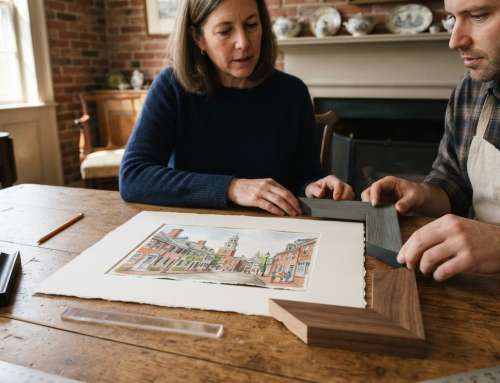
Image-Tec offers fine-art reproduction on canvas and custom framing for artists seeking a finished presentation. Framing surrounds and presents a print, while mounting attaches it to a supporting surface; they are different finishing methods. A canvas reproduction, for example, may be displayed with custom framing, while a paper print may call for another presentation. Specify the intended format when planning the reproduction.
How should original artwork be prepared and protected for scanning or photography?
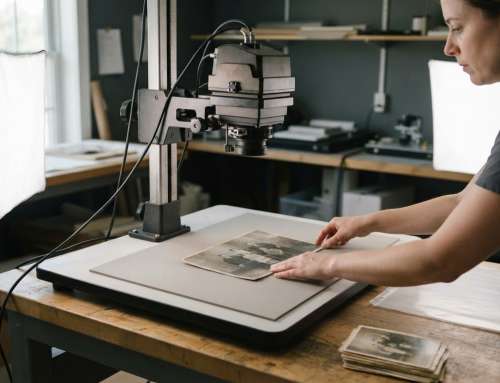
Fragile paper items require careful handling. Match the capture method to the original: scanning suits flat work, while photography is useful for larger or dimensional pieces.





Leave A Comment
You must be logged in to post a comment.