

A 360-degree view should add to a vehicle listing, not replace its regular photos. 360 car photography for dealerships gives shoppers an interactive way to inspect a vehicle from different angles, while standard images remain useful for highlighting specific details and features. Each format has a distinct role.
It makes sense to weigh the production effort against the value of giving shoppers a fuller visual record. The right approach depends on how you present vehicles, how consistently you need images, and what your dealership’s listing workflow requires.
This guide explains what 360 vehicle photography can and can’t replace, what affects pricing, and which production and workflow options are worth considering. You’ll also learn what to expect from a professional photography process, so you can choose an approach that fits your inventory and presentation goals.
Key Takeaways
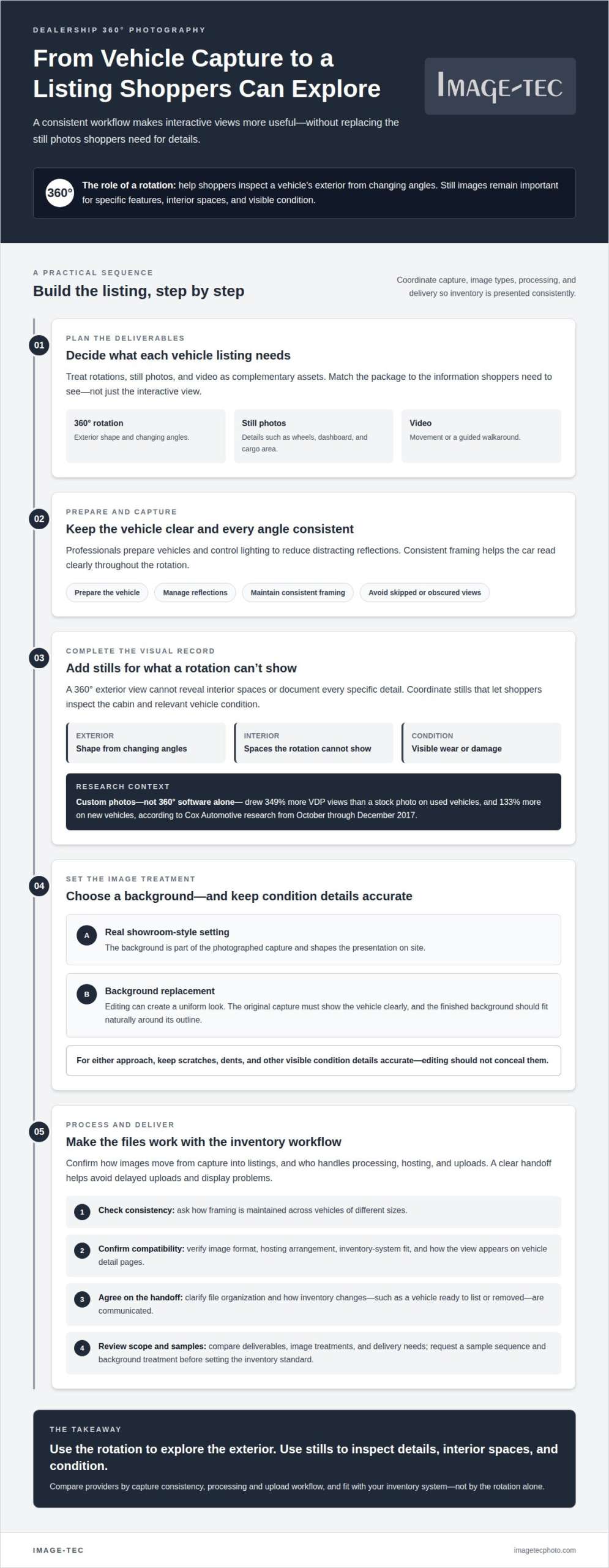
- Use interactive vehicle views to complement, not automatically replace, standard photos that highlight specific features.
- Compare providers on consistent capture and framing, efficient processing, and how well their workflow fits your inventory system.
- Understand how project scope, image requirements, and delivery needs shape photography costs before selecting an option.
- Choose a real or digitally created background based on the presentation you want and the consistency your listings require.
Can the software replace regular vehicle photos?
No. An interactive rotation complements regular vehicle photos; it doesn’t replace detail shots. Professionals prepare the vehicle and control lighting to reduce distracting reflections. They also keep framing consistent throughout the rotation, helping every angle present the car clearly.
Interactive vehicle content
An interactive rotation lets shoppers move around a vehicle instead of inferring its shape from selected angles. It can support closer feature exploration and give buyers a fuller view of the exterior. For dealerships, 360 car photography for dealerships works best as part of a broader merchandising plan. Look for complete coverage, smooth transitions, and views that don’t skip angles or obscure features.
Exterior, interior, and condition images
A 360 exterior view shows the vehicle’s shape from changing angles, while still photos can highlight a wheel, dashboard, or cargo area. Interior images reveal spaces the exterior rotation cannot show. Condition photos document visible wear or damage. A 360 car photography for dealerships workflow should coordinate these formats so shoppers can explore the vehicle and inspect relevant details.
Vehicle photo research points to a role for both interactive views and custom stills. According to Cox Automotive, multiple custom photos drew 349% more VDP views than a stock photo on used vehicles, and 133% more on new vehicles, October through December 2017. These findings concern custom photos, not 360-degree software alone. They support showing the actual vehicle rather than relying only on stock imagery.
For effective merchandising, treat rotations, still images, and video as complementary assets. A rotation helps shoppers examine the exterior; a close-up can show a specific feature, while video can present movement or a guided walkaround. Professional studios prepare vehicles, manage lighting, and capture consistently, helping dealerships create a coherent presentation across inventory listings.
What should dealers compare when choosing a 360 car photography provider?
Compare capture consistency, processing and upload workflow, and compatibility with your inventory system. Confirm the delivered image format, hosting arrangement, and how the interactive view will appear on vehicle detail pages. Common problems include uneven framing, distracting reflections, delayed uploads, and rotations that do not display correctly.
For dealership inventory, a standardized capture environment helps keep vehicle rotations consistent. Ask how framing is maintained across vehicles of different sizes and how images move from capture into listings. A clear workflow makes it easier to present changing inventory uniformly.
Consider the complete merchandising package, not just the rotation. You may need still photos and video alongside interactive views, with each format serving a distinct purpose. For example, a rotation shows exterior angles, while video can guide shoppers through vehicle features. Match the deliverables to the information your listings need to communicate.
In-house photography gives a dealership direct control over capture schedules, but it also requires staff training, equipment, and a repeatable process. For teams looking to build foundational skills internally, hands-on programs such as pictorial.com.sg illustrate how structured training helps photographers master lighting and camera controls. Hiring a professional photographer moves that work outside the dealership. Compare the approaches by considering who prepares vehicles, maintains consistent framing, processes images, and uploads finished assets.
Branding should support a clear vehicle presentation, not compete with it. Decide whether dealership logos or branded backgrounds will appear and where they will sit in relation to the vehicle. A logo that obscures a feature, for example, makes the image less useful. Set a consistent treatment for the full inventory.
Speed to market depends on capture, processing, and delivery working together. Clarify how completed images are organized and how inventory changes are communicated, such as when a vehicle is ready to list or has been removed. For online views, establish who hosts the files and what the listing platform requires. This helps prevent avoidable delays and display issues.
Advertised pricing and project-cost considerations
Advertised rates can describe different scopes, so compare deliverables before comparing offers. One quote may cover vehicle stills; another may include a 360-degree sequence, background treatment, or organized delivery. Any project price depends on scope and is provided after a quote request. Key factors include the number of vehicles, capture requirements, image treatments, and how files must be prepared for listings.
A dealership photographing its full inventory needs a repeatable setup for every vehicle. Consistent backgrounds help car photos look cohesive, while changes in lighting or framing can make listings feel uneven. Ask how the workflow keeps vehicle position, background, and image sequence consistent. Buyers can then compare vehicles without visual differences distracting from their features.
Background replacement can create a uniform look, but it adds an editing decision. The original capture must show the vehicle clearly, and the finished background should fit naturally around its outline. Keep condition details accurate: editing should not conceal scratches, dents, or other visible features. A real showroom-style setting shapes the background during capture; replacement creates a different presentation.
Still photos and 360° capture also need a coordinated plan. A sequence should maintain consistent framing and rotation, while selected stills can show details that buyers may want to inspect closely. Decide whether the project needs both formats, and how the images will be named and delivered. Request a sample of the proposed sequence and background treatment before setting the standard for the entire inventory. That step helps align expectations around image consistency and project scope.
Real showroom-style backgrounds versus fake backgrounds
A real showroom-style background places the vehicle in a photographed physical setting. The floor, walls, and lighting are part of the original capture, so reflections and shadows come from that environment. This approach suits automotive listings that call for a grounded showroom presentation. Before the shoot, position the vehicle and clear distracting objects from the frame. A tidy setting supports consistent images without background replacement.
A composited background separates the vehicle from its original setting and places it against another scene. This can create a uniform look across inventory photographed in different locations. The process requires careful edge work around mirrors, windows, tires, and rooflines. Check that the replacement background’s perspective and light direction fit the vehicle. Otherwise, the car may look detached from its surroundings.
Custom photo backgrounds offer another option. A dealership can use a photographed branded setting or a neutral studio environment, then apply the treatment consistently. Decide how logos, colors, and floor details should appear before the full photography workflow begins. Keep branding secondary to the vehicle, and never let a graphic or sign cover a feature buyers need to see.
AI background removal can isolate a vehicle, but the result still needs a quality review. Inspect fine edges, including glass, antennae, mirrors, and wheel spokes. Look for missing details, halos, or fragments of the original background. In a 360 sequence, review the entire rotation, not only one selected frame. A clean result in a single image may reveal inconsistencies as the vehicle turns.
Choose the treatment based on the presentation you want and the available capture environment. Real showroom photography preserves the original setting; compositing can standardize varied locations. With either method, set a background and lighting standard, photograph a sample vehicle, and review every angle before applying the workflow across inventory. Consistent treatment helps shoppers focus on each vehicle, not differences between images.
Image-Tec
Image-Tec provides commercial photography and 360 photography for dealerships seeking a professional vehicle presentation. The work can support an inventory plan that pairs interactive rotations with selected still images, consistent backgrounds, and clear detail views. This is a practical next step when you want a coordinated visual approach rather than treating each format as a separate task.
Share which vehicles you need photographed, the intended listing formats, and your preferred background style. These details help define the capture requirements and finished images. Image-Tec provides commercial photography for vehicles, with in-studio and on-location options to suit the project. Based in Methuen, Image-Tec serves dealerships in the surrounding area, including Boston, Manchester, NH, and Newburyport.
Contact Image-Tec to discuss your dealership photography project.
Set a Visual Standard for Your Inventory
Define a visual standard that can carry across inventory changes. Decide which vehicle views matter most, how shoppers should explore each listing, and what presentation best fits your dealership. A clear brief gives the photography project a purpose beyond adding another asset to a vehicle page.
For 360 car photography for dealerships, think about how the images will support your dealership’s identity over time. A consistent approach can help new listings feel connected, even as vehicles and inventory mix change. Start with the outcome you want shoppers to experience, then shape the production around that goal.
Image-Tec provides commercial photography for businesses with specific visual needs. Contact Image-Tec about dealership photography to discuss a project suited to your inventory. A thoughtful visual standard is a practical foundation for your next step.
Frequently Asked Questions
Is professional 360 car photography right for every dealership?
Not necessarily; it is most useful when an interactive vehicle presentation fits the dealership’s inventory and listing strategy. A store with frequently changing vehicles may prioritize a repeatable capture process, while a smaller selection of listings may need fewer production steps. Consider how buyers browse your inventory, which details they need to assess, and whether your listing workflow can accommodate interactive media.
What is 360-degree car photography for dealerships?
It is a sequence of vehicle images presented so viewers can rotate the car through different exterior angles. Shoppers control the view rather than relying only on fixed photographs. For example, a listing can pair an exterior rotation with separate interior and condition images, giving each format a specific role in describing the vehicle.
What equipment and software does a provider need for 360 car photography?
A production setup typically combines a camera, controlled lighting, a way to capture consistent angles, and software to assemble and deliver the rotation. The photographer also needs a process for preparing vehicles and handling the resulting files. Ask how the workflow maintains consistent framing and produces images that work with your dealership’s listing and inventory tools.
What does 360 car photography cost for dealerships?
Professional photography pricing is project-specific and provided after a quote request. The scope, number of vehicles, image treatments, and delivery needs all affect the project. For a useful estimate, specify whether each vehicle needs a rotation, still photographs, or both. Describe the listing workflow too, since file preparation and delivery requirements can shape the work.
How much does professional dealership 360 car photography equipment and setup cost?
There is no single equipment-and-setup figure that fits every dealership. The investment varies with capture equipment, lighting, the rotation method, processing software, and any integration needed for inventory listings. An in-house setup also takes staff time and a consistent process. Compare that full operating effort with a professional photography project scoped to your vehicles and deliverables.
Which 360 car photography platforms and providers should dealerships compare?
Compare providers by capture consistency, image processing, file delivery, and compatibility with your inventory workflow. Image-Tec provides commercial and 360 photography from Methuen, serving businesses in the region, including Boston, Manchester, NH, and Newburyport. Focus your comparison on how the provider’s deliverables fit your vehicle listings and how the finished imagery will be managed within your existing process.






Leave A Comment
You must be logged in to post a comment.